


Published : 17 Feb 2013, 10:59 AM
Updated : 23 Apr 2022, 04:22 PM


On Sunday, she said solutions must be reached on important bilateral issues between India and Bangladesh without too much delay.
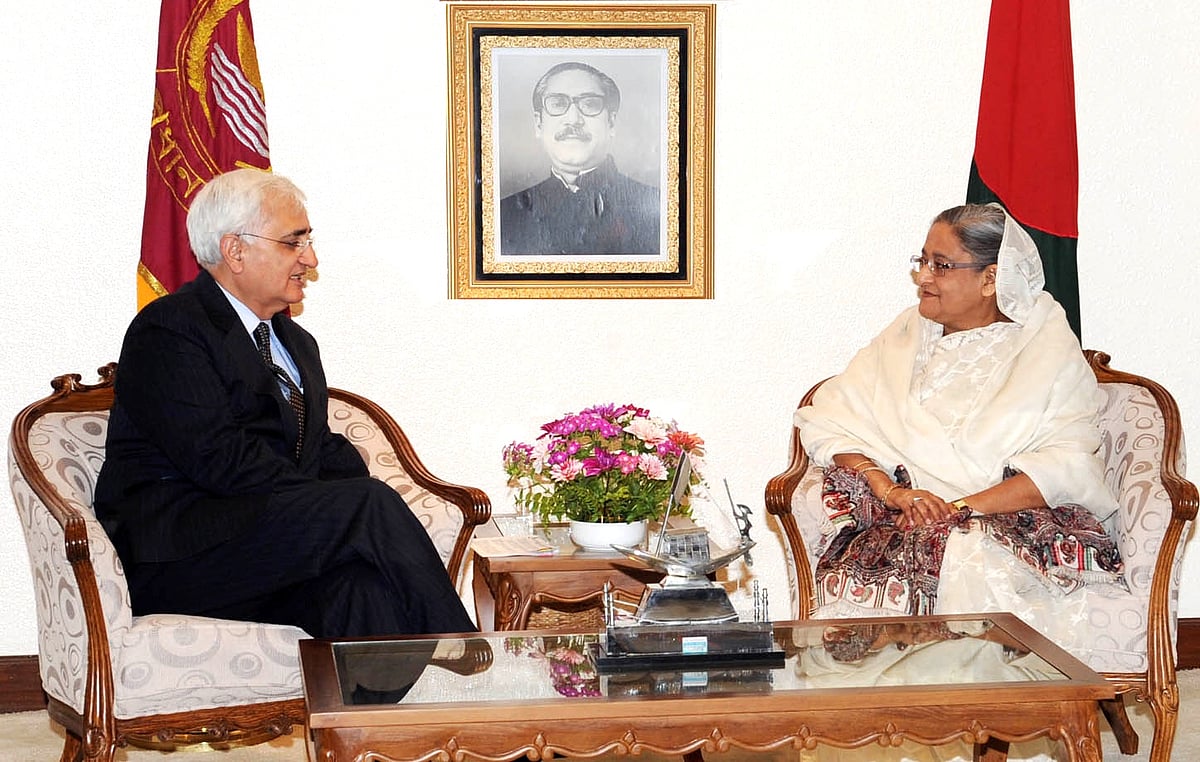
“We hope India will take a progressive view to solve the complexities involved in Teesta water sharing,” Hasina said after meeting Indian External Affairs Minister Salman Khurshid.
The Prime Minister said it was only to be expected that there would be problems between neighbouring countries. “They (the problems) will have to be addressed through discussions.”
The neighbouring countries were expected to sign a deal on sharing the waters of Teesta during Indian Prime Minister Manmohan Singh’s 2011 Dhaka visit.
Faced with stiff opposition from the West Bengal Chief Minister Mamata Banerjee, Singh had to be back off from signing the agreement, whose draft was ready.
Banerjee says a deal may adversely affect the interest of her state but media reports suggest she shelved a report by hydrologist Kalyan Rudra who had advocated maintaining the 'normal flow of Teesta' towards Bangladesh without much withdrawal in the upper reaches.
Following Manmohan’s trip, Foreign Minister Dipu Moni visited West Bengal but failed to secure Banerjee’s support for the Teesta agreement.
Analysts say Banerjee is trying to use the Teesta issue to drive a hard bargain with New Delhi to secure a special financial deal for her cash-strapped state.
However, Indian President Pranab Mukherjee and Congress President Sonia Gandhi expressed their willingness to sign Tessta agreement when Prime Minister Sheikh Hasina’s daughter Saima Wazed Hossain recently met with them in New Delhi.
The Prime Minister said both the countries are working to stop border killings by Indian Border Security Force (BSF).
She hoped that a bill would be passed in the Indian parliament to make the 1974 India-Bangladesh land boundary agreement (LBA) take effects. “The problems over enclaves and boundary demarcation would be over (after the passage of the bill).”
The LBA and its additional protocol signed in 2011 cannot be implemented as they are yet to be approved by Parliament. The Indian government said a bill on the agreement would be placed in legislative assembly in its next session.
Hasina said Bangladesh already ratified the LBA, also known as Indira-Mujib agreement. “For the ratification, our Constitution has been amended. The Indian Cabinet also gave the bill the go-ahead.”
She thanked the Indian government for releasing $50 million grants, to be used for Padma bridge, under the $1 billion credit that it made available to Bangladesh for building communication infrastructure.
India and Bangladesh in Aug 2010 signed the agreement for the credit of which $200 million are grants. Khurshid handed over the cheque to Bangladesh for $50 million grants, which, the Prime Minister said, is a good sign for the proposed Padma bridge.
Finance Minister AMA Muhith last week said the government would use the $200 million grants for the Padma bridge project as and when they implement the biggest-ever infrastructure project with their own resource.
Mentioning that Pranab Mukherjee had announced the grants for Bangladesh when he was the Indian Finance Minister, the Prime Minister said: “We know Pranab Mukherjee as our dada (brother). He’s the beloved dada of all of us.”
She said Bangladesh has already bought 50 articulated buses from India under the loan agreement. Ten of the buses have arrived in Bangladesh and the rest are going to join the BTRC fleet soon, she added.
Hasina expressed the hope that the Ashok Leyland-made 16-metre-long and 58-seat articulated buses would add new dimensions to Bangladesh’s communication system.
“Not only articulated bus, we’re procuring other types of buses from India under the project.”
Expressing gratitude to India for its support for Bangladesh during the 1971 Liberation War, the Prime Minister said: “They (India) have stood by us today for our development.”







