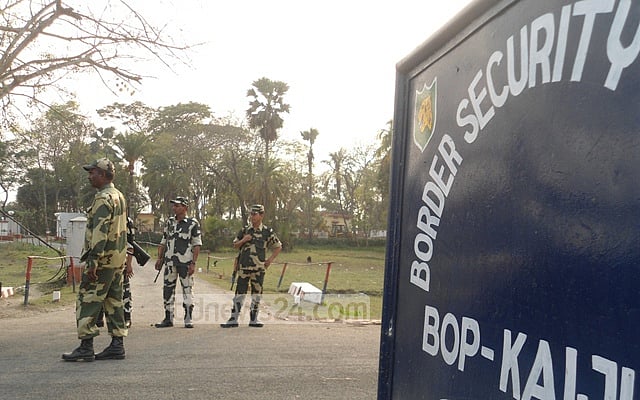
He was shot dead by cattle smugglers on Jan 8 near a border outpost in West Bengal’s North 24 Parganas, opposite Bangladesh’s Satkhira district.
BSF personnel of that outpost kept his helmet - which he wore while on duty that foggy night - hanging from the branch of a tree before which he was positioned.
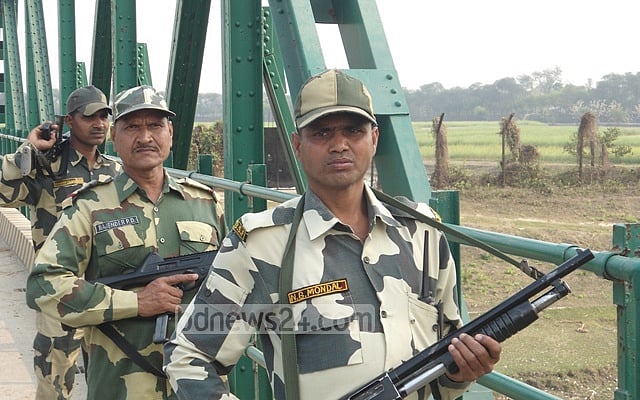
A group of Bangladeshi journalists were taken to that outpost on Saturday as part of the BSF’s first-of-its-kind border familiarisation tour.
The BSF is at times referred to as a ‘killer’ force by some in Bangladesh whenever a border shooting hits the headlines.
The visit was part of the BSF’s effort to dispel “wrong perceptions” about them in Bangladesh.

“I want to send a very clear message that the BSF is a very professional and disciplined force,” BSF Inspector General of the South Bengal Frontier, Kolkata, Sandeep Salunke, told bdnews24.com on Sunday at the end of the tour.
“There is no question of any BSF personnel being authorised to shoot to kill,” he asserted.
“They are advised to exercise the maximum restraint and use all means at their disposal to restrain people.”
With a series of events between Dhaka and Delhi, the relations between the countries have seen a quantum leap in the last six years, but border management remains a tormenting thorn.
The IG, however, said some incidents on the border should not affect the “warm” bilateral relations.
Bangladesh shares much of its border with Indian states that hem the country on three sides.
It is mostly a plain-land border, and people on both sides look the same with a strong affinity in culture, tradition and habitation.
At the ‘Ghojadanga’ border outpost a Bangladeshi, Afzal Hossain, was seen passing the zero area with his baggage.
He had passport and visa, and told bdnews24.com after entering the Indian territory that he was on his way to visit a relative living within a few kilometres of the border.
“Relatives live on both sides of the border,” said a BSF personnel accompanying the journalists. “It’s a challenge for us to identify who is Bangladeshi and who is Indian when we are on duty at night.”
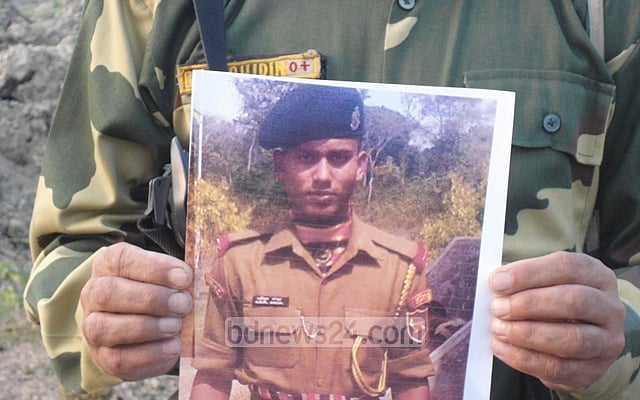
Golam Mohidin, in uniform, holding the Mondol’s picture, said the cattle smugglers had attacked his colleague from the Indian side.
“First, they (Bangladeshi smugglers) come to India and collect cattle. Then they try to cross the border in a group,” he said.
“That (Jan 8) was a foggy night. The smugglers were in a large number, and one of them shot him even before we could realise, from a distance, what was happening,” he said.
Other than patrolling, BSF personnel stand one after another a few yards apart along the border.
Being shot, Mondol also opened fire and injured one smuggler.
“He (the smuggler) was later identified as an Indian,” Mohidin said.
Referring to that attack, the IG said, “You can understand that as a trained and disciplined force they also have the responsibilities to protect themselves when they come under attack.”
“So, they fire in their right of self-defence,” he said. “Sometimes, unfortunate incidents take place during the firing.”
“Any loss of life is sad. It’s unfortunate. It should not happen.
“At the same time, when they fire they don’t know the nationality. It is only later that we try and find out who is injured,” the IG continued.
“My boys are under strict instructions to fire only when their life is threatened. Otherwise, they maintain tremendous restraint,” he said.
He said the number of BSF personnel injured have risen to over 100 a year, while the number of smugglers being wounded had dropped significantly.
Border management techniques vary from area to area with the varying nature of the products smuggled.
The South Bengal Frontier, which is opposite Satkhira district, faces challenges of cattle smuggling.
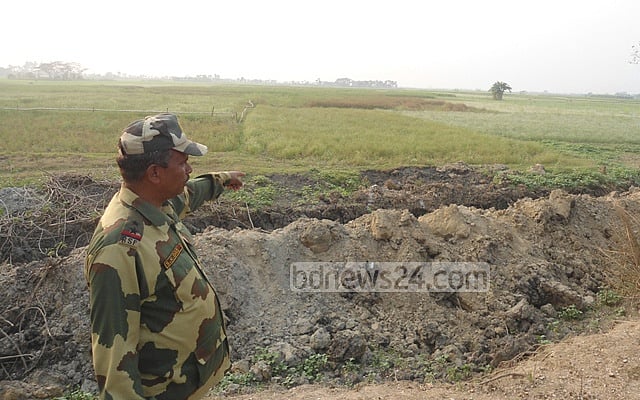
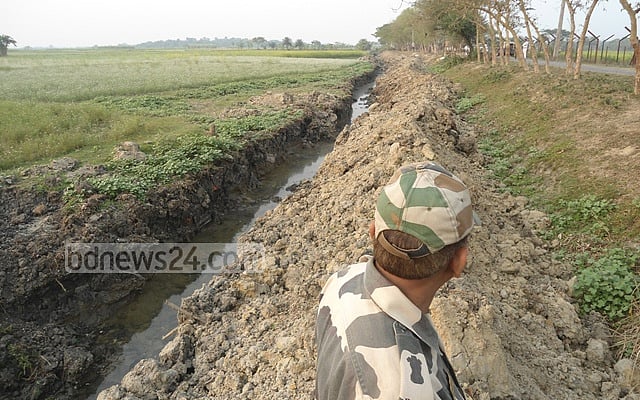
Both Bangladeshi and Indian smugglers operate in groups. After Mondol’s death, BSF dug a 30-km-long canal near the border to prevent cattle crossing.
bdnews24.com also visited the spot where a Bangladeshi cattle smuggler, Liton Hossain, was injured after being shot by the BSF at around 4.30am on Jan 24. He is in an Indian jail now.
He was trying to cross the border with cattle from India through the Panitar border outpost area.
“They come in a group and try to mix with the border people and then cross over to Bangladesh. It’s difficult to identify who is Bangladeshi and who is Indian once they mix up,” Manoj Kumar, Deputy Commander of the 144 Battalion, said.
“You think BSF is a killer. But we fire only when we are left with no other option.”
He said the force had adopted, in 2012, the strategy to use non-lethal weapons like Sound Grenade, Pump Action Grenade and Chilli Grenade that create sound and smoke to disperse crowds on the Bangladesh-India border.
“First, we use sound grenade to disperse the crowd and then we use PAG that shoot spray bullets to injure them.
“After exhausting those means, we fire,” the Deputy Commander said.
“Please don’t misunderstand us. We are not here to kill people. Our aim is to stop smuggling,” he said.
In the two-day border familiarisation tour, the Indian border force, with their hospitality, tried to convey the message that they were friends of Bangladesh.
One of them said: “Since its birth, Bangladesh and India have been friends. The BSF had opened the border in some parts in 1971 even before Delhi asked it to do so.”
“When we see a Bangladeshi, we see a friend is coming. Why will we shoot them?” he asked.
IG Salunke said they wished to continue such journalists’ exchanges to correct the “wrong perceptions and facts” about them.
“We (BSF) have a mandate. We cannot decide policy. We only implement the government’s policy.
“There are some perceptions that we feel need to be corrected,” he said.
“We (India-Bangladesh) have warm relations. This should not be affected by a few incidents.”
He said they also had “excellent” relations with their counterpart, BGB (Border Guard Bangladesh), and in the Director General level talks in Delhi last December they decided to hold joint coordinated patrolling, particularly at night.
The joint patrolling had helped to curb incidents on the border, he said.
The BSF has also introduced new technologies like ‘Hand Held Thermal Imager’ on the border that helps them to scan all objects within a five-kilometre range in the dark.