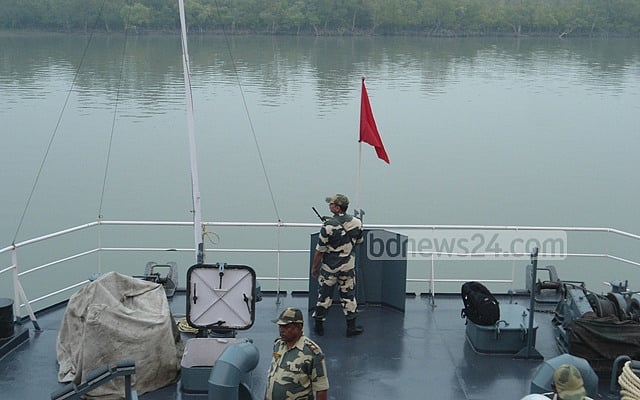
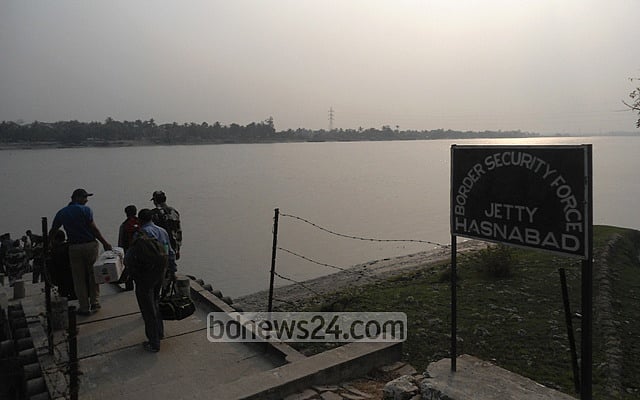
The Border Security Force (BSF) personnel deployed on this outpost, who otherwise are on patrol, are trying to impress the guests on board with their hospitality.
This Friday night, they are with a group of Bangladeshi and Indian journalists.
With a series of events between Dhaka and Delhi, the relations witnessed a quantum leap in the last six years, but border management remains a big thorn between the neighbours.
Shootings on the frontier sometimes hit the headlines in Bangladesh.

“This is to see the border from the other side,” Indian High Commission in Dhaka’s spokesperson Sujit Ghosh briefed the Bangladeshi group before their departure on Thursday evening.
Bangladesh shares two-thirds of its international borders with India, mostly land.
But there are 154 kilometres of international river borders, 64 kilometres of which pass through the common heritage mangrove forest Sundarbans.
Smugglers carry mostly drugs and cattle from India to Bangladesh, while readymade clothes and fish go there from this side of the border.
Some Bangladeshis also use river routes to get across the border for treatment and work as daily labour, while Indians come to see their kins on the other side of the fence.
“It’s very difficult to identify who is Bangladeshi and who is Indian along the border with the same look, culture, tradition and habitation,” said Deepak Minz, a Deputy Commander in the BSF while presenting the border picture.
“Our strategy has been to use non-lethal weapon since 2012,” he said.
“We hand over a person to the BGB if we understand he has crossed inadvertently. But if they have criminal intention we hand them over to police.”
Minz, however, made a pictorial presentation on how BSF members come under attack by the miscreants with machetes and local weapons.
“They come in large numbers and our personnel posted in a remote outpost become outnumbered as they try to encircle them and catch them without using lethal weapons,” he said.
He said criminals on the both sides are organised and sometimes attack the border guards in a coordinated way.
In 2014, Minz said, 99 members of the BSF were injured, but none of them died. The number was 72 in the previous year when two of them died.
Officiating DIG of the BSF Sector Headquarters Kolkata Arvinder Singh said the border situation was “quite peaceful now”.
“We have excellent relations with the BGB members,” he said.
“There is a misconception about the BSF, but the reality is otherwise.
“They (BSF personnel) are working compromising their own security, own rights,” he said.
Singh, however, felt regular interactions between the two forces was the key to get the relations better.
“Only integrated and coordinated approach can deliver better results on the border.
“But I can say barriers are reducing by the day,” he said, referring to the “confidence-building measures” like joint patrolling, training in each other’s institutions, and games being arranged regularly on either side of the border.
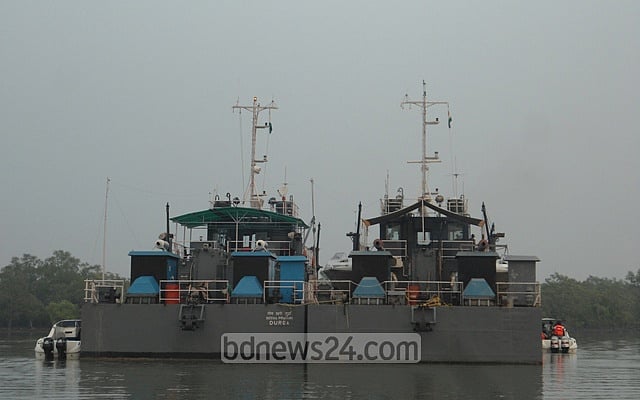
India has three floating outposts along its river border with Bangladesh. Each outpost has at least four speedboats that patrol the international border.
SP Durga is more than 34 metres long and nine metres wide and carries at least 70,000 litres of drinking water, and 24,000 litres of fuel at a time.
One platoon BSF personnel, or 30 memebers, are deployed in one such outpost.
“We perform two different types of duties in the day and night,” said one BSF personnel on board ‘SP Durga’, who did not want to be named.
“In the daytime we just observe. But at night we patrol. One is general patrolling and the other is ambush patrolling,” he said, explaining that they hid in some hotspots used by smugglers to ambush them.