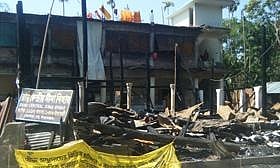
'Our heritage is charred'
Evidence of the Sept 29 mayhem still scars Ramu's landscape, Shamima Binte Rahman reports about the blows to the place's heritage.
bdnews24.com News Service
bdnews24.com
Published :
29 Oct 2012, 03:20 PM
Updated :
09 Aug 2022, 04:26 PM
Shamima Binte Rahman
Back from Ramu
Dhaka, Oct 29 (bdnews24.com)—Nothing has changed much on the geographical map of Ramu. The police box in the intersection of four main streets, the roads to the Buddhist settlement, all remain as they were.
However, the landscape lies charred, a month after the Sept 29 communal violence which saw six Buddhist temples and Viharas and nine residences torched along with vandalisation and looting of 150 residences and six other temples.
The terror that the minority community felt is still reflected in their eyes, despite assurances from the Prime Minister and other senior members of the government.
"Look, it was such a big attack, but no one was killed. In real riots, they kill people. I fear that something more violent will happen, this was just the tip of the iceberg," local theatre activist Sunil Kanti said, voicing the community's inability to believe that such an attack could have been sparked only by a Facebook post.
A rumour that a Buddhist youth, Uttam Barua, posted a photograph on his Facebook account for denigrating Islam touched off the riot in the late hours of Sep 29 night.
And the 15 cases filed over the incident are also terrifying the local Muslims.
As a sign of their protest, the Buddhists at Ramu will refrain from setting afloat Fanush (candle-lit balloons) as a part of their Prabarana Purnima celebrations on Monday, a tradition that has been a part of the ceremonies for ages.
A visit, 25 days after the event, found the residences and temples lying in the same state as they were after the attack. Temporary military and BGB camps are all around, an effort to allay the fear of the minority people.
Only four residences have been rebuilt by the Border Guard Bangladesh with sign boards stating their contribution. Even though, the army has taken responsibility to rebuild the temples, none of the work has been initiated.
'Charred heritage'
The Shima Buddhist Vihara, the largest monastery in the town dating back over 300 years, is still in ruins. The charred wooden pillars, utensils and other everyday usage materials in the remains lie as testimony to the attacks. In the ruins devotees continue their prayers.
Records of the establishment show that a two-storied building of the Vihara, a residence of monks, the meditation room and a metal temple were burnt to the ground. The fire also gutted a several venerable holy relics including a 2000-year old lock of hair of Gautam Buddha, a preserved teeth of a religious leader from the same period and two thousand -year old ancient letter written on palm leaf, religious texts and Tripitoks written in Burmese, Bengali, Singhalese and English.
Pointing out that even though the Prime Minister had assured them that the temples would be restored, Shima Buddhist Vihara's chief 83-year old Satyapriyo Mohathero asked how the priceless artefacts could be done so.
"Even if you pay hundreds of crores of taka, how will you get back the religious scripts aged over twenty five hundred years, Buddha's hair, artefacts representing nearly 300 years of heritage? To whom should I explain and how that I have lost everything, that we have lost everything."
Ramu's oldest Buddhist Viharas, which are three-kilometres away from the town, Ramkot Vihara and Bonashrom have been dated to be approximately 2,300 years old by archaeologist A K M Zakaria. They were not that affected in the attacks but they make up the rich tradition of the area.
The Viharas, most of which were constructed using wood and dated over hundred years, followed the traditional designs of Buddhist structures in Myanmar, Thailand, China and Japan.
"It is not like they have destroyed only us, they have destroyed Triloker Guru [the lord of the three worlds]. They have blackened the history with their fire. So much have they burnt that we can't read the roots of our own history," Mohathero added.
Terror remains
"I am afraid. I cannot help shedding tears when I look at the burned-down temples. I fear for the future of my children and their children to come. What awaits them?" said Aneel Barua as he sat on the charred floor of the Shima temple.
Aneel is in his 70s, and represents one of those families which had donated lands for temples dating back nearly a century.
"We are not supposed to leave for anywhere else. This is my country. But I fear even when a dog barks nearby. I fear I may not see the next morning," he added.
Still none of the riot victims have moved anywhere else, living in fears added by what they said was the administration's reluctance to arrest the 'identified' attackers.
"What does it indicate when you find none of the identified attackers have been arrested?" asked octogenarian Subal Barua.
But a small trader, Kalimullah, thinks the list of those to be arrested includes many innocents, and it will not help prevent recurrence of such incidents anyway.
What is the motive?
Affected people do not think that anger triggered by a Facebook photograph led to the riot.
"I can say without any doubt that the attackers used kerosene, diesel, petrol and explosives. The question is from where did they get those materials?" asked Satyapriyo Mohathero.
Nipu Barua remembers how he saw the attackers bringing bitumen and petrol in drums. He lives near the temples set on fire.
Sumot Barua, a teacher by profession, said majority of the attackers were madrasa students.
As many as 200 Buddhist statues out of the total 400 were stolen in the attack, according to the affected.
"Don't you think stealing was one of the major motives as the statues would earn money?" questioned Nitish Barua, a businessman of Choumuhoni area.
"I think some dishonest Muslims have been used by somebody else. The motive was to steal the precious statues and the stones engraved in those."
For the theatre activist Sunil, the motive is a common one, to benefit from religious instability.
"The result is that we feel divided. Now we suspect Muslims."
bdnews24.com/sbr/rn/eh/ac/bd/1857h