Published :
08 May 2014, 10:47 PM
Updated :
19 Oct 2022, 07:29 PM
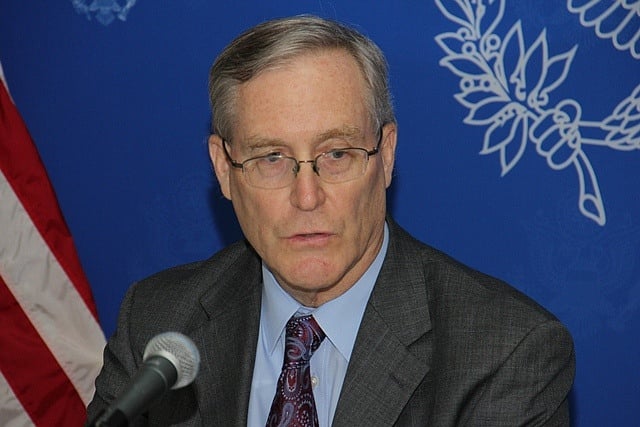
The Deputy Assistant Secretary for energy resources Robert Ichord on Thursday said “diversification” should be the key to address the power crisis in Bangladesh.
He, however, stressed that efficient energy use in combination with renewable energy could play an important role in meeting power-starved Bangladesh’s electricity needs.
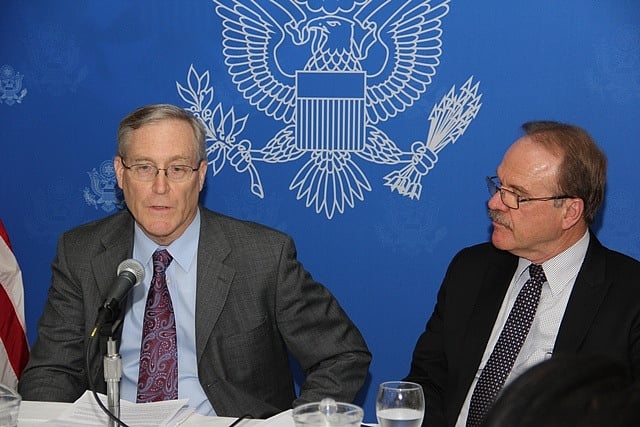
Ichord was discussing the power situation with a small group of journalists at American Club in Dhaka.
He began his official visit on Wednesday to promote “sustainable energy for all”, an initiative that began two years back at the ‘Rio +20 Conference’ on sustainable development.
The initiative promotes universal access to electricity by 2030, doubling the rate of energy efficiency, and raising two fold the share of renewable energy in the energy mix.
Bangladesh has also plans to generate 39,000 MW power by 2030, almost half of which would come from coal, an issue that is debatable.

According to the plan, nuclear power would contribute more than one-tenth of the production by 2030 while oil, hydro and renewable power would account for only 2,700 MW.
Bangladesh currently generates about 65 percent of its power from gas-fired plants, while 26 percent comes from costly diesel run power plants.
Ichord said Bangladesh’s policy of coal-based and nuclear power were “logical” from the “base load power generation”.
But he could not rule out the dependence on gas in the long-run strategy. “It continues to be a major source in the country,” he said.
Based on the US Geological Survey analysis, he said, Bangladesh had additional on-shore and off-shore gas resources, but added off-shore extraction would be “very expensive”.
He said the US was taking a clear policy on coal in President Obama’s climate action plan.
In the plan, he said, the US sought to work with countries “to develop low-emission strategies”.
He said a process was underway with the Bangladesh to develop and analyse a viable low-emission strategy.
But he said that public financing in coal should come “only in exceptional cases”.
Ichord had initiated the first US energy assistance programmes in Eastern Europe in 1990-91 and the New Independent States in early 1992.
In this capacity, he contributed to efforts promoting nuclear safety and the closure of high-risk reactors such as Chernobyl.
About Bangladesh’s nuclear plan, he said it would be $ 5 billion or $ 7 billion investment and would be required to develop “tremendous” human resources as well as infrastructure.
That he said would be difficult for Bangladesh since it lacks current capacity.
“There will be a lot of challenges on the safety side,” he said. “I think the diversification option is the best policy”.
The government is at present pursuing a plan to build a nuclear power plant in northern Rooppur district with Russian support, while Prime Minister Sheikh Hasina recently said there would be another in Southern Bangladesh to meet growing power needs.
The US Deputy Assistant Secretary, however, had stressed “energy efficiency” from the demand side.
He said Bangladesh could have saved all energy “if more efficient buildings have been built in the 25 years”.
He had earlier visited Dhaka last year, 25 years after his work with the USAID in Asia.
He said all countries must look at “very carefully” at the potential for energy efficiency that he said “probably the lowest cost source of energy”.
He said it was easy to achieve energy efficiency since did not need finding coal, oil or gas. “It is in the bank”.
“All we have to develop and invest and apply technology that exists,” he said, “not even new technology (we need)”.
He, for example, said LED lights had saved “hundreds of megawatts” and “even more” globally.
He said all kinds of appliances including air-conditioning and refrigerator were possible to use energy efficiently, reducing electricity demand, and by extension cutting the need for coal and nuclear plants.
According to the US embassy, he would leave Dhaka on Saturday.
The US ambassador in Dhaka Dan Mozena was present at the discussion.