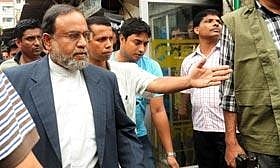
Mir Quasem denied bail
The decision comes from ICT-1 against Mir Quasem Ali who had fled to Saudi Arabia and returned after the 1975 killing of Bangabandhu Sheikh Mujibur Rahman Full story
bdnews24.com News Service
bdnews24.com
Published :
19 Jun 2012, 05:21 AM
Updated :
09 Aug 2022, 03:54 PM
Dhaka, Jun 19 (bdnews24.com)—The first war crimes tribunal of Bangladesh rejected a key Jamaat-e-Islami policymaker's bail plea on Tuesday.
The International Crimes Tribunal -1, set up to deal with crimes against humanity during the 1971 War or Independence, had ordered the arrest of Jamaat executive council member Mir Quasem Ali on Sunday.
Subsequently Mir Quasem, head of Diganta Media and founder of the Ibn Sina Trust besides his involvement with numerous other commercial and social ventures, was sent to Dhaka Central Jail.
He has been accused of crimes against humanity including murder and torture.
The defence argued that Mir Quasem, said to be among the financiers of Jamaat, was a successful and 'highly respected' businessman and had no inclination to leave the country.
Abdur Razzaq, who is representing the top Jamaat leaders at the war crimes tribunals, said the accused also suffered from physical ailments and required constant medical attention and physiotherapy.
Further, the counsel said, "There are no reasonable grounds to believe that he will be convicted."
The only reason that the man was being 'harassed in this fashion' was that his party was currently in the opposition and at odds with the ruling Awami League.
The first war crimes tribunal Chairman, Justice Mohammad Nizamul Huq, rejected the plea saying that although the law did not provide for bail the tribunal did introduce the provision and has indeed given bail to one person accused of war crimes.
Referring to former BNP minister and MP Abdul Alim's case, Justice Huq said the two cases were quite different because Alim was virtually immobile.
He said the tribunal did not find any reason why Mir Quasem should be enlarged on bail. "The prayer for bail is thus rejected."
The Jamaat leader was produced before the judges at the hearing.
Police arrested Mir Quasem, from Naya Diganta newspaper office on Sunday afternoon, within an hour and a half of the tribunal issuing an arrest warrant.
He is also an Islami Bank director and director of non-governmental organisation Rabita al-Alam al-Islami.
The charges against the Jamaat leader include that he was the Chittagong unit commander of Al-Badr, a vigilante outfit mobilised by Jamaat's erstwhile student wing Islami Chhatra Sangha and was third in outfit's command structure.
Such auxiliary forces like the Al-Badr, Al-Shams and Razakar actively engaged with the Pakistan Army to thwart the freedom struggle in 1971.
Crimes against humanity including murder, massacre, rape and loot had allegedly taken place in Chittagong under his watch during the war. There are also allegations that he ordered the massacre and murders at the Razakar camps there.
Mir Quasem, who is from Manikganj's Harirampur, was better known as 'Mintu' to the people of Chittagong during the war. He was part of the Islami Chhatra Sangha during his college days.
He is also one of those who had made the list of the intellectuals to murder them at the fag end of war. The intellectuals were killed on Dec 14, 1971, only two days before the victory.
After independence, Mir Quasem Ali had fled to Saudi Arabia and returned after Bangabandhu Sheikh Mujibur Rahman and most of his family was brutally massacred on Aug 15, 1975.
Two war crimes tribunals are currently dealing with cases involving six Jamaat-e-Islami leaders including former and current party chiefs and two party men of main opposition BNP.
According to reports, Mir Quasem, and his US expat brother Mir Masum Ali hired a top US lobby firm, Cassidy and Associates, and spent $310,000, soon after the tribunal was formed, to move Washington favourably.
A special envoy for war crimes, Stephen Rapp visited Bangladesh three times since then and made a number of recommendations that he suggested would contribute towards ensuring a fair trial.
bdnews24.com/ta/bd/1610h