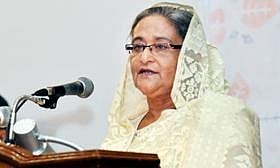
Lack of democracy triggers uprising: PM
Sheikh Hasina tells an international conference that absence of 'participatory democracy' and lack of 'social security' are the key factors that fuel people to demonstrate against governments. Full story
bdnews24.com News Service
bdnews24.com
Published :
05 Aug 2012, 09:28 AM
Updated :
09 Aug 2022, 04:05 PM
Dhaka, Aug 5 (bdnews24.com) – Prime Minister Sheikh Hasina on Sunday said absence of 'participatory democracy' and the lack of 'social security' were the key factors that fuelled people to demonstrate against governments in different countries.
She also said that with these two factors missing, 'social stability and durable peace have been disrupted '.
Hasina was speaking at the inaugural session of the International conference on 'people's empowerment and development' organised by the Foreign Ministry at Hotel Ruposhi Bangla in the capital.
Widespread demonstration across Arab states in 2010 forced autocratic regimes in Tunisia, Egypt, Libya and Yemen to quit. The uprising became popularly known as 'Arab Spring'.
Mentioning 'sustainable' peace as a key element of social justice, Hasina said, "It is only possible when people are empowered to be associated with meaningful development."
In her inaugural speech Prime Minister emphasised on people's empowerment by reducing poverty, hunger, inequality and deprivation through social safety programmes, and also creating jobs for all. She also stressed on sustainable and inclusive growth, human resource development, and fighting terrorism and militancy.
"I believe these issues are interlinked," she said.
Hasina also mentioned her 'model for people's empowerment' floated at the 66th session of the UN General Assembly.
"I strongly believe, this model can be dedicated to the people who are victims of political, economical, social, cultural deprivation and marginalisation."
"I am very happy that… the model I presented at the 66th session of the UN General Assembly made a place in your hearts," Hasina said greeting the participants of the international conference.
She also expressed hope that the experience and knowledge of the participants would further strengthen the 'model' and it would be established as an 'exemplary, universal and effective model'.
Implementation of the model, Hasina said, would require all-out support from the governments, civil societies, UN, international financial institutions and development partners.
Hasina pointed out that there was no alternative to democracy for achieving peace and development. "If democracy and social justice are not established, poverty, discrimination, sufferings and marginalisation thrive in the society giving birth to extremism and terrorism."
The Prime Minister went on to detail on the steps taken by her government, including allocating highest for the education sector, to implement the model in Bangladesh for the empowerment of the people.
She added that effort was on to bring marginalised people under the social safety net. "We have ensured rights of all ethnic minorities. We are sincerely fighting terrorism and extremism."
Foreign Secretary Mohammed Mijarul Quayes gave the welcome address at the conference presided over by Foreign Minister Dipu Moni.
Deputy Prime Minister and Foreign Minister of Nepal Narayan Kaji Shrestha, Rural Development Minister of India Jairam Ramesh, Minister for External Affairs of Sri Lanka GL Peiris, Works and Human Settlement Minister of Bhutan Lyonpo Yeshey Zimba and Deputy Foreign Minister of Maldives Ali Hameed, UN Deputy Under Secretary General Joan Clos and UNESCO's Director General Getachew Engida also spoke at the inauguration.
bdnews24.com/sum/ra/rn/sk/1510h