


Published : 04 Mar 2014, 09:49 PM
Updated : 23 Apr 2022, 02:22 PM


The four-member Appellate Division bench, headed by senior Justice Surendra Kumar Sinha (SK Sinha), passed the order in a case filed by eight eminent citizens, challenging a decision of the BNP-Jamaat coalition government that was in power from 2001-2006.
Professor Gazi Saleh Uddin of the Chittagong University sociology department told bdnews24.com that some 5,000 people had been slaughtered November 10, 1971 at Pahartoli during the Bangladesh's Liberation War.
Locals refer to the place as ‘Jalladkhana’ (execution spot).
On that day, the Pakistani army and their local collaborators had killed Uddin’s father, Ali Karim, a railway official, and three others of the family in that slaughter ground.
Advocate Manzill Murshid argued for the petitioners at the hearing on Tuesday, while the Additional Attorney General Murad Reza stood for the state.
Murad Reza told bdnews24.com: “The court has passed its verdict with some observations. The killing ground now has to be preserved. The verdict will give directives on how to preserve it and the spell out ways to evict grabbers.”
Advocate Manzill Murshid, who pursued the petition on behalf of the petitioners in the High Court, said that, in 1998, the then Prime Minister Sheikh Hasina had ordered for preservation of the site following an appeal by an organisation, Projonmo-71.
The government subsequently acquired 1.75 acres to implement the project and allocated Tk 9.4 million in this regard.
But the then BNP-led four-party alliance government that followed cancelled the project and decided to withdraw the allocated money.
Later, eight eminent citizens, including Professor Zafar Iqbal, Professor Muntasir Mamun and Mili Rahman, lodged the petition with the High Court, challenging the legality of the government decision.
After the High Court settled the petition on January 16, 2011, the petitioners moved the Supreme Court, challenging the High Court decision.
Manzill Murshid said: “Today the Appellate Division in its final verdict accepted the appeal of the petitioners.”
During a preliminary hearing, the Appellate Division had ordered the formation of a special committee to ascertain whether the killing ground was situated on the acquired land.
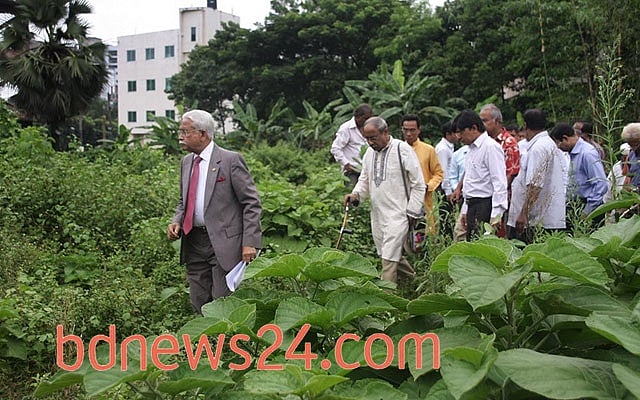
Following the court order, a committee headed by Major General (retd) KM Shafiullah, chief of "S Force" and one of the Sector Commanders during the Liberation War, was formed. The panel confirmed the location.
The committee visited the spot in September 2011. Panel member Shahriar Kabir had told reporters citing the statements of the eyewitnesses that some 10,000 people had been killed in the ground between April and December of 1971.
He said that ‘Jalladkhana’ would prove to be the country’s largest killing field if the death count was authentic.
A five-storey building now stands on the venue constructed by University of Science and Technology, Chittagong (USTC) to house the faculty of Zia International Institute of Business Administration (ZIIBA).
Shahriar Kabir had then said, “Founder of USTC National Professor Nurul Islam had given his testimonial. Except he, the university building now stands on the killing ground. Nurul Islam claimed that the university building doesn’t stand on the killing ground.”
After the USTC authorities started construction of the building on the land in 2007, the High Court passed a stay order on the construction of the building in response to a writ petition in 2010.
Shahriar Kabir said that according to the statements of the witnesses, the killing ground covered some 1.75 acres and the whole site was filled by skeletons, skulls and bones of people.
“The witnesses said that skeletons were found in fishing nets in the canals adjacent to the site even after several months of the mass killing. The “Biharis” (a group of non-Bengali residents and citizens of the former East Pakistan) had killed the Bengalis in the site between April and December in 1971.”







