Published :
06 May 2011, 02:04 PM
Updated :
10 Aug 2022, 04:46 PM
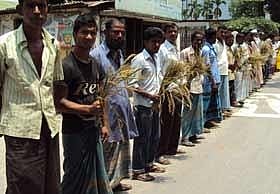
Gopalganj, May 6 (bdnews24.com) -- Gopalganj district Krishak League, the farmers wing of the ruling Awami League, formed a human chain in the town, demanding compensation for around 2,000 farmers hit hard by cultivating hybrid rice 'Jhalak'.
The Krishak League leaders, activists and farmers joined the programme holding 'Chita' rice (rice containing no substance) in their hands in front of Gopalganj Press Conference on Friday.
Later, district Krishak League general secretary M M Samsul Alam read out a written statement at a press conference at the press club.
Energypac Agro Ltd, a seed-providing firm, imported the Jhalak seeds (Agro G-1) from Winner Hi-Tech Seed Company of China.
According to the district's Department of Agriculture Extension (DAE), around 8,000 farmers of Gopalganj Sadar, Kotalipara, Tungipara and Kashiani Upazila cultivated Jhalak on 350 hectors, of which crops on 55 hectares were entirely ruined and that of 120 hectors partially.
In Noakhali, around 7,000 farmers also suffered a massive setback in Jhalak production. The hybrid rice was cultivated on 1,665 hectares, of which crops of 465 hectares were fully damaged and that of the rest partially.
The affected farmers of Noakhali also demanded compensation by forming a human chain and setting Chita rice on fire in front of the deputy commissioner's office.
Samsul Alam at the press conference claimed that some 700 farmers who cultivated Jhalak suffered a complete loss of crop while over 1,000 farmers suffered partial loss.
Acting president of central Krishak League Sharif Ashraf Ali, district unit president Sheikh Lutfar Rahman, Krishak League leaders Humayun Kabir and Kabir Hossain were present at the press conference.
Gopalganj DAE deputy director Bhashkar Chakrabati told bdnews24.com on Apr 26 that the neck blast disease was seen in the origin of the flower-spikes when those start to appear.
"The black spot appeared in the middle of the plant leaves after it was affected by the blast disease, which finally causes the flower-spikes to die."
He said a list of 210 affected farmers of the three upazilas -- 110 of Kotalipara Upazila, 60 of the Sadar Upazila and 40 of Kashani Upazila -- had already been sent to the agriculture ministry and Energypac Agro Ltd.
The farmers, however, said no list was made for the affected farmers of Muksudpur Upazila and the Department of Agriculture Extension was not informed of the affected farmers of Tungipara Upazila.
The affected farmers at the press conference and human chain programme demanded compensation for Energypac Agro Ltd.
bdnews24.com/corr/cs/skb/mr/1955h