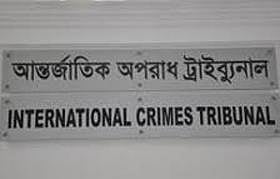
ICT-1 limits time for deposition, quizzing
The order notes that testifying at the tribunal would not necessarily mean wastage of time and harassment
bdnews24.com News Service
bdnews24.com
Published :
05 Jul 2012, 06:03 PM
Updated :
09 Aug 2022, 03:58 PM
Dhaka, Jul 5 (bdnews2four.com) — The first war crimes tribunal of Bangladesh on Thursday decided to limit the duration of deposition and cross-examination of witnesses.
The proceedings ran up to 5pm, an hour over the regular hour for adjournment, as the defence and the prosecution argued on the court's desire to set time limits.
International Crimes Tribunal-1 Chairman Justice Mohammad Nizamul Huq had indicated earlier that the time limit would naturally vary from one witness to the next and the time for cross-examination would generally be double that of the time taken for deposition.
Justice Huq, after considering the defence and prosecution arguments, adjourned the cross-examination of the first prosecution witness against Jamaat-e-Islami guru Ghulam Azam. He said in his order that the first witness, Moontassiruddin Khan Mamun, a noted historian and a Dhaka Univeristy professor, could be cross-examined for one more session.
The order noted that defence counsel Mizanul Islam had submitted he would need two more days for satisfactorily concluding the cross-examination but would try to do in within one day.
Set up to deal with the crimes against humanity during the 1971 Bangladesh Liberation War, the tribunal indicted former Jamaat chief Azam on five charges including incitement and conspiracy.
The tribunal has insisting that the defence wrap up the cross-examination soon since Wednesday. However, on Thursday the tribunal said that the defence should get through its questioning by the day's end.
But despite the defence counsel's efforts, which the order also noted, Mizanul Islam could not finish.
The senior defence counsel lost his cool several times through Thursday and the courtroom broke into heated arguments both before and after the lunch recess. However, both the sides showed restraint after the lunch recess and the cross-examination proceeded relatively smoothly.
Justice Huq indicated that he would pass an order and asked the defence and prosecution for their arguments.
Defence counsel Mizanul Islam said he had asked all relevant questions. "The only two questions that the tribunal found irrelevant were skipped."
He said that he was going as fast as possible but for the pointless arguments that had broken out during his questions. "Further, the witness is not quite answering the questions put to him," said Islam.
He was obviously alluding to Moontassir Mamun's standard answers like 'I would have to go through the relevant documents before I can answer that question,' or 'If indeed I had written something then it might have stated such matters' when he was asked questions on historical matters that he has researched.
The Dhaka University professor's answers did not satisfy the defence and Mizanul Islam had to tell the court several times that the witness was not answering the question put to him. He mentioned that during his submissions and said, "The purpose of cross-examination fails when the witness does not answer the questions directly and instead brings in new factors."
The counsel said that he also had a right to cross-examine the witness on those points, which the court had also allowed on occasions.
The chief prosecutor, Ghulam Arieff Tipoo, said there was no end to the problems that the defence was raising. But the fact of the matter was that the cross-examination had been continuing for days now. And the trial proceedings neeed to be expedited, he said.
He noted the defence efforts but argued for setting a time limit.
The order
The order began with the noting that the current witness, better known as Moontassir Mamun, had began his deposition on Sunday. He had deposed for three hours and forty-five minutes. Since then his cross examination has continued for three full days, meaning six sessions.
Justice Huq said in his order that the witness was someone who had a number of other engagements and duties, which perhaps had national and internal significance.
He said that the law provided for the tribunal to take appropriate measures for expeditious trial in light of which the tribunal framed its rules and limit the duration of deposition.
The tribunal chief said in his order that it also wanted to send out a message that testifying at the tribunal would not necessarily mean wastage of time and harassment.
"We are of the view that the time has come to interfere for expeditious trial," said Justice Huq. The tribunal chief noted that there was public cry for justice.
He said in the order that the defence would be allowed just another session of cross-examination on a date that the witness found convenient.
Heated exchanges
Earlier in the day, heated exchanges between the prosecution and defence saw Jamaat-e-Islami guru's defence counsel Mizanul Islam lose his temper for the first time since he has been conducting trials at the tribunal.
Even Justice Huq said he would note the date in red ink, "This is the day when Mr Mizanul Islam became excited."
Thursday saw resumption of first prosecution witness Moontassir Mamun's cross-examination.
Counsel Mizanul Islam, for the first time since December 2011 when he started coming to the tribunal, interrupted during the submission of prosecutor Zead-Al-Malum, a practice that he pointedly refrains from, setting an example for a number of other counsels both on the prosecution and the defence sides.
Malum was trying to make a point that the witness was being tortured at the court by the defence in the name of cross-examination. However, the tribunal said that although it did not find the specific question irrelevant, it did believe that the cross-examination was being too lengthy.
The defence counsel apologised immediately afterwards. "I am extremely sorry," he said, to which the tribunal chair remarked that this was indeed a first in his court.
However, just before the court was about to go into lunch recess, defence counsel Mizanul Islam became visibly angry at a comment of Malum, which in a way ridiculed the defence counsel's personal attributes.
He prayed for an early adjournment to be able to collect himself. The tribunal then discussed other matters on the cause list and Justice Huq eventually adjourned the proceedings but said the court would return 15 minutes early at 1:45pm.
Jamaat Guru in ICT-1
On Dec 12, 2011, the prosecution brought a 52-point charter of charges against Azam and appealed for his arrest. Later, following the tribunal order, charges were re-arranged and presented to the tribunal on Jan 5.
He was produced before the tribunal on Jan 11 and sent to jail the same day. Since that evening, Ghulam Azam has been kept at the prison cell of the Bangabandhu Sheikh Mujib Medical University for better treatment considering his delicate health.
A former chief of Jamaat-e-Islami, arguably the largest Islamist organisation in the subcontinent, Azam is allegedly among the key people who pioneered anti-liberation efforts in 1971 colluding with the Pakistani military junta of that time.
He is widely perceived to have been among core group of right-wing supporters of the Pakistani Army, who came out strongly in support of a united Pakistan.
Ghulam Azam, then chief of Jamaat, was instrumental in setting up the infamous Peace Committee at the national level. The Razakars, an auxiliary force set up mainly to actively thwart the liberation forces, are said to have been mobilised through the Peace Committees across Bangladesh.
Among the most notorious vigilante militia are the Al Badr, whose membership is said to have been mainly dominated by the Jamaat's student wing called the Islami Chhatra Sangha at that time.
The Al Badr is alleged to have spearheaded execution of the intellectual elites of Bangladesh just days before the victory on Dec 16, 1971.
Azam also spoke in favour of Pakistan to the Middle Eastern countries during the war, according to the prosecution.
He stayed in London for seven years after 1971 and returned to Bangladesh in 1978 during BNP founder Ziaur Rahman's rule. Having led Jamaat for long, Azam retired from active politics in 1999.
His party remains a key ally of the main opposition BNP. Two Jamaat leaders, also behind bars for war crimes charges, even served as ministers during the BNP's last tenure in government between 2001 and 2006, when Azam's party was part of the ruling coalition.
Azam was indicted on five charges including incitement, conspiracy and abetment of war crimes.
bdnews24.com/ta/nir/2345h