


Published : 06 Jun 2015, 07:37 PM
Updated : 08 Aug 2022, 04:50 PM


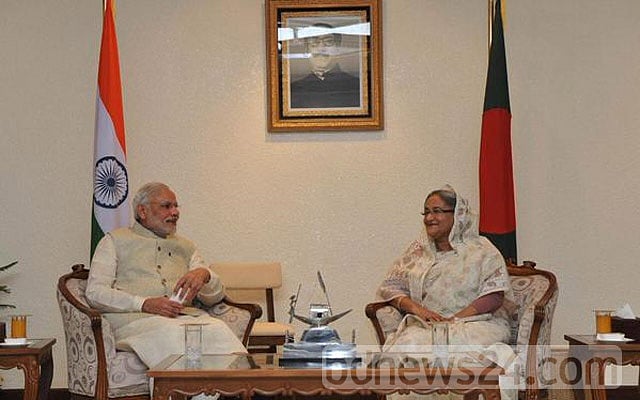
Sheikh Hasina said this in a joint statement after, in her words, “a very fruitful bilateral talks” with her guest Narendra Modi on Saturday.
The Bangladesh leader said new deals and protocol and the launch of bus services were “examples of their commitment to seamless connectivity across the region”.
“The signing of the Coastal Shipping Agreement, the renewal of the Trade Agreement and the Protocol on Inland Water Transit and Trade, as well as the flagging off new bus services are examples of our commitment to seamless connectivity across the region to reduce inequalities and maximizing welfare gains,” Hasina said.
Indian Prime Minister Modi termed connectivity “the catalyst for deeper engagement”.
“Bangladesh’s decision to allow transit of power equipment and food-grain to the Northeast,” he said, “echoes the strength of your human values and our shared economic opportunities.”
“Connectivity by road, rail, rivers, sea, transmission lines, petroleum pipelines and digital links will increase.
“Today, we have unveiled some of the pathways to this future,” Modi observed.
Hasina said they decided to open Bangladesh mission in Guwahati. and Indian missions in Khulna and Sylhet since “people-to-people contact is the strongest of our links”.
“This again,” according to her, “reflects our growing mutual confidence and shared commitment to expand our relationship."
Along with West Bengal Chief Minister Mamata Banerjee, the two prime ministers flagged off Kolkata-Dhaka-Agartala and Dhaka-Shillong-Guwahati bus services.
Modi said the bus services were to “connect our citizens more easily and our two nations more closely”.
“We have renewed existing trade and transport agreements. We have added new dimensions to our economic ties.
“The coastal shipping agreement will boost bilateral trade. The Indian Economic Zone will promote Indian investments in Bangladesh.”
Hasina said Modi assured her of his government's cooperation to narrow the trade deficit.
She said to “bring balance in trade between the two countries”, they agreed to establish special economic zones for India in Mongla and Bheramara.
“We hope, this would increase Indian investment in Bangladesh substantially.”
Modi admitted to being “conscious of the huge trade imbalance, despite duty free and quota free access to Bangladesh in India on all but 25 items”.
“Yet, I have assured Prime Minister that we will do everything we can to bridge the deficit.
“Indian investments in Bangladesh will help. I will also try to make trade smoother and easier, including at the border. The agreement on standards and testing is a step in that direction.”
He continued that Bangladesh-India development ties were ‘scaling new heights’ and referred to the ‘speedy implementation’ of $800 million line of credit and $200 million grant from India.
“We are pleased to extend another line of credit of $2 billion to support infrastructure and other development activities in Bangladesh.”
He added the agreements on human trafficking, counterfeit Indian currency and maritime safety “show our security cooperation is growing”.
Hasina stated at the beginning of her speech: “This is truly a historic moment. We are transforming our relationship to a greater height.”
“We understand each other's concerns and priorities.”
Hasina also said they signed a number of bilateral documents, covering diverse areas of cooperation.
“These include economic cooperation, trade and investment, security, infrastructure development, education, science and technology, IT and culture.”













