


Published : 28 Feb 2015, 12:35 AM
Updated : 23 Apr 2022, 12:25 PM


Abul Hassan Mahmood Ali on Friday also reminded them that both Bangladesh’s own legal system and the ICT Act 1973, under which the trials were going on, allows death penalty.
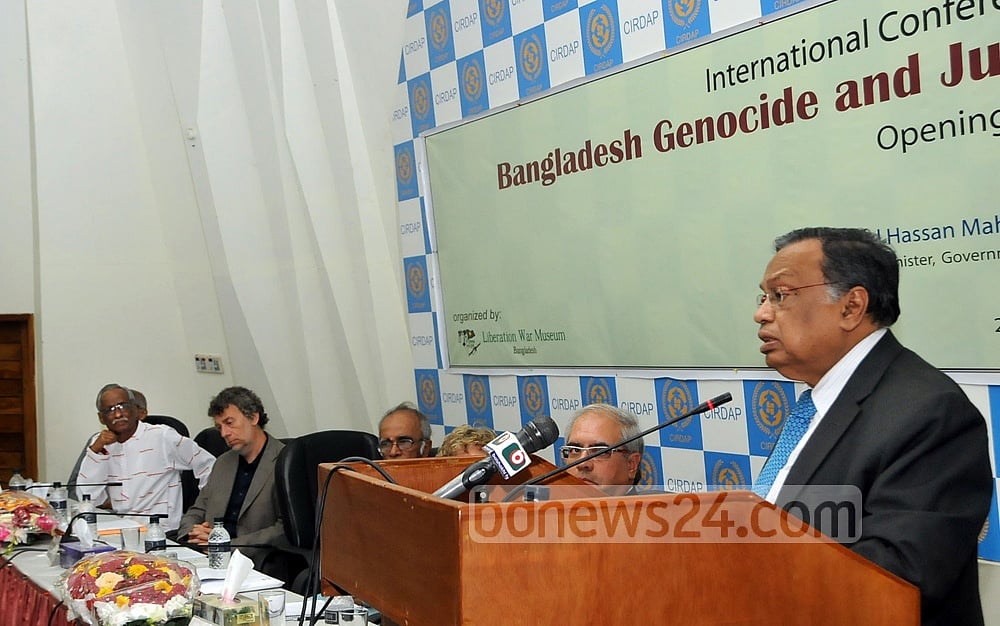
He was speaking at the inauguration of the international conference on ‘Bangladesh Genocide and Justice’ organised by the Liberation War Museum in Dhaka.
Bangladesh began trying war crimes suspects in 2010, nearly four decades after the war of independence in 1971.
The minister said in 1971 Bangladesh experienced “one of the worst genocides” since the Holocaust, but lamented that it had received rather “scant” attention in international genocide scholarship until recently.
He said the Pakistani forces had killed three million Bengali civilians, and raped more than 200,000 women.
Ten million people fled to in India and 40 million were displaced.
“A small minority of ideologically motivated local collaborators and auxiliary forces abetted and participated in these mass atrocities,” he said, giving the background of the war crimes trial.
Genocide scholars and jurists from home and abroad, including Judge Daniel Horacio Obligado from Argentina, attended the conference.
He said the European Parliament, and the US Ambassador on Global Criminal Justice Stephen Rapp of late acknowledged the efforts to bring the perpetrators to justice.
The EU, however, has reservations over death penalty.
Ali quoted the founder of South Asia Democratic Forum Paulo Casaca who was present at the conference.
Casaca said: “I personally oppose the death penalty. In this case, however, the question is whether or not the crimes of which the accused have been convicted deserve the maximum penalty allowed under the law. In this regard, my position is definitely ‘yes’.”
The foreign minister said considering Bangladesh’s socio-political fabric, “we have reasons to believe that retributive justice for the horrific crimes committed would help pave the way for restorative justice and reconciliation in the long run”.
He, however, said Bangladesh remained “sensitised” to the international accountability, as had been evident from its becoming a party to the Rome Statute on the International Criminal Court.
“It is, therefore, only expected of all of us to refrain from any acts of brinkmanship that may jeopardise peace, stability and security.”
Referring to the trial process, he said the Bangladesh experience should also make “an engaging case study” for the long travails Bangladeshis had to endure to secure justice for the 1971 mass atrocities, from the perspective of international criminal justice.
The government started the trial to end the culture of impunity perpetrators enjoyed and uphold the rule of law, Ali said.
The tribunals set a “new paradigm” in international criminal justice system by trying internationally defined mass-atrocity crimes through domestic courts under a domestic legislation.
The foreign minister said the tribunals including the judges, prosecution and investigation teams were “fully independent” of the executive.
“Going beyond the scope of the Nuremberg and Tokyo trials or other international tribunals, the ICT Act, 1973 allows the verdicts of the tribunals to be appealed against at the apex court of the land (Supreme Court of Bangladesh).”
“Yet,” he said, “the detractors of the trials, often working on behalf of the accused, have embarked on a propaganda campaign to undermine the integrity and conduct of the trials.”
The minister, however, said the shadow of mass-atrocity crimes continue to loom large in different parts of the world, despite international community’s resounding ‘no’ to genocides,
“I am certain our world can do better than just watch these fault-lines and eventual tragedies unfold before our eyes,” he said.
“We must react before it is too late. We need to fathom how to prevent genocides and invest in it using the tools we have in the international legal system.”
Ali said haunted by the 1971 memories, the current Bangladesh government would continue its foreign policy of saying “never again” to any genocide and atrocities in the world.
“We strongly believe that the messages of prevention, prosecution and memorialisation of genocides need to be resonated through all regions and continents of the World”.
He thanked the Liberation War Museum for playing “a singularly important role” in memorialising the genocide and crimes against humanity committed in Bangladesh in 1971.
The minister, however, said the recent violence, arson and terror being “perpetrated by the BNP-Jamaat combine” starkly resemble the atrocities Bangladesh witnessed in 1971.
He urged all conscientious citizens around the world to reject such terror and violent acts, and join the people of Bangladesh in “united call” for putting an immediate stop to such barbarity.
He also rejected any dialogue call and said “there can be no meaningful engagement with those quarters that support and believe in terror tactics to drive home their political agenda”.













