


Published : 01 Apr 2017, 09:48 PM
Updated : 11 Apr 2022, 09:00 PM


They see the relations between the two neighbours are “multidimensional” relations where both countries can work on a whole range of issues including basin-wise management of all rivers, trade, investment, poverty eradication, and contemporary issues such as climate change for the benefit of the two people.
Focusing only on Teesta will distract other issues, they said.
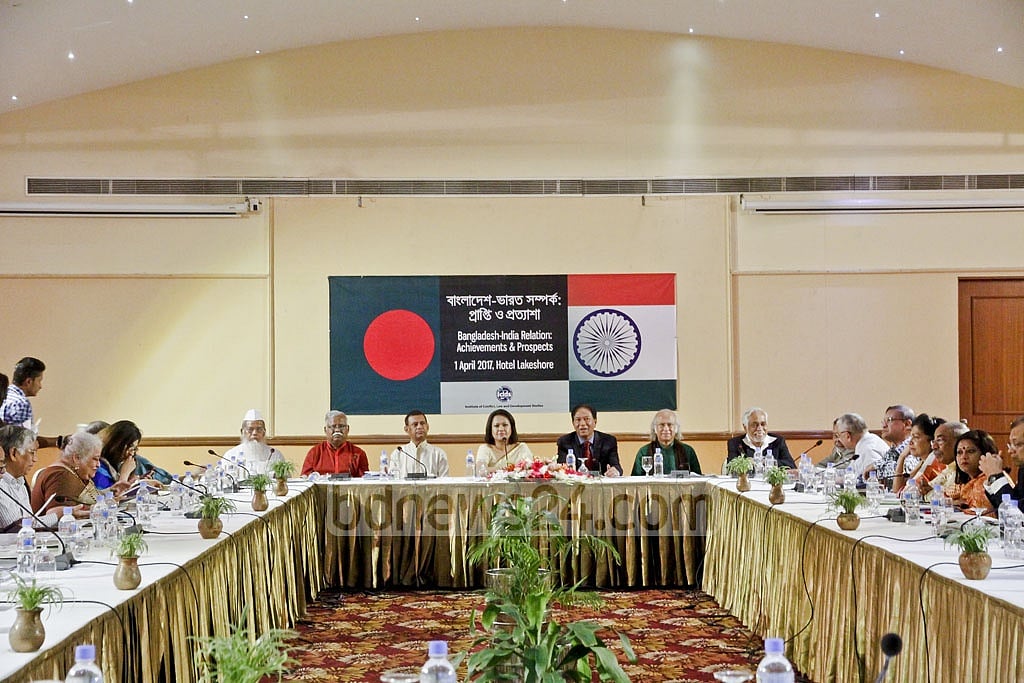
They also spoke in favour of strong defence relations between the countries while speaking at a discussion on India-Bangladesh relations on Saturday.
Prime Minister Sheikh Hasina’s three-day tour to India begins Apr 7.
The comment came at a time when there is no progress in sight to resolve the pending Teesta water issue. BNP leaders said there would have no meaning of the prime minister’s state visit if Teesta water sharing deal, which is blocked by West Bengal Chief Minister Mamata Banerjee, cannot be signed.
BNP was also speaking against any defence cooperation with India following media reports that both sides are discussing on intense defence cooperation.
The Institute of Conflict, Law and Development Studies (ICLDS) organised the discussion bringing together professional including lawmakers, former diplomats, justice, academics, cultural personalities, activities, NGO workers, religious leaders, and journalists.
ICLDS Executive Director Major General Md Abdur Rashid (retd) presented the keynote paper.
Moinuddin Khan Badal MP, Mahjabeen Khaled MP, Palli Karma-Sahayak Foundation Chairman Qazi Kholiquzzaman Ahmad, a former Supreme Court judge Justice AHM Shamsuddin Choudhury, Bangladesh Institute of International and Strategies Studies Chairman Munshi Faiz Ahmed, and former ambassadors Waliur Rahman, Ashfaqur Rahman, and M Shafiullah were among the discussants.
Maulana Fariduddin Masud, who is leading a campaign of Islamic scholars against militancy, Chief Information Commissioner Prof Golam Rahman, Vice-Chancellor of National University Prof Harun-or-Rashid, Former Deputy Governor of Bangladesh Bank Khandaker Ibrahim Khaled and Professor of International Relations at Jahangirnagar University Tareque Shamsur Rahman also spoke at the discussion.
Professor of sociology Sadeka Halim, Prof Zeenat Huda of Dhaka University, Professor of International Relations Dr Delwar Hossain, actor Pijush Bandyopadhyay, Policy Research Institute’s Senior Economist Dr Ashikur Rahman, Bhorer Kagoj editor Shyamal Dutta, Ekattor TV Managing Director Mozammel Haque Babu, and women right activist Rokeya Kabir also discussed on India-Bangladesh relations, among others.
Kholiquzzaman said the relation is “multidimensional” now. “We have to realise that and act on that. If we remain busy with Teesta only, then nothing will progress,” he said.
“Ganges river water treaty will expire nine years later. We could not make the barrage. We discussed the issue in 2000 but did not progress after BNP came to power. We have to discuss this. And also due to climate change, river water flow has been changed. We need to work together in that issue also,” he said.
He said Bangladesh must also give stress on sustainable development and increase the cooperation in technology exchanges.
“India can learn from us. We can also learn from India when it comes to the technological aspect of disaster management and agriculture production. So, we should not focus only on one point,” he said, referring to Teesta water sharing issue.
“We have to come out that mentality that nothing will happen if Teesta water issue is not resolved”.
Maulana Fariduddin Masud said nobody speaks anything when the relations with China and US are discussed.
“But when it comes to India, they bring the issue of religion. When you put forward religion issue, then people do not use their intelligent. And (some quarter) always take this advantage. Fundamentalism is being used in the relations with India”.
Ibrahim Khaled said India is a “trusted” friend of Bangladesh.
“They neither attacked Bangladesh nor showed any intention to attack Bangladesh any time, though we were unprotected during the 1965 Indo-Pakistan war,” he said, urging all to be “careful” about the anti-Indian groups who are “always critical” on any issue related to India, Bangladesh.
“If both countries have good military relations since the birth of the country, then the murderers of 1975 could not enjoy power for long,” he said, adding that “I don’t find any problem with the defence relations”.
Vice-Chancellor of National University Prof Harun-or-Rashid also said everything had been concentrated on Teesta. “We have to see the relations in a broader perspective in a comprehensive way”.
Former Ambassador Wali-ur Rahman said a “smokescreen” had been created before the visit, accusing BNP of playing on anti-India sentiment.
Mahjabeen Khaled, who is a member of the parliament standing committee on foreign affairs, said both sides are discussing on a MoU related to defence cooperation.
“The proposed $500 million line of credit which is being discussed will be used at our choice. There is nothing hidden in our relations. Where are the papers of the military agreement with China that BNP signed when it was in power in 2002?”
She said BNP spoke nothing when “we resolved problems such as land boundary agreement and maritime boundary issue, but they always try to create confusion among the people when it comes to any pending issues”.
“Sheikh Hasina will not do anything that will be against Bangladesh’s interest,” she said.
Prof Delwar Hossain said the relation is based on a “strong foundation” now. “We should not see it in a one-dimensional way focusing on Teesta only. It should be multi-dimensional”.
Prof Golam Rahman stressed on media’s role in highlighting the relations removing any mistrust perceptions.
Justice Shamsuddin Manik said the relation is a blood relation.
“We shed blood together in 1971. India-Bangladesh relation is different than any other country’s relations. If BNP did not give shelter to Indian separatist force and did not try to send 10-truck arms, then we could solve many problems by this time”.
Moinuddian Khan Badal MP, however, spoke against any military agreement. “India should realise that we have addressed their security concerns. Whatever the relations we have with India, we can continue that. There is no new situation created that calls for a defence agreement. So, India should not impose upon us”.













