


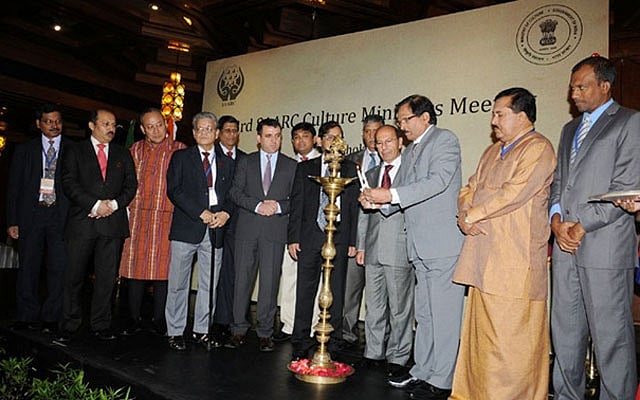
Published : 25 Sep 2014, 07:12 PM
Updated : 08 Aug 2022, 07:12 PM


Indian culture minister Shripad Naik, who chaired the meeting, said that the India-Bangladesh joint commemoration had given the two countries an opportunity to build a vibrant and forward-looking relationship.
“Culture plays a crucial role in ultimately shaping the development agenda of a nation. It represents a set of shared attitudes, values, goals and practices. Culture and its children – the arts – manifest themselves subtly in almost all economic, social and other activities. A country as diverse as India is symbolized by the plurality of its cultures,” he said.
The day-long meeting highlighted the dynamics of strengthening cultural relation between India and Bangladesh.
Naik also said that India had been actively associated with the restoration of the Pashupatinath Temple in Kathmandu, the development of the Gandhi Heritage Sites at Noakhali, in Bangladesh, the restoration of temples in Jaffna, Sri Lanka, and the establishment of a science museum in that country.
The meeting also resolved to declare 2016–17 as the SAARC year of cultural heritage.
Bamiyan in Afghanistan will be the SAARC cultural capital, which will be inaugurated in April 2015.
The Delhi resolution has decided to promote SAARC culture online by launching a dedicated SAARC website on culture, with emphasis on digitization of rare manuscripts, rare books, and other articles of intangible cultural value.
The 4th SAARC culture ministers meeting will be held in Bangladesh.
The resolution has also decided to promote the local-language literatures of the region, and make them available to readers across the world through translations, not only into English, but also through direct translation from one SAARC language to another.
For this, it has decided to give financial support to writers to enable them to work on creative projects, collaborate with other writers, and provide greater exposure to other cultures.













