Defence threatens to call Huq as material witness
The defence has threatened to call war crimes tribunal chief Nizamul Huq as a material witness in Jamaat-e-Islami leader Delwar Hossain Sayedee's trial if he does not step aside. Tanim Ahmed
bdnews24.com News Service
bdnews24.com
Published :
13 Nov 2011, 11:56 AM
Updated :
10 Aug 2022, 05:47 PM
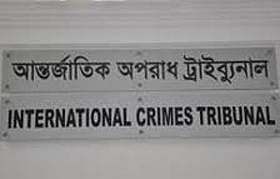
Dhaka, Nov 13 (bdnews24.com) — The defence has threatened to call war crimes tribunal chief Nizamul Huq as a material witness in Jamaat-e-Islami leader Delwar Hossain Sayedee's trial if he does not step aside.
Arguing for the recusal of International Crimes Tribunal chairman, defence cousel Abdur Razzaq said it would be tantamount to obstructing the course of justice if he does not step down soon before the day's hearing came to a close.
"Mr Justice [Nizamul Huq] has no constitutional, legal or moral right to remain as chairman of the tribunal. The sooner he resigns the better."
Justice ATM Fazle Kabir and judge AKM Zaheer Ahmed heard the submissions. Huq's chair was moved to one side and remained empty. The court will convene Monday to rule on the issue.
However, at one point of prosecution lawyer Haider Ali's rebuttal to the defence arguments AKM Zaheer Ahmed clarified that the defence was only appealing that the tribunal chairman remove himself from the case at hand which accuses Jamaat-e-Islami's executive council member Sayedee on 20 counts of crimes against humanity, including murder, rape, genocide, arson and loot.
Razzaq, at that time, confirmed that the Zaheer's understanding was correct.
During his rebuttal of the prosecution's arguments, Razzaq said at one point, "I am going to make a statement now. And it is a very important one." He went on, "If Nasim (Justice Nizamul Huq Nasim) does not recuse himself from this case, then we will call him as a material witness."
He reasoned that as part of a people's enquiry commission the judge had been involved in collecting evidence and testimonies of victims who accused Sayedee of committing war crimes.
Haider Ali told the press later that witnesses would be called only as the case merited and would be decided only upon the course of the trial proceedings. "This advanced warning is only to create a mental pressure for the judge."
Haider argued that the people's commission was no legal entity and did not in any way form a part of this trial. Hence, he argued ,Huq's involvement with that process did not in any way disqualify him
The proceedings began with defence counsel Razzaq arguing for the removal of Justice Huq in a crowded courtroom that had almost as many lawyers and observers standing on the two sides as were sitting with a large number of lawyers from both prosecution and defence.
Moudud Ahmed, a former law minister of BNP, and Khandkar Mahbub Hossain, an advisor to BNP chief Khaleda Zia, also argued for Huq's recusal.
Haider pointed out that the commission was not among either of the parties to the only case underway at the tribunal. He said the two parties were the chief prosecutor and the accused, Sayedee.
Razzaq said that as a member of the secretariat of the enquiry commission Huq was involved in the investigation of war crimes allegations against Jamaat leaders including its chief Motiur Rahman Nizami, secretary general Ali Ahsan Mohammad Mojaheed, Sayedee and BNP leader Salahuddin Quader Chowdhury.
Huq was also involved in the process of obtaining statements of witnesses, many of whom are likely to appear before the tribunal to give evidence.
A written statement handed out by Tajul Islam, who regularly argues on behalf of Sayedee, states, "In his capacity as a member of the secretariat, he also recommended that [those persons] be tried for war crimes by the International Crimes Tribunal."
The statement reads that in view of Huq's direct involvement with the people's inquiry commission, "he has no right to perform the functions of the chairman of the International Crimes Tribunal."
Razzaq referred to other cases where judges had been disqualified for much less including one case relating to a similar case in Sierra Leone.
He concluded saying that the sooner Huq removed himself the better. But in case he did not, Razzaq said, "Our submission to your lordships would be that you come out in favour of justice."
Moudud said it was rather unfortunate that such a hearing had to take place in the first place.
"I am sure this would be awkward for the judges too," he said observing that the remaining two judges of the tribunal would have to decide on the fate of their chairman.
On Oct 30, the war crimes tribunal adjourned Jamaat leader Sayedee's trial until Nov 20 after a heated argument with the defence.
The tribunal head ordered the defence to submit its list of witnesses on Nov 20 when the court would hear opening statements and record witness statements.
Before that, the court would hear a petition on Wednesday to review Sayedee's indictment order of Oct 3.
Charges against Sayedee, who was known as 'Deilla Razakar' in his area during the war, relate to involvement in killing of more than 3,000 unarmed people, rape of over nine women, arson, forcing Hindus to convert their religion, looting and other crimes against humanity. The crimes were committed in Pirojpur district.
Sayedee on Oct 3 denied the accusations brought against him.
Sayedee is the first man facing a formal trial among the five Jamaat leaders and two others from BNP facing similar charges.
He was arrested on July 30 last year. Apart from him, Nizami, Mojaheed and assistant secretaries general Mohammad Kamaruzzaman and Abdul Quader Molla have been arrested on war crimes charges.
Senior BNP leader Salahuddin Quader Chowdhury and Abdul Alim, a minister in Ziaur Rahman's cabinet, have also been arrested on similar charges.
Of the seven Jamaat and BNP leaders facing the war crimes charges, Alim is on conditional bail while the remaining six are behind bars.
bdnews24.com/ta/bd/1742h