Published : 21 Jan 2013, 03:24 PM
Updated : 23 Apr 2022, 04:01 PM


But the most unlikely ‘first’ triggered by Abul Kalam Azad’s death sentence was the International Crimes Tribunal-2 judges moving to the first tribunal’s larger courtroom to deliver the verdict.
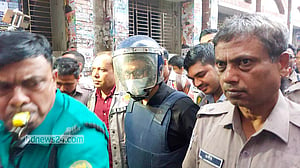
Premises of the Old High Court building that houses both the tribunals were teeming with lawyers, journalists, observers and enthusiasts as well as security personnel.
A full hour before the judgment was scheduled, television crew thronged the main entrance about 100 yards away from the colonial building that once housed chambers of the Chief Justice and before that played official residence of the Assam-Bengal Governor.
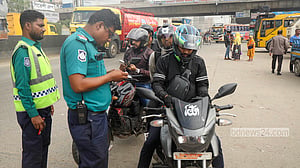
Visitors wishing to enter the premises, whether lawyers or journalists, had to wait several minutes in queue for even getting an entry pass where many were asked to produce their identification.
“I am from the press,” did not suffice on Monday for many journalists. Everyone was made to remove all kinds of metallic objects from their pockets while bags were thoroughly checked at the first archway — an unprecedented security procedure.
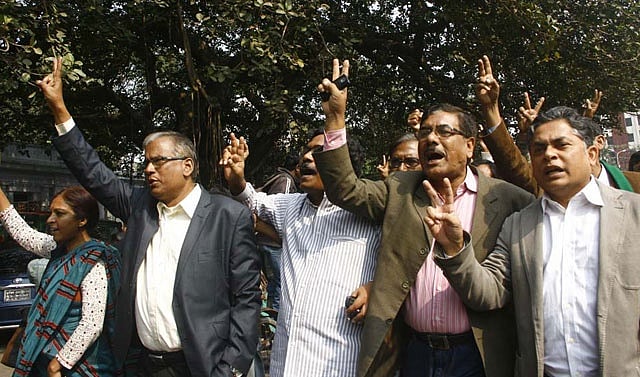
Once inside photographers and videographers jostled for a suitable spot to capture the who’s who that came to hear the first verdict.
Upstairs on the first floor, the spacious lobby was cramped for space, swarming with entrants waiting to be let into the second tribunal with a capacity to seat hardly 40.
The Attorney General who had come too with a retinue of lawyers from his office was convinced at one point that the judges should switch courts for delivering the verdict.
The top law officer’s attempts paid off and the second tribunal judges eventually convened proceedings before a packed courtroom with scores still left standing even after extra seats and sofas were brought in.
But before the bench officers took their seats, there was an apparent confusion among them, between those serving the first tribunal and those attending to the second.
Tribunal Chairman Justice Obaidul Hassan, flanked by Justice Mozibur Rahman Miah and Judge Shahinur Islam, took their seats about quarter of an hour after the scheduled time and the Chairman began reading out the verdict soon afterwards.
He began saying, “We have come to the first tribunal to give the verdict because the other courtroom is too small to accommodate so many people.”
He continued for the next one hour going through the summary judgement while all the split air-conditioners whirring at full capacity barely managed to keep the heat down right smack in the middle of winter.
However, the first case to reach verdict would still not run the full course, exhausting the due process, as the state-appointed defence counsel, Abdus Shukur Khan, said he would not file for a review of the verdict.
As for the appeal, Shukur Khan said it could not happen in absentia and that Azad could file an appeal upon his arrest or surrender within a month of the verdict.
After the one month is over, it would be up to the Supreme Court’s discretion to give him the opportunity.