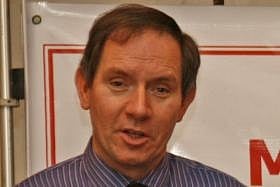
'Change in attitude can stop acid attacks'
British envoy to Bangladesh stresses the importance of places of worship to motivate people.
bdnews24.com News Service
bdnews24.com
Published :
25 Nov 2012, 02:52 PM
Updated :
09 Aug 2022, 04:33 PM
Dhaka, Nov 25 (bdnews24.com) – Acting British High Commissioner Nick Low stressed on 'changing attitudes' to bring down the number of acid attacks to zero, as he marked the International Day for the Elimination of Violence Against Women on Sunday by visiting acid survivors in Dhaka.
"We should make it very clear that it's (throwing acid) an evil that never had any justification," he said as victims at the Acid Survivors Foundation (ASF) narrated how they came under the gruesome attack and their horrendous experiences afterwards.
Twenty-three-year old Rehana Khatun was one of them. A man after years of stalking threw the highly corrosive substance on her face on Sep 13, 2010 midnight when she peeped out of the window following a sound outside her residence at Sadullahpur under Gaibandha.
"He took 10 to 15 seconds to pour it," she said. "He started stalking me when I was a student in class VIII, but I could not avoid him (the stalker) even after wearing a veil during my study in Dhaka."
She studied diploma in Laboratory Science after passing the secondary examination and obtained a job in a clinic.
After the attack that disfigured her, Rehana lost her job as a lab technician, but she said the attacker, who is a soldier in the armed forces, is still in the job.
"People caught him on that night and handed him over to the police. But army took him away as they would carry their own investigation," she said, "Surprisingly they did not find him guilty and suggested us to file lawsuits in civil court."
"We filed lawsuit in Gaibandha district court but were not getting witnesses to testify in the court. Recently he got the case stayed for six months from the High Court," poor Rehana said while appealing for job to meet her ends meet.
Statistics show 'tough' law has brought down the number of acid attacks in Bangladesh, but activists have been saying that 'powerful' attackers remain unpunished as happened to Rehana.
According to ASF records, the number of acid attacks came down to 84 in 2011 from 490 in 2002 when a tough law carrying death penalty for attackers was enacted. The law also made it a non-bailable crime.
Terming the acid victims 'sincere, dignified and strong', Nick Low said, attitudes should be changed.
He said even a single attack cannot be accepted. "We are children of god…that's should be made very clear in mosques, temples and all places of worship," he said while stressing the importance of places of worship to motivate people against acid attacks. .
Low also saw the facilities available at the ASF for the care and support of acid victims during his visit and said, the practices of ASF can be replicated in other parts of the world where people come under such attacks.
According to a media release, the UK government has been supporting the ASF since 2004. It says over the last 10 years 3,000 survivors have been supported through this programme.
The Dutch Ambassador in Bangladesh Drs Gerben Sioerd De Jong and the Country Representative of the Department for International Development's (DFID), Sarah Cooke, accompanied the Acting High Commissioner.
bdnews24.com/nih/ano/2040h