Published : 01 Oct 2026, 12:40 AM
Updated : 01 Oct 2026, 12:40 AM


Meta has opened its Facebook monetisation programme to at least 19 pages run by Bangladesh’s law-enforcing agencies, according to a Dismislab investigation.
That is despite the company’s own policy excluding government institutions and agencies from such earning opportunities, the independent fact-checking and digital media research initiative found.
The pages include the verified accounts of Bangladesh Police, Bangladesh Navy and the Airport Armed Police Battalion, as well as at least 14 district police offices, it said.
The pages are linked from official government websites and most identify themselves as a government organisation, police station or law-enforcing agency.
Dismislab identified the pages using Meta’s partner-publisher list and a monetisation archive maintained by Netherlands-based WHAT TO FIX, which researches social media monetisation policy and transparency.
Some of the pages have had access to Meta’s earning programmes since 2020. Sherpur district police and Bangladesh Navy joined Facebook’s in-stream ads programme on Jun 6 that year.
Bangladesh Police’s verified page entered a monetisation programme in March 2022, while several district police pages followed in 2023. The Airport Armed Police Battalion and Tourist Police Bangladesh joined in January 2024.
Meta replaced its in-stream ads, ads on reels and performance bonus programmes with a broader content monetisation programme on Aug 31, 2025.
The new system allows earnings from photos and text posts as well as videos.
According to WHAT TO FIX’s archive, 11 Bangladeshi law enforcement pages joined the new programme on Sept 2, 2025.
Bangladesh Police joined five days later. Seven others joined directly in 2025 and 2026, with Narail district police becoming the latest on Aug 22, 2026.
Meta says its content monetisation programme is currently invite-only. This means the 19 pages received invitations or otherwise gained access through Meta’s system.
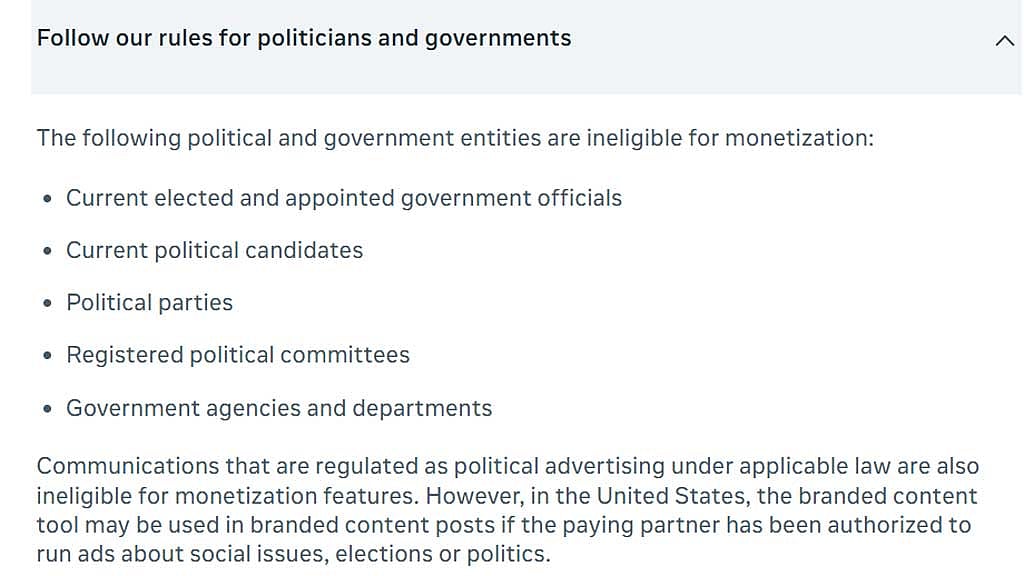
Yet Meta’s partner-publisher policy says government institutions and agencies are not eligible for monetisation.
Only two of the 19 pages were categorised as “public figure” or “digital creator”.
The other 17 identified themselves as “police station”, “law enforcement agency”, “government organisation”, “government official” or “armed forces”.
Access Repeatedly Cut, then Restored
Bangladesh Police’s page, which has more than 2.7 million followers, has moved in and out of Meta’s monetisation programmes several times.
It first joined in-stream ads on Mar 20, 2022, but was removed 10 days later. It subsequently rejoined and was removed four more times before remaining in the programme from Jul 29, 2024 to Aug 26, 2025.
It joined the new content monetisation programme on Sept 7, 2025 and remains there.
The Chuadanga district police page shows a similar pattern. A police official said its monetisation had been blocked, but Dismislab found that the page rejoined the new programme on Nov 8, 2025 and remains active.
The Cumilla district police page joined in-stream ads and ads on reels in August 2025.
Although ads on reels was suspended the next day, its in-stream access continued, followed by entry into the new programme on Sept 2.
An official managing the page said it had earned a small amount.
“I think we got around $10 last year, and it is still sitting there on Facebook. We have not withdrawn it,” he said.
Dismislab said similar monetisation has been documented for law enforcement pages in India, the Philippines, Israel, the United States and the United Kingdom.
The investigation also raised concerns that financial incentives tied to engagement could influence how police and military agencies communicate online, potentially placing clicks and earnings ahead of public safety and privacy.
Dismislab said it contacted Meta for comment and would add any response to its report.