Published : 12 Aug 2026, 09:25 PM
Updated : 08 Sep 2026, 09:32 AM


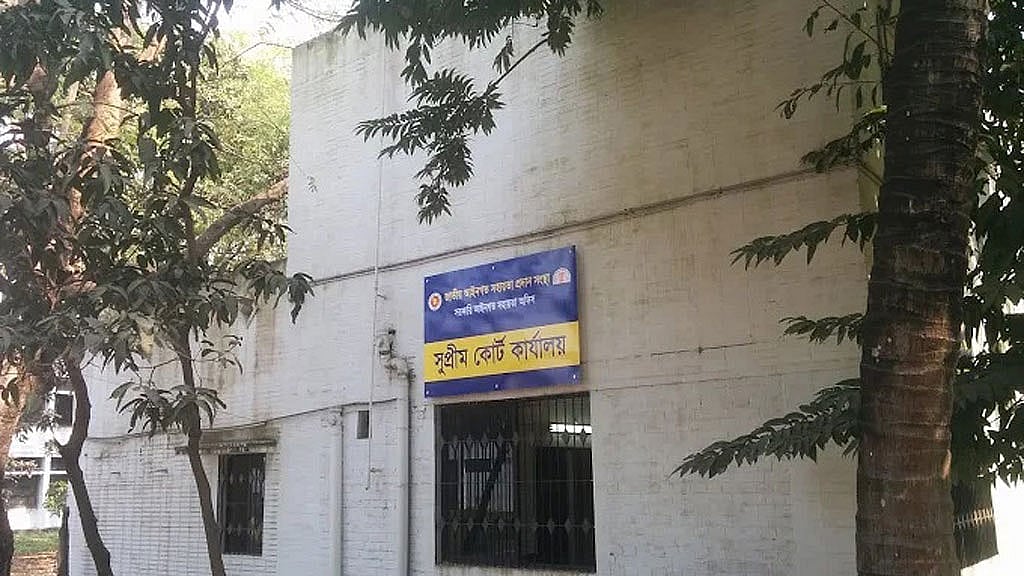
The chief justice has authorised the Supreme Court Legal Aid Office to settle cases through mediation.
The Supreme Court administration has issued a circular in this regard, Chief Legal Aid Officer Md Imtiazul Islam told bdnews24.com.
According to the circular signed by Supreme Court Deputy Registrar Al Imran Khan, the chief justice has allowed the office, initially, to conduct alternative dispute resolution (ADR), particularly mediation, in cases under seven laws.
These are the Family Courts Act, 2023, Parents’ Maintenance Act, 2013, Dowry Prohibition Act, 2018, Women and Children Repression Prevention Act, 2000, Penal Code, 1860, Specific Relief Act, 1877, and Negotiable Instruments Act, 1881.
Imtiaz said the legal aid system provides two types of mediation: “pre-case” mediation, before a case is filed, and “post-case” mediation, after a case is filed.
“However, there is no provision for pre-case mediation at the Supreme Court Legal Aid Office; only post-case mediation is available,” he said.
He said serious or cognisable offences would not be eligible for mediation.
“Basically, mediation is available for family disputes or minor cases of a petty nature, such as simple fights,” he said.
Family Disputes
The circular says attempts can be made to settle cases through mediation under Section 5 of the Family Courts Act, 2023 involving divorce, restitution of conjugal rights, dower, maintenance, and guardianship and custody of children.
Section 5 of the law establishes the jurisdiction of family courts over these five types of matters.
“Saving a family through mediation is a positive thing,” Imtiaz said. “In a settlement, both parties can be brought together to resolve misunderstandings and an effort can be made to reunite them, which generally does not happen in court.”
He said mediation can also be used to try to resolve disputes over dower or recovery of money owed.
Maintenance of Parents
Cases under Section 5 of the Parents’ Maintenance Act, 2013 have also been brought under the mediation system.
If a child fails to look after their parents, the father or mother can file a case against the child. If such a case reaches the High Court in an appeal or revision, the court may refer it to the Legal Aid Office for mediation.
“We will bring both parties together and discuss the matter. If we can reach a settlement, I will send a report stating that the case has been settled on these terms,” Imtiaz said.
He said the Legal Aid Office itself does not dispose of cases. Whether or not a settlement is reached, it sends a report to the court. The court then disposes of the case based on that report.
Dowry and Violence Against Women
Cases under Sections 3 and 4 of the Dowry Prohibition Act, 2018, and Section 11(c) of the Women and Children Repression Prevention Act, 2000 are also covered by the system.
Imtiaz said if someone demands dowry but does not assault anyone, the offence falls under the Dowry Prohibition Act. If a person causes a simple injury over a dowry demand, the case falls under Section 11(c) of the Women and Children Repression Prevention Act.
However, serious and non-compoundable offences such as murder, rape or an offence under Section 326 of the Penal Code will not be eligible for mediation.
Penal Code Offences Covered
According to the circular, cases involving offences under Section 143 of the Penal Code, relating to punishment for being a member of an unlawful assembly; Section 447, criminal trespass; Section 448, house-trespass; Section 323, voluntarily causing hurt; Section 324, voluntarily causing hurt with a dangerous weapon or means; and Section 325, voluntarily causing grievous hurt, may be referred for mediation.
Also included are cases under Section 354, involving assault or criminal force against a woman with intent to outrage her modesty; Section 379, theft; Section 380, theft in a dwelling house, building, tent or vessel; and Section 381, theft by a clerk or servant.
The circular also includes cases under Section 406, criminal breach of trust; Section 417, cheating; Section 420, cheating and dishonestly inducing delivery of property; Section 494, marrying again during the lifetime of a husband or wife; Section 500, defamation; and Section 501, printing or engraving matter known to be defamatory.
Cases involving attempts to commit offences punishable under Section 511 of the Penal Code have also been included.
However, if a case involves multiple sections, whether the entire case can be referred for mediation will depend on the overall nature of the case, the relevant legal provisions and the conditions set out in the circular.
Civil and Other Cases
Cases under Sections 8 and 9 of the Specific Relief Act, 1877, involving recovery of possession of property; Section 12, specific performance of contracts; Section 39, cancellation of instruments; Section 42, declaratory decrees regarding title or legal rights; and Section 54, injunctions have also been included in the mediation process.
Cases involving dishonour of cheques under Section 138 of the Negotiable Instruments Act, 1881 are also eligible.
Under the section, dishonouring a cheque because there are insufficient funds in the bank account or because the cheque amount exceeds the agreed limit is treated as an offence.
Chief Legal Aid Officer Imtiaz said mediation would save both time and money.
“A case may take five to seven years to be disposed of in court, but through mediation by the Legal Aid Office, our goal is to resolve a matter within one to two months,” he said.
He also said the legal aid mediation service is provided free of charge.
In a court judgment, one party generally wins while the other is dissatisfied. But when a dispute is resolved through mediation, both parties can be satisfied, Imtiaz said, describing it as a “win-win situation.”