Published : 20 Oct 2026, 05:12 PM
Updated : 20 Oct 2026, 05:12 PM


The cost of Dhaka’s MRT Line-1 metro rail project has more than doubled, and bringing it down is now on the agenda of Prime Minister Tarique Rahman’s visit to Japan.
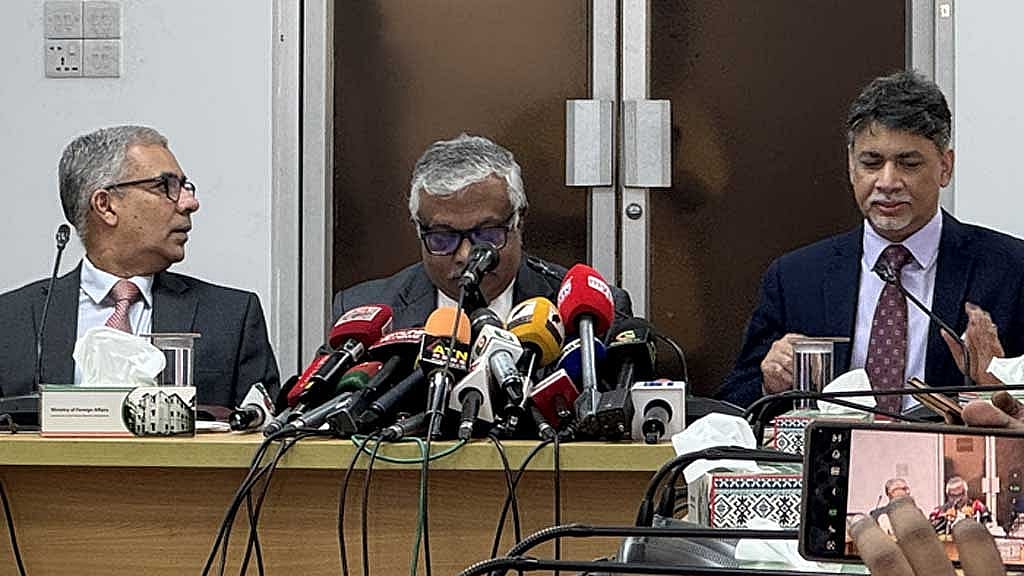
Foreign Secretary Asad Alam Siam told a press conference on Monday that the issue of reducing the interest burden will be raised during the trip, though the outcome will only become clear after the talks.
At the invitation of Japanese Prime Minister Fumio Kishida, Tarique will travel to Japan from Oct 25 to 28, his fourth trip abroad since taking office in February.
The prime minister’s delegation will include Finance Minister Amir Khosru Mahmud Chowdhury, Finance Advisor Rashed Al Mahmud Titumir, State Minister for Foreign Affairs-1 Humaiun Kobir, State Minister for Power Aninda Islam Amit, Advisor for Posts, Telecommunications and Information Technology Rehan Asif Asad, Invest Bangladesh Chairman Ashik Chowdhury and Special Assistant for Overseas Employment in the Asia-Pacific region Md Shakirul Islam Khan.
At a meeting of the Executive Committee of the National Economic Council (ECNEC) on Sept 16, the cost of the country’s first underground metro rail line, running from the airport to Kamalapur, was raised by 117.64 percent in the project’s first revision.
Japan is financing the project.
Asked whether the prime minister would seek a cost reduction in Japan, Siam said: “We have sought different kinds of technical assistance from Japan for building various infrastructure… as you said, capital funding and a great deal of information support.
“These infrastructure cooperation issues will certainly be discussed at the bilateral meeting of the two prime ministers. Beyond the metro rail, there is other mutual infrastructure cooperation. So there will be detailed discussion there.”
Bangladesh wants lower-interest loans from all its development partners, the foreign secretary said, adding that global conditions and each country’s domestic considerations would also shape the outcome of the discussions.
Matarbari Deep Sea Port
Japan wants to build an ‘industrial value chain’ around Bangladesh’s Matarbari deep sea port, which it is financing.
The plan would link seven states of northeastern India with the Bay of Bengal and Southeast Asia.
Asked what Bangladesh’s position would be on this from a regional relations standpoint, Siam said: “Our thinking is that our economic development and the capacity our port infrastructure needs match each other.
“That is, the capacity our ports need to handle the volume of exports and imports we expect to see 10 years from now is where the concept of this Matarbari port expansion project was developed.”
The secretary said the country’s energy crisis will also come up during the visit.
The prime minister will tour the Chiba LNG terminal in Japan. He is also due to visit a power plant, Unilever’s headquarters and the Toyota factory in Nagano.
Rest of the Schedule
Highlighting the existing "strategic partnership" between the two nations, Siam noted that cooperation spans infrastructure, technological advancement, human resource development, and security assistance.
“We hope this visit will strengthen and expand these activities further.”
The secretary said the scheduled visit offers a chance to make the ties “deeper and stronger”.
The Economic Partnership Agreement (EPA) signed between Bangladesh and Japan last February has opened “new possibilities” for expanding trade and investment, he said.
“Japan, as one of Bangladesh’s main development partners, has been helping build and implement several important infrastructure and connectivity projects, including the metro rail, the third terminal of Shahjalal International Airport and the Matarbari deep sea port.”
He hopes the visit will widen access for Bangladeshi goods in the Japanese market, increase Japanese investment and strengthen business ties.
It should also open the way for cooperation in new areas such as renewable energy, environment, science, technology, digital innovation, research and human resource development, Siam said.
On the second day of the trip, Oct 26, Tarique will hold a bilateral meeting with the Japanese prime minister at his office. He will also attend a dinner hosted in his honour by the Japanese prime minister.
The chairman of the Japan-Bangladesh Parliamentary Friendship League, the chairman of the Japan-Bangladesh Committee for Commercial and Economic Cooperation, the president of the Japan International Cooperation Agency (JICA), the governor of the Japan Bank for International Cooperation, the president of the Japan External Trade Organization and the chairman of the Sasakawa Peace Foundation will call on Tarique.
The prime minister will also deliver the keynote speech at the Japan-Bangladesh Economic Forum, the secretary said. “As a result of this visit, we hope the bilateral relations between Bangladesh and Japan will grow stronger.
“New dimensions of the relationship will open up. And new private investment will come to Bangladesh from Japan.”
“We also expect faster and timely completion of ongoing essential projects, stronger economic partnership, more economic and development assistance, and continued security assistance.”
Siam said several memorandums of understanding (MoUs) could be signed during the visit, on cooperation in agriculture and fisheries, human resource development and skills, civil aviation, marine environment conservation and local government modernisation.
“We are discussing about eight MoUs, and we hope three or four of them will be signed,” he added.