Published : 29 Aug 2020, 11:27 PM
Updated : 17 Oct 2022, 11:12 AM


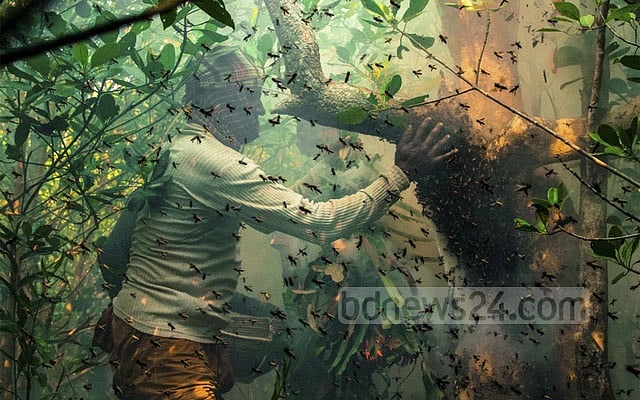
Each of his 10-member team got around 150 litres of honey after the season.
“But the price was nothing compared to the troubles we went through to secure the passes and the danger we faced to collect honey,” said Alamin.
He now has no job until the next honey collection season. His father works as a rickshaw-puller in Khulna city.
“We do nothing most of the year. We also have to take loans of Tk 70,000 to Tk 150,000 from the local lenders. People of this area carry the burden of loans for generations,” Alamin said.
Most of the traders at Nolian Bazar, the local market near Alamin’s home under Sutarkhali union at Dacope Upazila, depend on the forest.
They sell fish, crabs, honey, shrimps, mangrove palm leaves and whatever they collect from the forest. Traders also sell boats and fishing equipment at the market.
Tiger or crocodile attacks, snake bites, natural disasters like storm or floods, and shrinking income and resources have forced the residents of Nolian Bazar and many other areas near the forest in Khulna and Bagerhat to look for alternatives to the risky jobs.
The government has taken a project for their rehabilitation, but it covers very few people at a slow pace, the residents say.
Rasul Mia, a man in his 60s, said his younger brother Kalam Mia, a hunter, died in a tiger attack seven years ago.
“I have to take care of his family now. I have also faced tigers several times, lost two teeth in an attack by robbers. But I have to continue [working in the forest] because I don’t have an alternative,” he said.
Rasul has lost his land to riverbank erosion. Having seen cyclones wash away their homes several times, his family live in a home on a dam near the local launch pier.
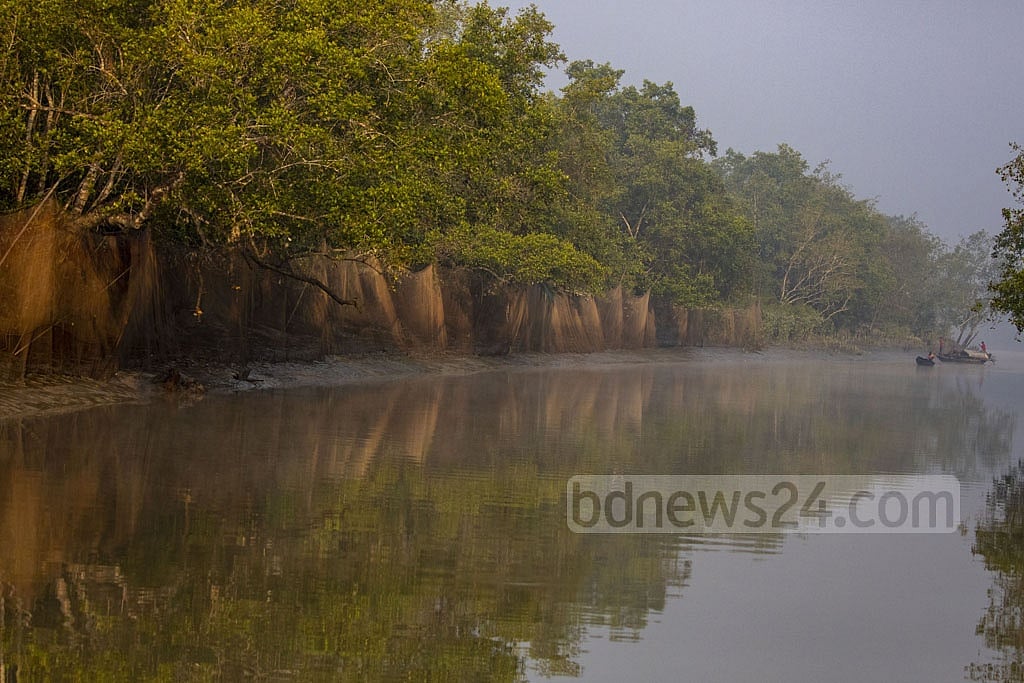
If he can manage fishing pass for seven days, their team of three earn around Tk 5,000. But the seasonal ban on fishing has made it hard for them to earn throughout the year.
Abul Bashar, a local journalist, said effects of climate change have reduced the resources which the workers are allowed to collect for four to five months annually.
The amount of fishes one person can catch in a year now is equal to the catch of a single season in the past, he said.
He alleged harassment of the workers by forest officials, who are also accused of taking bribes from the workers for passes.
“It’s because of these reasons that the people of these areas have lost interest in working in the Sundarbans. They want alternatives now,” Bashar said.
Bashirul Al Mamun, divisional forest officer for the west zone of the Sundarbans, denied the allegations of harassment and bribery.
He, however, admitted that the number of people collecting fish, leaves or honey from the forest has dropped significantly.
“Besides limiting access of the people dependent on the forest, tourism has also been banned since March due to the coronavirus pandemic,” he said, adding the moves have had a positive impact on the ecology of the forest.
Anwarul Kadir, the executive director of the Sundarban Academy in Khulna, said the people reliant on the forest have begun shunning it also because the natural disasters have created an environmental awareness among them.
“They don’t want the resources of the forest damaged,” he said.
SCARCE EFFORTS, BUT WORKING
The government has launched a project to rehabilitate the people who depend on the Sundarbans by engaging them in farming and other jobs.
One of the beneficiaries, Abu Sayed of Bagerhat’s Mongla, was a fisherman.
He has opened a grocery with Tk 40,000 he got from the project after the government banned fishing in his area, declaring it a dolphin sanctuary.
Another beneficiary, Fazlu Howlader, added some more money to the cash he got from the project to buy a ‘Nasiman’, a locally made small passenger carrier.
Md Aliar Rahman, a member of Chila union council in Mongla, said some people of his area received cash, equipment like sewing machine, and training under the project, but the number was not sufficient.
Mohammad Belayet Hossain, Sundarbans east zone divisional forest officer, said the project has so far supported around 75,000 people since 2010.
The government estimates that at least 50,000 families in five districts near the Sundarbans depend on the forest.