


Published : 11 Jan 2013, 01:26 PM
Updated : 09 Aug 2022, 10:05 AM


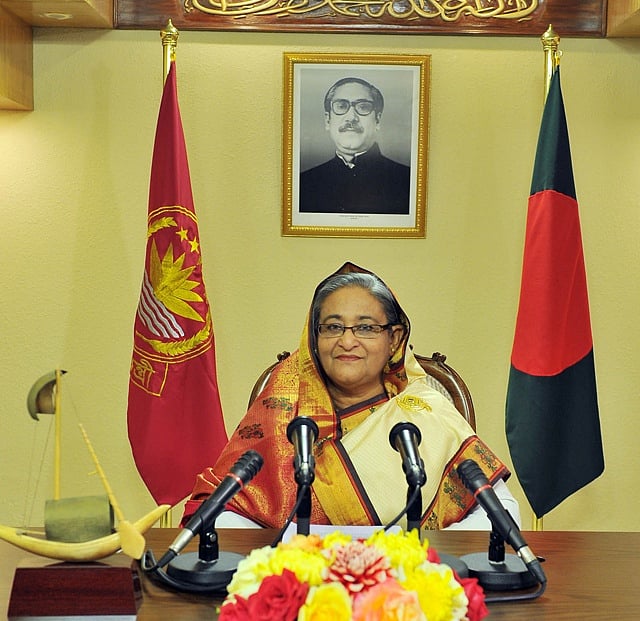
In a televised address to the nation in the evening marking four years of the Awami League-led coalition government, she asked people to be vigilant about their Constitutional rights and asked the opposition to reject the path of confrontation.
“The world is now saying that the present government’s massive development works are taking Bangladesh towards progress.
“To achieve our goals, it’s essential to maintain continuity of the government. And it’s you (the countrymen) who can give us the chance,” she added.
She commented that by giving her party another mandate, the people would be able to carry on the works for securing economic freedom.
The Prime Minister started addressing the nation at 7pm and state-run Bangladesh Television (BTV) and Bangladesh Betar (Radio) aired the 29-minute speech.
Hasina said that the country would emerge as a poverty- and hunger-free, happy, prosperous, justice-based and non-communal ‘Digital Bangladesh’ on the back of the massive development activities taken up by her government.
She urged the opposition to do away with the politics of confrontation and said, “Don’t try to save the war criminals. The nation will never forgive you in that case.”
The Prime Minister called upon all to make real the immense promises to build a new Bangladesh being inspired by the spirits of the Liberation War.
About the trial of the alleged war criminals, Hasina said, “No matter how hard the BNP-Jamaat conspire, the trial of those who violated the dignity of our mothers and sisters and killed the intellectuals will be held on the soil of Bengal.”
She recalled the looting, arson and torture on the innocent Bengalis by the anti-liberation forces and local collaborators of the Pakistan army to say: “I seek cooperation from you, the countrymen. I solicit your blessing.
“Now the trial of the war criminals and anti-liberation elements has become a public demand.”
She was critical of the main opposition BNP’s stance on the war crimes trial who she said has hit the ground to save the war criminals by ignoring this demand. “They’re creating anarchy. Jamaat-e-Islami has chosen the path of destruction, she added.
The Prime Minister lambasted military ruler General Ziaur Rahman for providing identified war criminals with political platform. “The BNP’s unity with the war criminals is nothing new. Their founder Ziaur Rahman formed an illegitimate Martial Law government in 1975 and later began politically rehabilitating the war criminals and anti-liberation elements.”
“He (Zia) had released them from jail. He had brought many others back to the country and gave them citizenship and also established them in politics. He made them Prime Minister, Ministers and Advisors.”
Ziaur Rahman made Shah Azizur Rahman, who supported Pakistan in the United Nations during the Liberation War in 1971, the Prime Minister. Ghulam Azam also returned to Bangladesh on a temporary visa with a Pakistani passport.
In her address, the Prime Minister also highlighted the successes and efforts of her government in the economic sector in the last four years.
At one stage of her address, Hasina said: “Bangladesh is now being seen as the future growth engine. Bangladesh is now the fifth leading country in achieving long-term growth.”
She said the country was going through severe economic crisis when her government assumed office on Jan 6, 2009. “We faced an acid test after forming the government. So, we held a cabinet meeting on the very first day of the government and fixed immediate-, short-, middle- and long-term strategies.”
“The government has passed the last four years working hard. You’ve provided us all-out support. The flow of development has touched every family. We’ve taken a hard stance against corruption.”
In its electoral manifesto, the Awami League had pledged to start the construction of the Padma bridge if they would go to power. But after four years into its office, the construction of the country’s largest-ever infrastructure development project yet to start.
She further said her government made the Anti-Corruption Commission independent; it now can summon ministers and the advisors enjoying the status of ministers whenever its wants for the sake of investigation.
“Was it possible during the previous BNP-Jamaat government? Could the ACC dare summon any minister? You, the countrymen, will judge.”
“To remove all sorts of irregularities, those of Hall-Mark and Destiny involved in the embezzlement of money have been arrested. Drives are ongoing and will continue against different irregularities and corruption.”
The national anti-graft agency is interrogating former Communications Minister Syed Abul Hossain for his alleged involvement in the conspiracy to exchange bribes in the Padma bridge project and Prime Minister’s Health Affairs Advisor Syed Modasser Ali on allegation of his influencing Sonali Bank to grant loan illegally to the Hall-Mark Group.
Hasina said that her government made money laundering prevention laws to thwart money laundering-related crimes including smuggling illegally earned money out of the country. The government also reformed the Securities and Exchange Commission (SEC) to rev the capital market.
She rattled off a list of successes including new opportunities for overseas recruitment, growth in remittance inflow, increasing export earnings and foreign currency reserve reaching record $13.11 billion mark amid global economic meltdown in the last four years.
The Prime Minister said that the Speaker, Cabinet members, MPs and government officials have been made to pay income tax.
About the revenue collection doubling in the last four years, she said, “As a result, we could spend more money on development programmes. The socioeconomic development has paced up.”
At the beginning of her speech, Hasina said, “After the end of four years in power, now we can say with pride that among the election pledges that we made to the people before the last general election, we’ve been able to fulfil the target in most of the cases despite different obstacles and limitations.”
“In some cases, we’ve achieved more than the targets.”
The Prime Minister also thanked the people for voting the Awami League to victory by a big margin in the ninth parliamentary election held on Dec 29, 2008.
“The government’s journey with people from all walks of life will also continue in the days to come,” she observed.
Hasina said that the economy was doing ‘very well’ despite the global economic meltdown. She claimed that all the macroeconomics indexes were moving positively.
She cited the strong admiration of the UN and other international institutions for Bangladesh’s progress in the socioeconomic sector and said, “Now Bangladesh is a role model for development in the world.”
Recalling the bloody BDR mutiny soon after her government assumed office in 2009, the Prime Minister said, trial of 6,041 soldiers was completed on charge of mutiny while that of 850 mutineers on charge of killing would be completed soon. The trials of the Aug 21 grenade attack and ten-truck arms and ammunition haul are at the final stages.
She said that the government made the Right to Information Act, Whistle Blower Protection Act and Human Rights Commission to establish good governance. Nearly 41,000 helpless poor people are getting legal support under government finance.
Internet service and information service centre have been introduced in each union and four million rural people are getting the e-service every month, she said. Internet speed has increased and expenditure gone down.
She said 100 million mobile SIMs were currently being used in the country and that 3G mobile phone has been launched recently.
Bangladesh's sovereign rights have been established on 111,631 square kilometres on the Bay of Bengal after the victory in the maritime dispute against Myanmar, she said.
About the resolution to power crisis, she said: “We have so far set up 54 power plants to generate 3,845 megawatts of electricity. Highest 6,350 MW electricity has been supplied. The power production has been increased to 8,525 MW.”
Hasina said the government signed an agreement with Russia to set up a nuclear power plant to generate 1,000MW electricity. “We are encouraging solar power production.”
She said that textbooks were distributed free of cost among the students from first to ninth grade while 7.8 million students were being given stipends. As many as 26,200 primary schools were nationalised and jobs of 104,00 teachers brought under MPO (monthly pay order) programme.
Application of information technology has been ensured in all economic activities including banking sector, service sector, education, health and agriculture, Hasina said.
“We have restarted the closed jute mills. Export of jute and jute goods increased. Jute's genome sequencing has been done. Bangladesh has almost attained self-sufficiency in foodstuffs. Food and nutrition security is being ensured.”
About the development of the communication system, she said there has been massive construction of roads and bridges to develop the communication system. “New railway tracks are being built and new rail services being introduced.”
Hasina said that the navigability of the rivers was increased through dredging and the river routes were kept operational.
She spoke of implementation of service providing projects including flyovers and overpasses for development of Dhaka city.
The Prime Minister said that the government recently signed a loan agreement with Japan to implement the proposed Metro Rail Project, in a major breakthrough in building the country's first metro rail system in Dhaka, aiming to ease the city’s chronic traffic congestions.
Hasina had been addressing the nation in the first week of January every year since her party formed government in 2009. She addressed the nation on Jan 5 last year, Jan 6, 2011 and Jan 6, 2010.











