Published : 19 Sep 2015, 01:30 AM
Updated : 28 Jul 2022, 10:27 AM


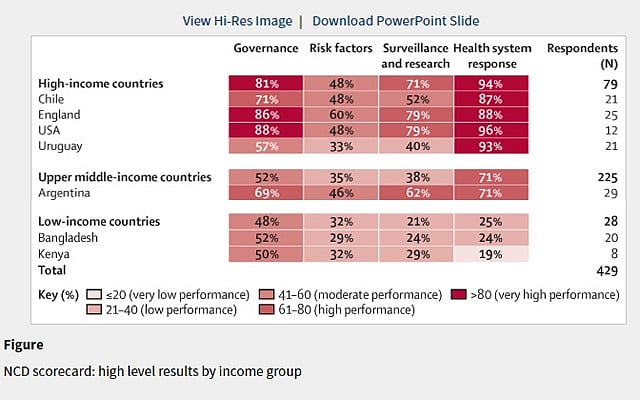
British medical journal The Lancet published the findings of the new scorecard on Friday, measuring the performance of 23 countries in reducing their burden of non-communicable diseases.
The scorecard shows that many countries including Bangladesh are yet to establish needed actions to reduce deaths and disability from non-communicable diseases such as heart disease, stroke, diabetes, cancer and chronic lung disease.
Grand South — a global network of 11 research centres including icddr,b — developed the scorecard as a tool to monitor and help improve the performance of countries with high non-communicable disease burden.
The scorecard was developed following a United Nations political declaration, after a high level meeting in 2011 that committed countries to take actions that would help prevent and control non-communicable diseases.
“Many actions are needed to reduce the burden of non-communicable diseases, and the scorecard will help countries identify the gaps to be filled,” says Sir George Alleyne, chair of the International Policy Advisory Group that advised GRAND South.
Non-communicable diseases are responsible for half of Bangladesh’s annual mortality and account for 61 percent of the country’s disease burden.
The scorecard identifies Bangladesh's low performance in reducing risk factors, conducting research and surveillance, and strengthening health systems in relation to non-communicable diseases.
Like Bangladesh, India and Pakistan also scored relatively low compared to other participating countries.
India scored better than Bangladesh and Pakistan in reducing risk factors.
The challenges Bangladesh now faces is about establishing a strong surveillance system for tracking burden and risks of each of the major NCD conditions among the target populations.
Other challenges include ensuring availability of key essential drugs for NCD in primary care health centres, and reducing risks by strengthening food policies on reduced salt intake, reduced consumption of high content sugar beverages, trans-fats and marketing of unhealthy foods addressed to children.
“The Scorecard has been quite useful for tracking actions of government’s progress in implementing its strategic plan for control and prevention of NCDs in Bangladesh,” Dr Aliya Naheed, an associate scientist of icddr,b’s Chronic Noncommunicable Diseases Unit says.
She said government should adopt the ‘NCD Scorecard’ for establishing a self-monitoring system to assess progress in various health sectors.
“The Scorecard reflects moderate progress in governance, but poor progress in health system response, assessment of NCD risk factors, and surveillance and research.”
She said strengthening the primary care strategy for early screening, diagnosis and treatment, along with financing and mobilising communities to lead a healthy lifestyle are crucial steps to halt the emergence of non-communicable diseases in Bangladesh.
There are more than 18,000 community clinics at rural level in Bangladesh, but the current health workforce is not adequately equipped for screening and treating NCDs at the community level.
Dr Naheed said the number of trained personnel at the secondary and tertiary care services was “not sufficient for systematic risk assessment, diagnosis, and treatment of NCD”.