Published : 28 Sep 2021, 11:08 AM
Updated : 08 Apr 2022, 01:14 PM


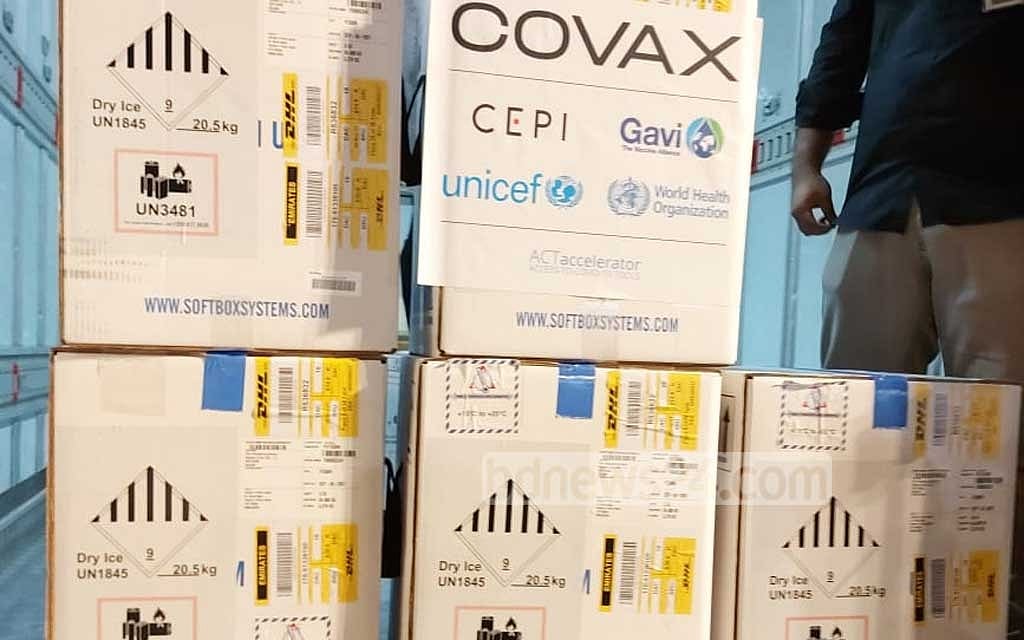
The vaccine consignment arrived at Hazrat Shahjalal International Airport from the US on Tuesday.
“The vaccine doses came on a Maldivian Airlines flight from Florida through Munich in Germany. Officials from the health ministry, DGHS, CSMD and the airport have received them,” said Md Maidul Islam Pradhan, senior information officer at the Ministry of Health and Family Welfare.
Bangladesh has received the doses under the COVAX initiative, he said.
A total of 3.6 million Pfizer vaccine doses have arrived in Bangladesh so far. The first consignment of 100,620 doses arrived on May 31 and another shipment of 1 million came on Sept 1.
STORAGE CAPACITY FOR PFIZER VACCINE INCREASED
The Pfizer vaccine must be stored between -90 degrees Celsius and -60 degrees Celsius.
The vaccine needs an ultra-cold freezer for storage and thermal shipping containers or ultra-freezer vans to transport it.
It can also be refrigerated at 2 degrees Celsius to 5 degrees Celsius for five days. At 30 degrees Celsius, the vaccine can be used for up to two hours.
Due to the storage-related complexities of the Pfizer vaccine, Bangladesh had requested last June that COVAX provide coronavirus vaccines that are ‘easy to store and transport’ in the local weather.
“We told COVAX that it would be unmanageable for us due to the local weather. We told them not to give us something that we can’t store. We need a large amount to maintain the cold storage supply chain. Who’ll provide that money?” Prof ABM Khurshid Alam, director general of the Directorate General of Health Services said on Jun 10.
But recently the DGHS’s capacity to store vaccine doses has increased with the purchase of 29 new freezers and locating 21 more in different places including Bangladesh Agricultural University, said Prof Alam.
“We didn’t know that the Agricultural University and other agricultural institutes are capable of storing vaccines. They use such freezers to store seeds. Now we have around 21 locations that can help us to store vaccines and also, we’re purchasing 29 freezers. We’ll get them in November and can store more Pfizer vaccines.”
Bangladesh can store up to 7 million doses of Pfizer vaccine, said Prof Meerjady Sabrina Flora, additional director general in DGHS.
NEW HIGH-CAPACITY FREEZERS
Twenty-six ultra-low temperature freezers delivered by UNICEF through COVAX in August are enabling Bangladesh to receive, store and distribute large quantities of COVID-19 vaccines that require ultra-cold storage.
Each of the 26 freezers can hold over 300,000 doses of COVID-19 vaccines, supporting administration of these vaccines into districts beyond Dhaka. Tuesday’s COVAX shipment of 2.5 million US-donated doses of Pfizer is made possible thanks to this additional ultra-cold chain capacity, UNICEF said in an emailed statement.
“As more countries come forward through COVAX to ensure equitable access to the vaccines, increasing the ultra-cold chain capacity in receiving countries is of crucial importance,” said Tomoo Hozumi, UNICEF representative in Bangladesh. “UNICEF, as an implementing partner of COVAX, will continue to support Bangladesh until the end of the pandemic. No one is safe until everyone is safe,” he added.
The delivery of 26 ultra-low temperature freezers to Bangladesh is part of UNICEF’s global target of delivering 350 ultra-low temperature freezers to more than 45 countries on behalf of COVAX.
As of today, only 9 percent of the population in Bangladesh has been fully vaccinated. COVAX aims to ensure equitable access to vaccines and supplies, particularly to low and middle-income countries.
“WHO highly appreciates COVAX for extending its support to the Government of Bangladesh,” said Dr Bardan Jung Rana, WHO country representative. “Ensuring global access to COVID-19 vaccines offers the best hope to slow down the pandemic, save lives and secure the world economic recovery. Each of these freezers will play a key role in improving the country’s ultra-low cold chain vaccine storage capacity,” he added.