


Published : 04 Jul 2019, 01:59 AM
Updated : 08 Apr 2022, 02:15 PM


Sujan R Chinoy, director-general of the Institute for Defence Studies and Analyses (IDSA), says one thing is clear – “a multipolar Asia is in everyone’s interest”.
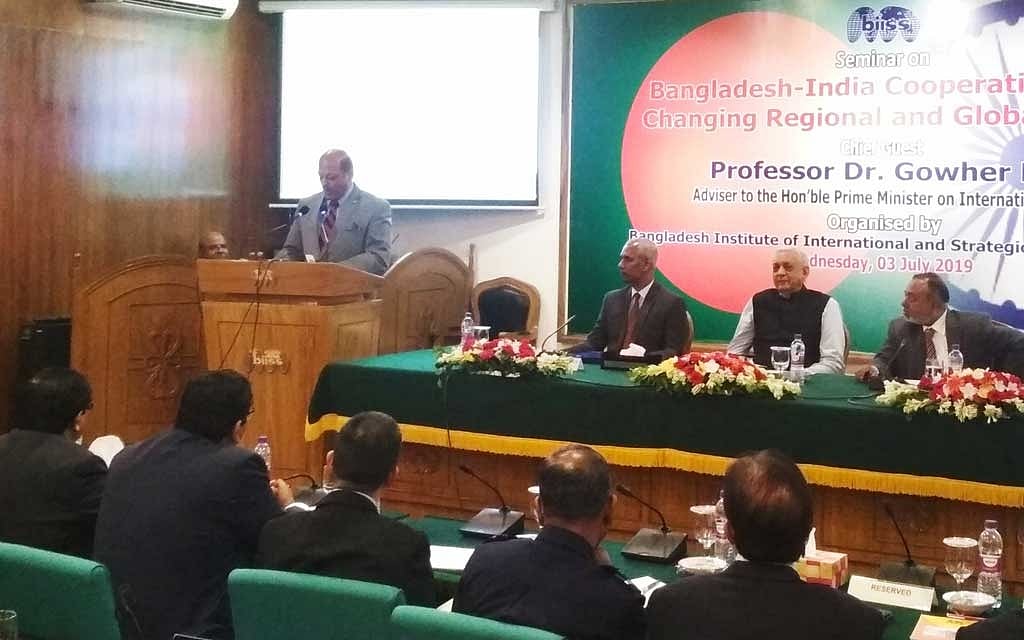
A career diplomat of the Indian Foreign Service from 1981-2018, Ambassador Chinoy spoke in Dhaka on Wednesday on the India-Bangladesh relations in the changing global and regional context.
The government think-tank, the Bangladesh Institute of International and Strategic Studies or BIISS, and the IDSA jointly hosted the seminar with Prime Minister’s International Affairs Advisor Gowher Rizvi as chief guest.
Rizvi said India is at the centre of Bangladesh’s foreign policy and there is no debate or question about that. “But we also have other neighbours to take into account. We can’t ignore them. That’s why we’ve opened our trade and economic relations with China.”
The theme of the seminar “Bangladesh-India Cooperation in the Changing Regional and Global Context” has been picked at a time when key drivers of globalisation such as the liberal trading order and the flow of goods, services, capital and technology are being reassessed.
“Protectionism has reared its head. Easy developmental finance comes with conditions. Anti-migrant sentiments thwart the free movement of human talent,” Chinoy said.
“Technology, that vital pillar of progress, is open to misuse and the world seems on the brink of an intense battle for technological superiority in the age of artificial intelligence and quantum physics.
“What is more, power is fractured. States and non-state actors have acquired the means and the skills-set to overcome asymmetry.”
He said no single country is capable of enforcing its writ on all issues at all times. “Hedging and multi-alignment are part of every country’s toolkit.”
Chinoy said the Asian Century appears “inevitable”, but what kind of a century it will be remains “unclear”.
“Will it be a century of peace and development, as it really should be for all of us, or will it involve long drawn contestations and wars?
“I pose this question because we live in interesting times, when the reigning hegemon that is the United States of America, and the aspiring hegemon that is the People’s Republic of China, both question the very global order that have made them what they are,” the IDSA chief said.
“This is markedly different from the balance of power during the Cold War, or the brief interregnum of unipolarity during the 1990s after the collapse of the Soviet Union.
“Relations between the US and China are complex. No two rival powers have been so interlinked by trade and investment ties as they are.
“Never before have all others been so intertwined in a web of relations as we all are today in a globalised world. This makes for very difficult choices,” he said.
“Yet, amidst all these challenges, we must continue to strive for peace and progress. There are multiple opportunities for India and Bangladesh to work together on the basis of our national interests”.
“Bangladesh’s on-going modernisation blends in with India’s rapid economic transformation”.
Today, Bangladesh is the biggest developmental partner of India. India has extended extended 3 Lines of Credit totalling $8 billion to Bangladesh in the last 8 years.
“Our development partnership remains anchored in the principles of equality, mutual respect and mutual benefit with demand being driven by Bangladesh’s priorities.
“There is much that we can do together, particularly in tandem with Japan, which epitomises the highest standards in technology and transparent project execution,” he said.
“Today, Bangladesh is the most important neighbour of India. Ties with Dhaka are a key pillar of India’s security with parts of India being ‘Bangladesh locked’, and Bangladesh being a bridge to North-East India and the broader South-East Asian region.
“Bangladesh is a key player in the fulfilment of India’s Act East Policy. Arguably, our ties have evolved into a role model for other bilateral relations in South Asia,” Chinoy added.













