


Published : 07 Apr 2019, 06:34 PM
Updated : 08 Apr 2022, 02:06 PM


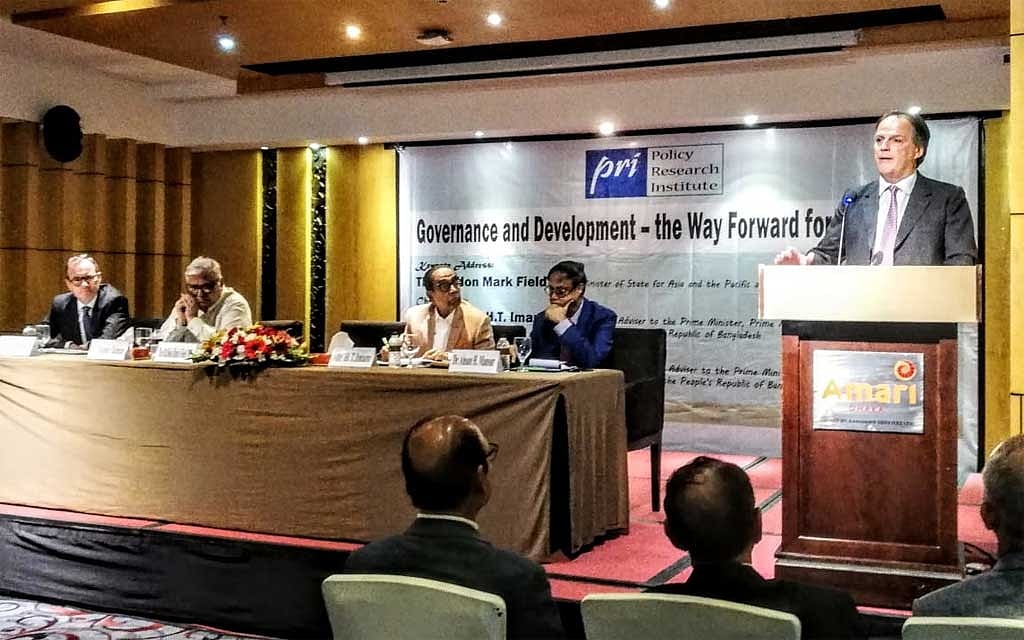
Addressing a seminar organised by the Policy Research Organisation (PRI) as the keynote speaker, the minister said, the relations with Bangladesh will be built on “strong historic, commercial, and cultural links.”
“There are few places in the world where the links are stronger than here in South Asia, thanks to the thousands of personal connections between us,” he said, speaking on UK-Bangladesh relations with a focus on governance and development in Dhaka.
“There are now some 600,000 British citizens of Bangladeshi heritage, many of them in my own constituency in London. We greatly value their contribution to all walks of British life,” he said.
Prime Minister’s political affairs adviser HT Imam and economic affairs adviser Mashiur Rahman were also present at the event moderated by PRI executive director Ahsan H Mansur.
The British minister spoke on the prevailing situations in the UK and Bangladesh, the relations between the two countries, its shared future, democracy as well as elections and education in his keynote.
In a brief exchange with the media before the speech, Field said that he is confident that the businesses will continue to operate as usual after Brexit.
This is his third visit to Bangladesh as the minister for Asia.
“It’s a level of engagement that clearly demonstrates the UK’s strong commitment to our relationship with Bangladesh,” he said in his written keynote, adding that the bonds of history and kinship between the countries “make our relationship particularly strong and deep”.
“As a long-standing friend, the UK welcomes the great strides that Bangladesh has made over the last half century, and recognises the great potential it has to achieve still more in the next,” he said, adding that the “UK stands ready to help Bangladesh achieve that potential, in whatever way we can”.
“And as a close friend I can speak frankly and say that what we want to see is a confident Bangladesh, with strong, transparent and accountable democratic institutions."
However, Field raised questions over the last parliamentary elections which the Awami League won by a landslide.
He said, “We want to see lively debate, a vibrant civil society, and competitive elections. And we want to see this flourishing democratic landscape carefully scrutinised and held to account by a free and vibrant media.”
“Again, as a friend of Bangladesh it gives me no pleasure to say this, but I fear the Parliamentary elections which took place here in December did not meet this standard – as I said at the time.”
The minister continued: “I also pressed for a full, credible and transparent resolution of all complaints. I think we all recognise that the notion of choice is crucial in any healthy democracy. Without it, there is a risk that voters might seek other ways of achieving the changes they want.”
“Ultimately, that could pose a much greater threat to stability than allowing them to express their views through democratic channels.
“That is why it is so important to have a political opposition in place, one that is able and willing to hold the Government to account and offer an alternate view.
“And it is also why it is so vital to allow space for a vibrant civil society, through which the people – and especially young people – can channel their energies, and indeed their frustrations, within the law.
“That means upholding Bangladesh’s fine tradition of allowing people to voice dissent and express themselves freely.
“It also means allowing the media to do its job of holding the powerful to account, which as we all know is so crucial in upholding the transparency and credibility of our institutions, and bearing down on corruption,” he said.
“This really matters, because the strength and accountability of our institutions, and the confidence that they inspire in investors, are also crucial to our democracies – and to our economies”.
Diversity is a common trait in both countries, said Field, adding that in both Bangladesh and the UK, people of different backgrounds – Muslims and non-Muslims - live side by side.
“In our increasingly divided world, we must continue to promote this model of co-existence and inclusion,” he said, adding that the latest attacks in Christchurch mosques were “yet another tragic reminder of the dangers of hatred and extremism”.
Prime Minister’s adviser HT Imam said he took the British minister’s comment on elections as “friendly”.
“We tried as much as you like to have it completely free, fair, and also transparent and acceptable by universal standards,” he said on the December 30 elections in which the ruling Awami League claimed an overwhelming majority.
Imam, however, said that it had been “very difficult” to hold the elections. “Some of us have been very critical of the Election Commission. But the work the EC has done really it has been very very tough,” he said.
He said the current government maintains strong relations both “officially and unofficially” with the British parliament and both the conservative and liberal parties.
“Our major challenge is providing good governance and also maintain steady and speedy growth for developments. We have twin goals,” he said.
He said good governance is not just maintain law and order, its also controlling the militants and also adhering the policy of ‘zero tolerance’ against militancy, and drugs.
“What we have been trying to is to provide better life to common people,” he said highlighting the pre-election manifesto of the ruling Awami League.
He also handed over a copy of the manifesto to the minister.
Adviser Mashiur Rahman said that Bangladesh faces a a choice between two extremes - a democratic secular government and political system and a Sharia-based Jihadi force.
“We got the better,” he said, on the Awami League’s election victory.
The British minister arrived in Dhaka on Thursday night “to discuss higher education”, according to the High Commission in Dhaka.
In his keynote he said he would be discussing with his counterparts on this visit is “the possibility of opening the local education market to greater competition”.
“I am sure that this will be a win-win for Bangladesh – good for your talented young people, and good for the country”.
He, however, said both countries can achieve their ambitions, “if we stay true to our democratic values.”
Some have suggested that the lengthy process of Brexit means “democracy has somehow failed”.
“As an elected parliamentarian, I can confidently say that the opposite is true: it is democracy in action - with all its imperfections,” he said with a hope that Bangladesh will remain a “true democratic values” as it graduates to middle income status.













