Published : 06 May 2026, 04:54 PM
Updated : 28 Aug 2026, 01:34 AM


Farmers in Korchar Haor have experienced starkly different outcomes this season, with geography and crop variety determining the scale of their losses.
The Haor, stretching across Sunamganj Sadar and Bishwambarpur Upazilas, contains 4,515 hectares of arable land, most of which was cultivated this year.
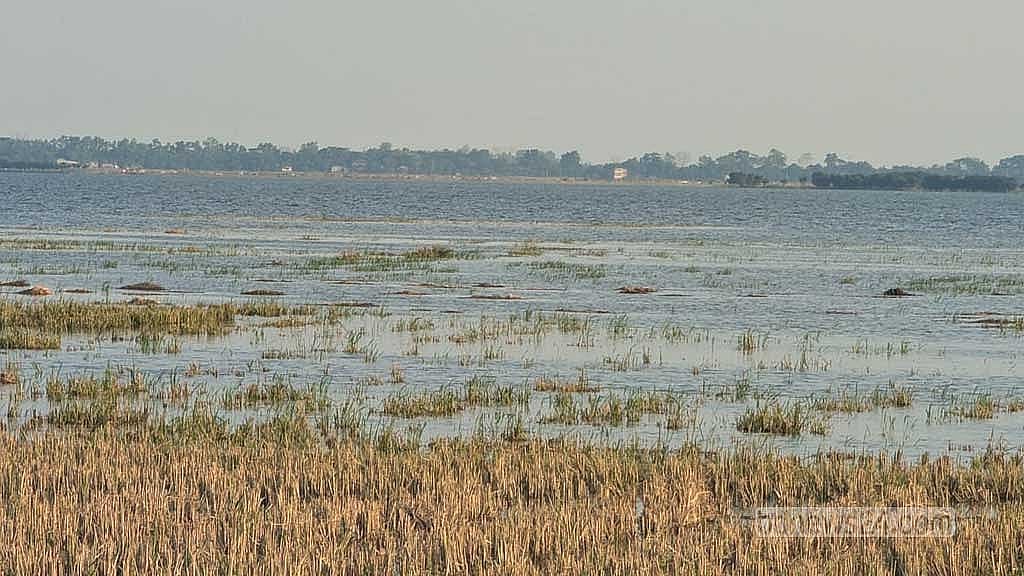
While waterlogging has hit the entire district, farmers in the northern reach of Korchar Haor have escaped with minimal damage.
Conversely, those in the deeper southern parts are facing heavier losses.
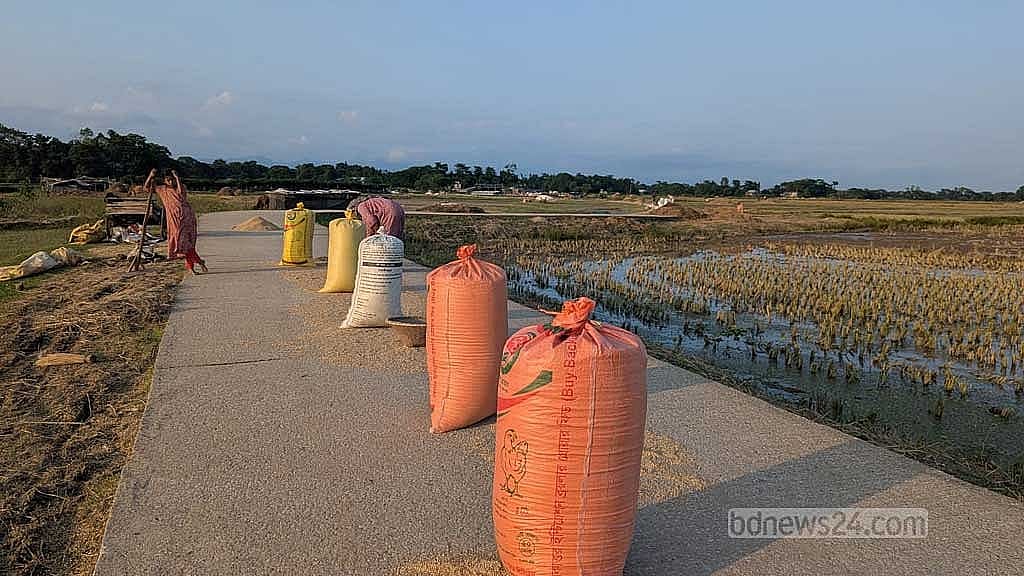
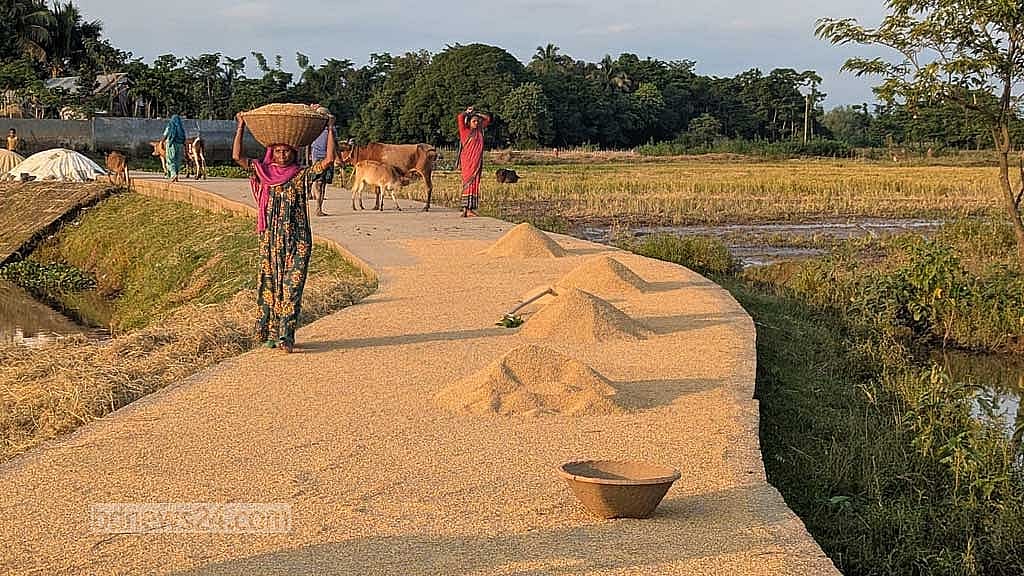
On Monday afternoon, growers in Muktikhola and Bishwambarpur were seen rushing to dry their grain on submersible roads and threshing floors during brief windows of sunlight.
Many families, including women and children, were also engaged in drying grain in open Haor spaces.
Local growers said the main damage occurred after harvesting, when continuous rain since Apr 26 prevented proper drying of paddy, leading to germination and rotting of grains.
Fodder stored for livestock also deteriorated in the wet conditions
Farmers in the northeastern section fared better as they opted for early-maturing varieties like BR-96 and BR-86.
Having planted their crops at least 15 days ahead of others, they managed to complete their harvest by late March or early April.
Despite higher maintenance costs, they secured yields of 15-20 maunds per kiyar (30 decimals).
They say early planting -- around 15 days ahead of others -- helped them cut much of the crop before peak waterlogging.
Some lower plots were affected later, but losses remained limited.
A contrasting picture emerges in the northwest. Farmers in Noagaon, Harinagar and Nallua say more than half their fields went under water.
Paddy cut during this period has rotted and sprouted due to rain. They blame deeper terrain and delayed ripening for the damage.
Muktikhola village farmer Abdul Mannan said, “I cultivated BR-96 rice on six kiyar (about 1.8 hectares / 4.5 acres). I harvested it at the end of Chaitra. I faced no major problems. Some fodder was damaged.
“The yield was around 15–20 maunds per kiyar (30 decimals). Cultivation costs were slightly higher.”
Similarly, Abdus Jahur, seen drying grain on a road, noted that his early harvest saved his crop and straw from the ruin that later harvesters faced.
Abdul Mukit, who grew the hybrid “Jhalak” variety, shared a mixed experience.
While his early plots yielded 18 maunds per kiyar, the grain he cut three or four days ago has started to sprout.
He observed that unlike local varieties, hybrid grains begin to germinate within a single day of getting wet.

In the southwest, the mood is sombre. Abdur Rahman of Noagaon said four to five kiyars of his land went under water, and the portion he harvested during the rain has since rotted.
He lamented that while the northern crops were successful, his deeper fields were "beaten" by the elements.
Shaukat Ali, chairman of Gourarang Union Parishad, echoed these concerns, noting that seven or eight villages in his jurisdiction saw about 11–12 decimals of their fields submerged by Apr 27.
He argued that the late-ripening crops in these low-lying areas left farmers vulnerable, and urgent rehabilitation is now required.
Mohammad Omar Faruk, deputy director of the Department of Agricultural Extension in Sunamganj, said early-maturing BR-96 helped northern farmers avoid major losses, while late varieties like BR-28 and BR-29 left many exposed to waterlogging.
Official data show that as of Tuesday, 80.163 percent of Haor paddy has been harvested in the district, while the overall rate across Haor and non-Haor areas stands at 69.487 percent.
This season, Boro rice was cultivated on 165,000 hectares in Haor areas and 58,236 hectares in non-Haor areas.
Harvesting has been completed on 132,489 hectares in Haor regions and 22,822 hectares outside the Haor belt.
Overall crop loss is estimated at 20,160 hectares.