Published : 16 Mar 2026, 05:28 AM
Updated : 21 Aug 2026, 03:28 PM


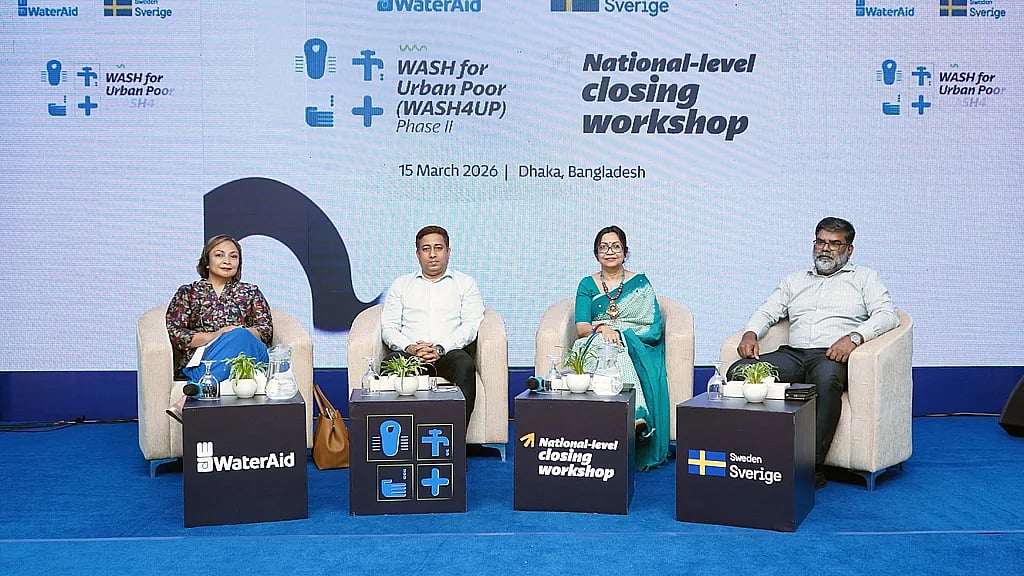
WaterAid Bangladesh has held a national workshop in Dhaka to review the achievements and lessons from its WASH for Urban Poor (WASH4UP) Phase II project, implemented between April 2023 and March 2026.
The event, organised with support from the Embassy of Sweden in Dhaka on Sunday, brought together policymakers, government officials, development partners, academics and representatives from NGOs and INGOs.
The initiative focused on providing inclusive and climate-resilient water, sanitation, and hygiene (WASH) services to informal settlements across Dhaka, Chattogram, Khulna, and several municipalities, the WaterAid said in a media statement on Sunday.
Around 120 participants attended the workshop, where baseline and endline results of the project were presented along with discussions on sustaining and scaling such initiatives.
Speaking as the chief guest, Mohammad Saiful Islam Mazomder, joint secretary of the Local Government Division, said the lessons learnt from the project would be integrated into national policy.
"Many important issues have emerged... necessary steps will be taken to support their implementation," he said.
Nayoka Martinez-Bäckström, first secretary (environment and climate) and deputy head of development cooperation at the Swedish embassy, emphasised that their relationship with WaterAid spans nearly 20 years. "WASH as a sector does not stand in isolation. A number of factors are connected and play a role in ensuring that the sector functions well," she remarked.
Mamun-Ul-Hasan, chief social welfare and slum development officer at Dhaka North City Corporation, emphasised the importance of maintaining infrastructure and ensuring services for city residents, expressing hope that WaterAid’s work would continue to expand.
The workshop was chaired by Hasin Jahan, country director of WaterAid Bangladesh, who also delivered the vote of thanks.
She said the organisation’s work had inspired the Directorate of Education to undertake initiatives with its own funding to promote improved WASH behaviour among school students.
Hasin also stressed the need for coordinated research involving the Department of Public Health Engineering, Dhaka Water Supply and Sewerage Authority, city corporations and private institutions to strengthen evidence-based decision-making.
The programme featured welcome remarks by Azman Ahmed Chowdhury, director of business development and quality assurance at WaterAid Bangladesh, a presentation on the project by Partha Hefaz Shaikh, director of programme and policy advocacy, and an open discussion moderated by Fayazuddin Ahmad, policy and advocacy lead at the organisation.
According to the organisers, the WASH4UP Phase II project addressed disparities in urban water and sanitation services affecting residents of slums and informal settlements, who often face waterborne diseases, poor sanitation and environmental hazards such as waterlogging and flooding.
Project results show that about 50,000 people gained access to safe water, while 46,000 obtained improved sanitation facilities. Another 90,000 people were encouraged to adopt better hygiene practices.
The project also enabled 18,000 people to access improved health services and provided safely managed sanitation services to around 15,000 people through faecal sludge treatment plants.
Additionally, 16,500 people received door-to-door solid waste management support, while public sanitation facilities under the project recorded around 9.5 million uses by commuters.
WaterAid is an international non-profit organisation working to ensure access to clean water, decent toilets and good hygiene worldwide, which it considers fundamental human rights.