Published : 21 Aug 2026, 07:12 AM
Updated : 08 Sep 2026, 09:34 AM


A waste facility is rising inside Bhawal National Park, one of Gazipur’s protected sal forests, despite objections from forest officials and environmentalists and a High Court order to halt construction.
For years, rubbish piled up beside the Dhaka-Mymensingh highway along the edge of the forest. Gazipur City Corporation’s answer was to move the waste away from the roadside by building a secondary transfer station (STS) inside the park.
But the solution has created a new environmental and legal concern: the facility is being built within the national park’s boundary, in what forest officials describe as its “core zone”, where waste dumps and commercial structures are prohibited.
Part of the park’s boundary wall has been broken to create an entrance, and construction has continued despite objections and the court order. A new electricity connection has now been added to the site, raising fresh concerns among environmentalists and forest officials.
The project covers three plots, two government-owned and one privately held. The city corporation says the facility is being built on the privately owned plot, while forest officials say its location within the national park does not make the construction permissible.
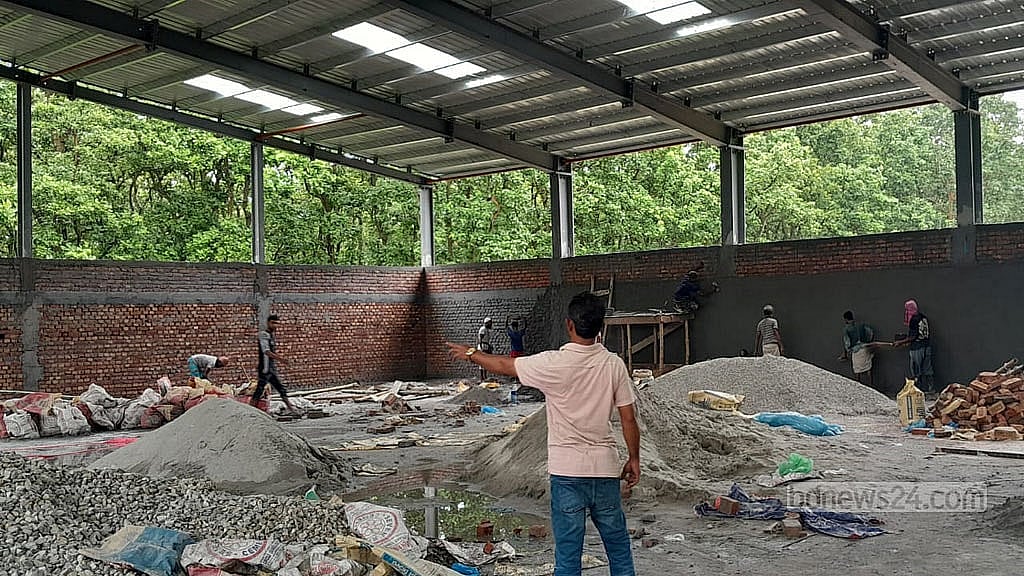
A visit to the site this week found construction moving rapidly, with workers aiming to complete the project by the Aug 4 deadline.
Engineer Md Manjur Alam of Dhaka Dock Yard said Delma Structure Builders was carrying out the work as a subcontractor for Dock Yard.
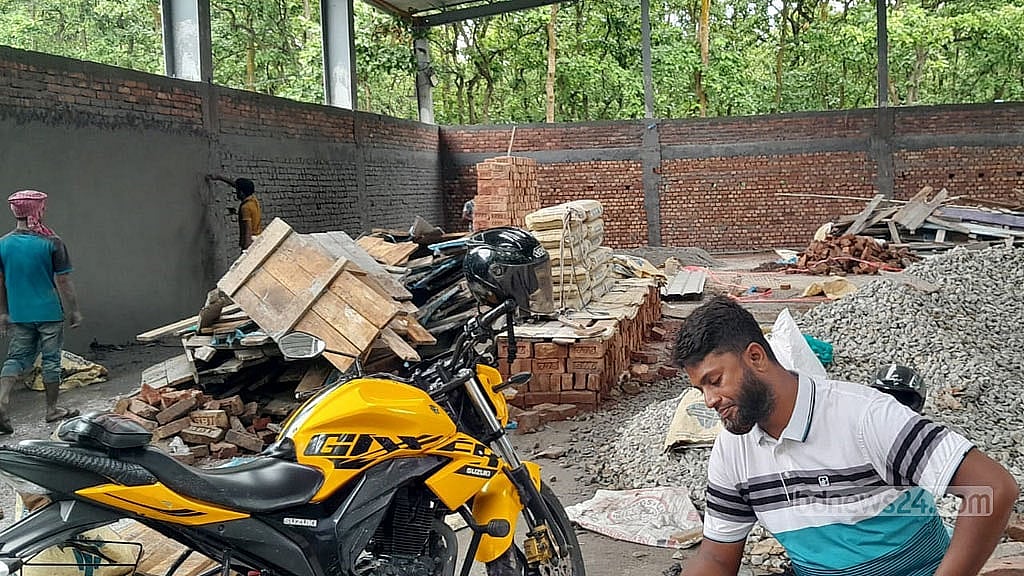
Delma owner Md Sohel Sad said construction was nearly complete despite what he described as difficulties and security concerns.
“We are working amid various obstacles and insecurity,” he said. “Construction of this roughly 7,500-square-foot waste facility is almost complete.”
He said materials had been stolen several times from the site, including reinforcing rods, 100ft of holder cable, three coils of electrical wire, five tonnes of rods and a welding machine.
“Even then, we hope to finish within the deadline.”
Waste had long accumulated at this part of Bhawal National Park.
Gazipur City Corporation initiated the project so rubbish would no longer pile up beside the highway but could instead be taken to the transfer station.
That may reduce waste along the roadside, but forest officials and environmentalists fear it will shift the environmental burden deeper into the sal forest.
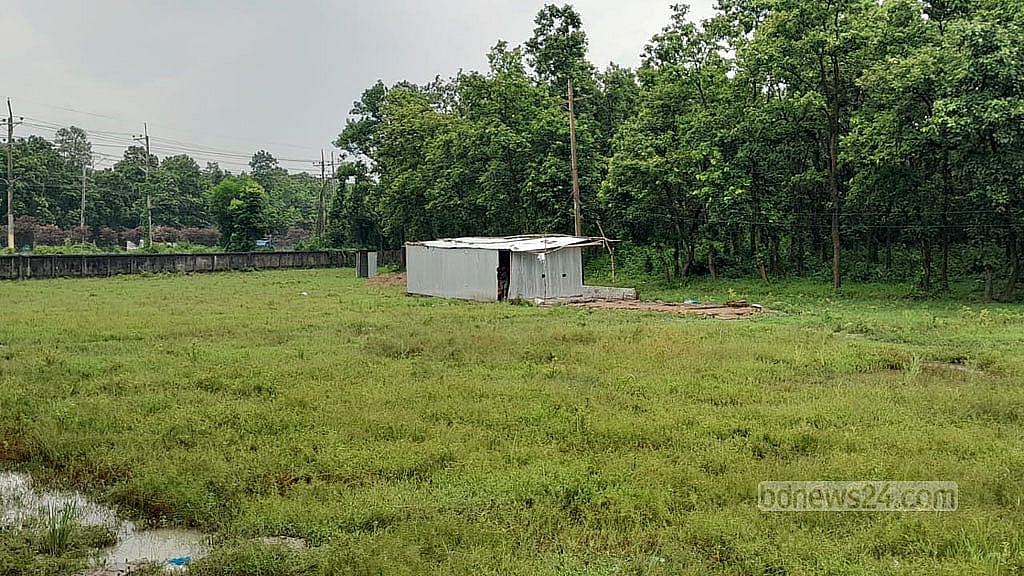
Part of the national park boundary wall has already been broken to create an entrance.
Through it stands a large structure under construction -- the city corporation’s waste transfer station.
Beside it hangs a sign promoting the government’s programme to plant 250 million trees, part of a broader effort to protect the environment.
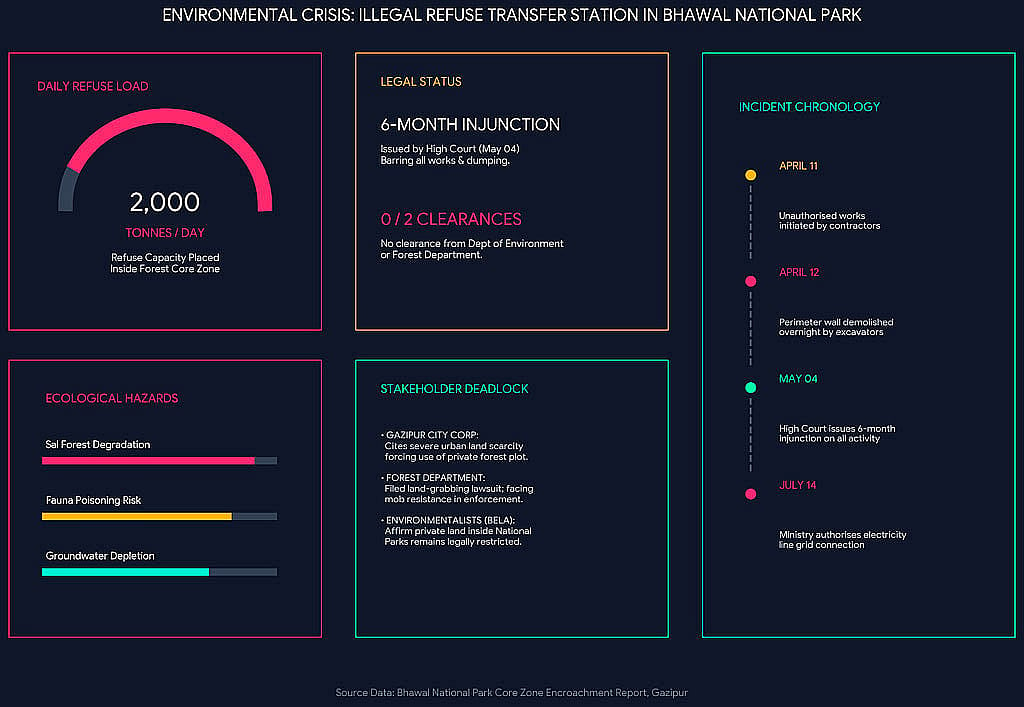
A worker at the site said construction was expected to finish within the week and that the facility would be capable of holding about 2,000 tonnes of waste at a time.
No Sign of Approval
Bhawal National Park Beat Officer Ashanur Tuhin said forest officials had opposed the project from the beginning.
But, he alleged, the city corporation had pushed ahead “by force” with the backing of influential people.
The waste station is being built within the national park’s “core zone”, where waste dumps and commercial structures are prohibited under forest laws.
In early May, the Bangladesh Environmental Lawyers Association (BELA) filed a writ petition with the High Court.
The petition argued that building an STS and dumping waste inside protected forest land violated the Forest Act 1927 and the Wildlife (Conservation and Security) Act 2026.
On May 4, the High Court ordered all construction inside the park to stop.
It also directed Gazipur City Corporation to refrain from dumping waste around Bhawal for six months.
Construction stopped for a time after the order, but later resumed.
Tuhin said, “The city corporation later used its authority to obtain an electricity connection for the project as well.
“We objected when construction began, but they did not listen. I later filed an encroachment case on behalf of the Forest Department under the law.”
He said a report was also sent to the Ministry of Environment and Forests, which in turn informed the local government ministry.
“But we received no instruction from there,” he said.
Tuhin acknowledged complications because part of the land is privately owned.
“We generally do not work much outside reserved forest land, so we have some limitations.
“Although construction is prohibited within the core zone, the law is not entirely explicit about certain structures on privately owned land.”
He said the Department of Environment nevertheless had jurisdiction because waste dumping falls into the “yellow category” of activities requiring environmental clearance.
“They have been informed. They also visited the site, but it is unclear what effective action they have actually taken.”
Objections Ignored
The project faced Forest Department objections from the outset.
When workers employed by the city corporation’s contractor began work on Apr 11, the range officer asked them to produce approval documents.
They could not do so, forest officials say, but work continued.
One Forest Department official said an excavator was used the following night to break part of the park boundary wall and create a road into the site.
“When we tried to stop the construction, a mob was created,” the official said.
“Politically influential people gathered at the site, leaving forest officials helpless.”
According to the Forest Department, Gazipur City Corporation obtained no clearance from either the department or the Department of Environment for the project.
On Apr 16 and Apr 20, the divisional forest officer sent written complaints to the relevant offices, stating explicitly that such construction inside reserved forest land was a punishable offence.
Forest officials said they also spoke to the city corporation administrator and chief executive officer and asked them to halt the work.
They refused, according to the officials.
The city corporation argues that the structure is being built on privately owned land.
Forest specialists counter that the plot lies within the national park boundary and that government policy has for years allowed only agricultural use there.
Private ownership, they say, does not automatically permit construction of a waste facility.
BELA Chief Executive and former advisor Syeda Rizwana Hasan told journalists that although the land was privately owned, its use was regulated by law.
There was no legal basis for building a waste centre inside a national park, she said.
“The law can be a tool, but common sense is most important,” she said.
“The bigger question is how anyone could think of building a waste station inside the boundary of a national park.”
Gazipur City Corporation Chief Executive Officer Tanjila Khanam said suitable land was difficult to find.
“The city needs several STSs for waste management, but because of the shortage of land we are not finding alternatives,” she said.
Fuelling Concerns
As construction of the waste station continued, a decision by the Ministry of Environment, Forest and Climate Change sparked fresh controversy.
In a letter dated Jul 14, the ministry’s Forest Branch-1 conditionally approved the installation of a temporary electricity line across about 0.026 hectares of forest land to provide power to a waste treatment plant built by Sreepur Municipality.
The decision has heightened concern among environmentalists.
They say that while waste facilities are already being built in forest areas, extending electricity infrastructure through the forest could place further pressure on an ecosystem already struggling to survive.
MKM Iqbal Hossain Chowdhury, divisional forest officer of the Wildlife Management and Nature Conservation Division, said Gazipur City Corporation had never obtained Forest Department approval for the waste station.
“They broke the national park boundary wall, and we removed the first shed they built,” he said.
“We had to fight hard over this.”
When forest staff tried to stop the construction, Chowdhury alleged, groups gathered and created a threatening situation.
“We sent reports to the relevant authorities. When construction began, we asked for the documents, but they could not show us any.”
Chowdhury said the city corporation was effectively pressing ahead “by force”.
“We can no longer go there. Whenever we do, an aggressive situation develops.
“But the people of Gazipur will eventually have to suffer the environmental consequences.”
The divisional forest officer warned that regular dumping of different types of waste could severely damage both the forest environment and air quality.
Wild animals could become sick from eating the waste, increasing the risk of death, while the entire ecosystem could undergo permanent changes, he said.
He also warned that deep tube wells could lower groundwater levels and threaten the natural growth and survival of the sal forest.
“Even so, we have done everything we can to protect the environment here.”
Akter Mahmud, professor of urban and regional planning at Jahangirnagar University, said a planned and science-based alternative for waste management had to be found.
“Otherwise,” he said, “forest land such as Bhawal will gradually disappear.”