Published : 18 Sep 2026, 01:59 AM
Updated : 18 Sep 2026, 01:59 AM


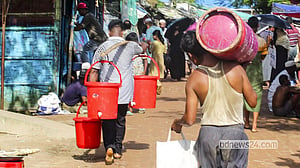
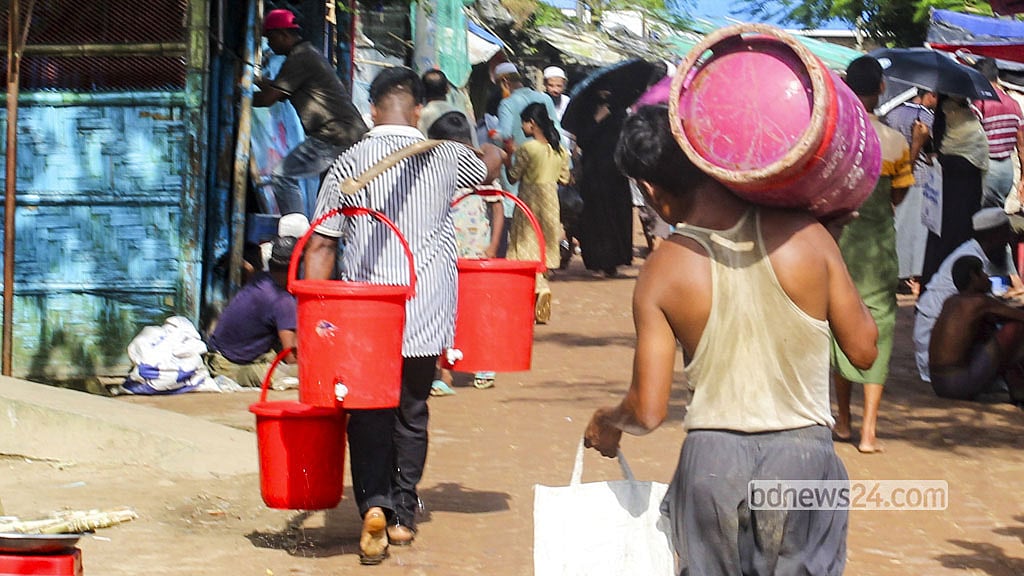
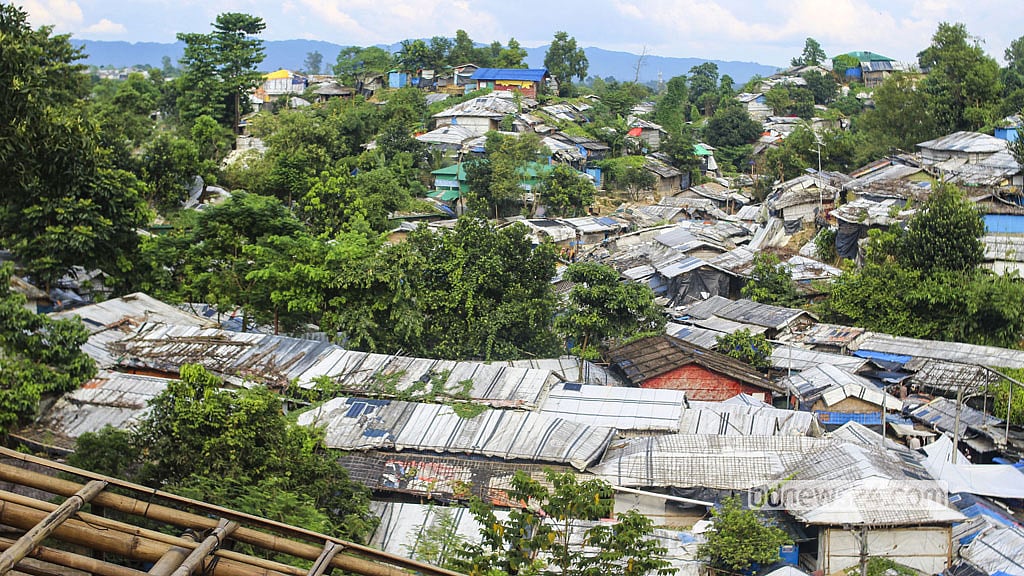
For the 25,000 Rohingya refugees living in Camp 22 in Cox’s Bazar’s Teknaf, access to clean water is a daily struggle.
Syed Amin, who fled Myanmar in 2017 and lives with his family of seven in a small shelter near the hills, says water is his biggest concern despite receiving humanitarian assistance.
During the rainy season, his family receives up to 20 litres per person a day. That water has to cover cooking, bathing and sanitation, leaving them to ration every drop.
In the dry season, supplies fall to between five and 15 litres per person.
"When we cook, we cannot bathe; and if we bathe, we cannot cook.
“Most of the time, we simply cannot bathe at all," he told bdnews24.com.
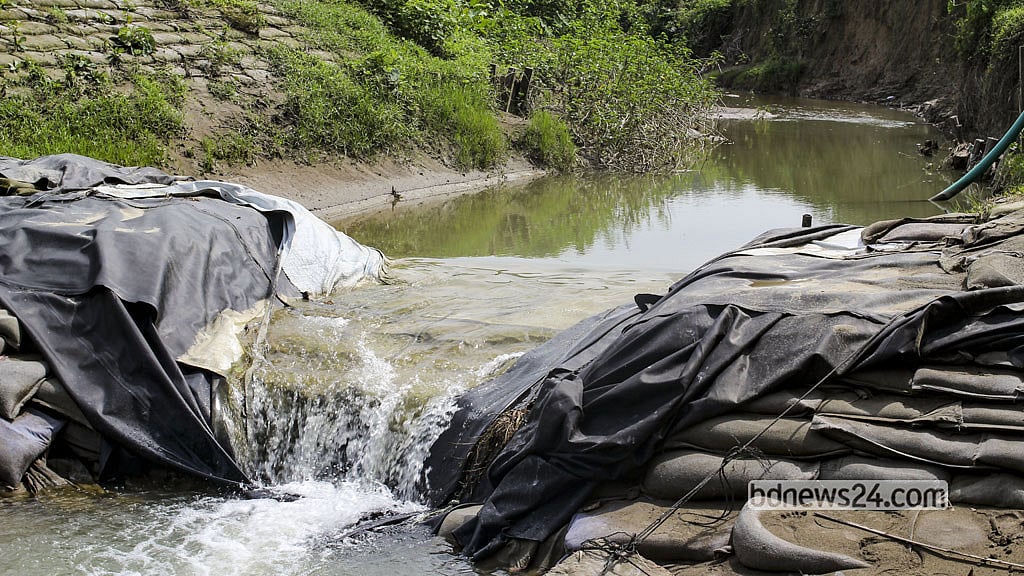
For the nearly 25,000 Rohingya refugees in Camp 22, every drop of this strictly rationed water originates from a nearby natural stream. As the dry season takes hold, even that channel runs dry, forcing engineers to divert water from a mountain stream nearly 5km away.
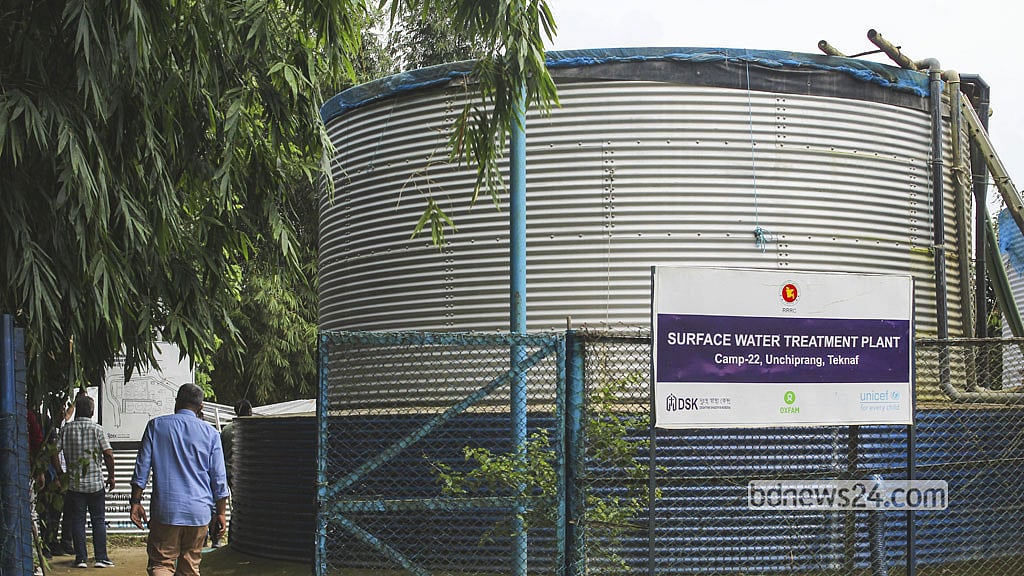
The water travels through a single surface water treatment plant before reaching Rohingya homes, enabling residents to meet only their most rudimentary needs.
A Daily Scramble at the Tapstand
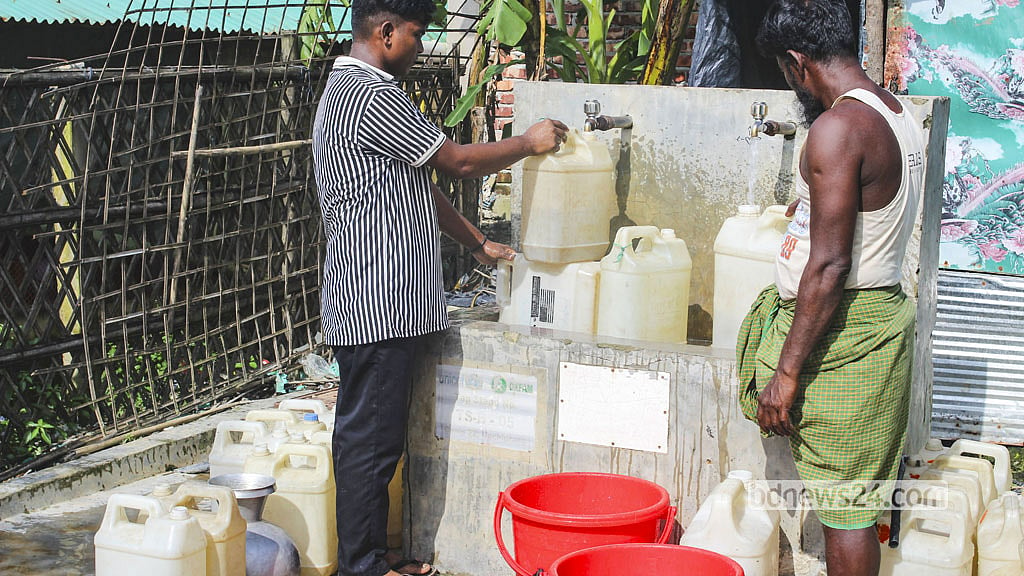
On Sep 9, Amin stood filling five-litre plastic bottles at a public tapstand near the Camp 22 market before hauling them up a steep, hilly track on a seven-to-eight-minute walk home.
Water is released twice daily, once in the morning and once in the afternoon. On that day, as the pumps roared to life at 2:40pm under the scorching late-summer sun, Amin worked alongside neighbours who had lined up with clay pots and plastic buckets.
A short distance away, 28-year-old Khaleda, who gave a single name, was collecting water at another tapstand with her young child.
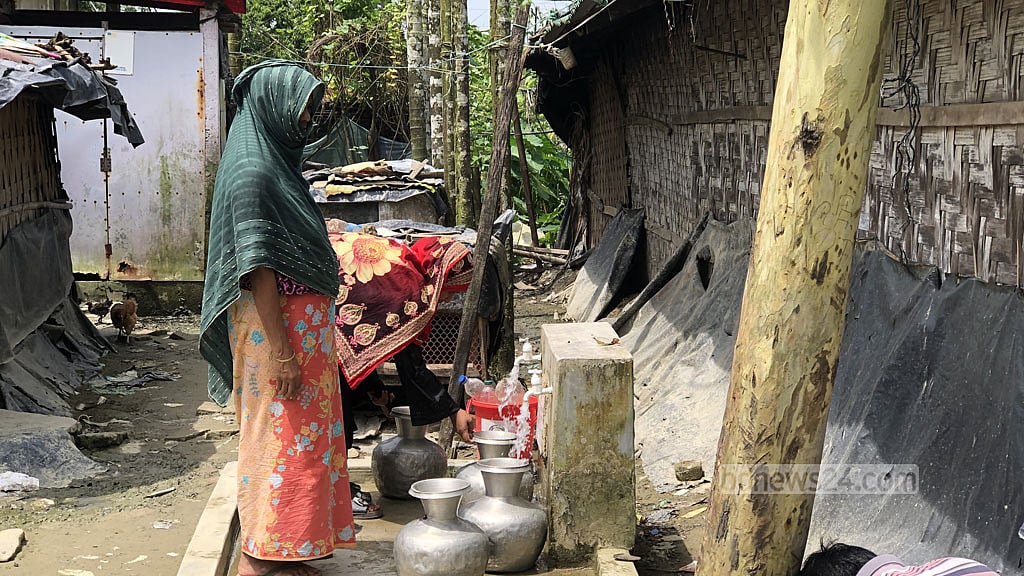
She explained that this single source must stretch to cover cooking, drinking, and hygiene for her family of six. When the supply drops drastically in the dry season, they are forced to make do with whatever small share they receive.
The entire Teknaf peninsula suffers from severe water scarcity due to its rocky geological formation, which prevents deep tubewells from reaching viable aquifers.
Non-governmental organisations working with refugees note that Rohingya families fleeing persecution in Myanmar have settled in Teknaf since the 1990s, historically getting by on shallow tubewells and open streams.
However, when hundreds of thousands of refugees crossed the border in 2017, the fragile network of shallow wells collapsed under the immense demand.
To address the brewing catastrophe, Oxfam constructed a surface water treatment plant at Camp 22 in February 2019 using funds from UNICEF.
The facility is operated by the local implementation partner Dushtha Shasthya Kendra (DSK).
Yet the intervention has not fully resolved the underlying deficit, according to Mizanur Rahman, Bangladesh’s refugee relief and repatriation commissioner (RRRC).
"There is a water shortage across the entire Ukhiya and Teknaf region, but in Teknaf, the crisis is exceptionally acute," he said.
"As Teknaf lacks sufficient groundwater due to its rocky terrain, we are forced to treat surface water for distribution.
“During the winter, the problem becomes so severe that we must resort to strict water rationing, sometimes supplying as little as five litres per person a day."
Mizanur warned that the situation is creating friction with host communities. Thousands of shallow tubewells sunk after the 2017 exodus rapidly depleted the remaining local aquifers.
"Local farmers in surrounding areas cannot access water for crop irrigation in winter," he noted.
"This is driving social tensions, as local residents and farmers bear the brunt of the depletion."
'No One Would Marry Their Daughters Into Our Village'
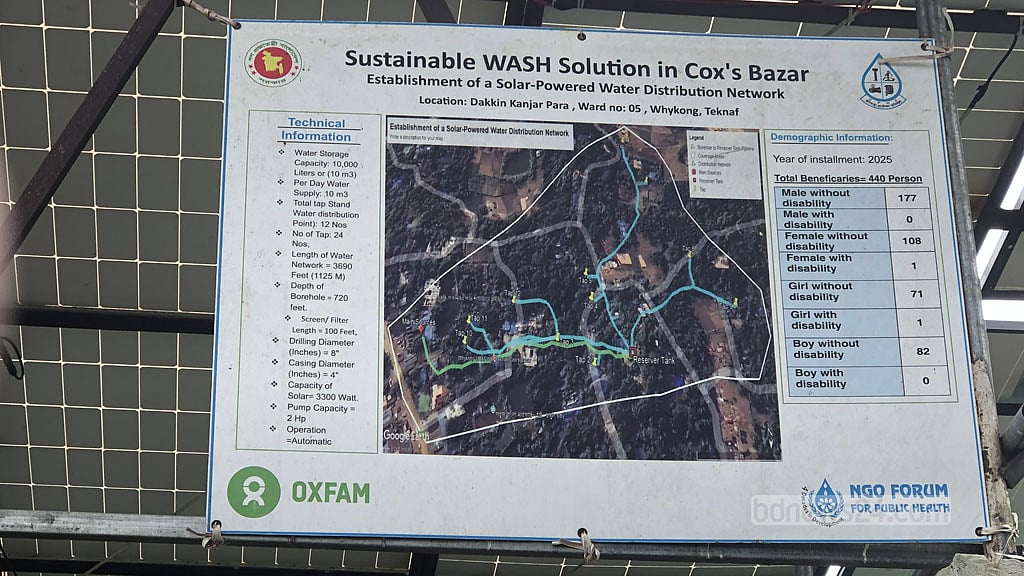
Three and a half kilometres from the Unchiprang refugee camp lies Khanjar Para, a local Bangladeshi settlement in Teknaf’s Whykong Union.
Perched on the edges of the hills, families here historically walked up to 2km through mountainous terrain to fetch water.
Now, a solar-powered pump installed by Oxfam in a residential courtyard pipes water directly to nearly 450 residents.
Recalling their past hardships, 45-year-old Senowara Begum said women used to set out in groups long before sunrise to trek to distant water points.
"Incidents of harassment against women were a regular occurrence. The suffering was endless," she recalled.
"The water scarcity was so severe that people from outside refused to marry their daughters into our village."
With the solar pump operating under community management, clean water now reaches homes perched high on the hillsides.
To secure a long-term solution, Mizanur said the Department of Public Health Engineering (DPHE) is planning a major regional surface water treatment initiative.
"The DPHE has taken up a project to supply piped water across Teknaf," he said.
"It may take another two to three years to operationalise, but it will be the largest domestic water supply initiative of its kind in Bangladesh."
How the Refugee Camps Get Their Water
Fazlul Karim, an assistant engineer with the DSK-UNICEF WASH project, detailed the process of extracting stream water, purifying it, and pumping it to refugee homes.
"In this region, you hit solid rock just 20 to 30 feet below the surface," he explained. "Even if you drill a tubewell, the yield is extremely low."
Under international Water, Sanitation, and Hygiene (WASH) standards for refugee settings, supplying the recommended 20 litres per person daily requires 500,000 litres of water a day for Camp 22 alone.
"Even with the surface treatment plant, we face severe operational challenges," Fazlul said. "The nearest stream source dries up by December. Furthermore, we must leave a portion of that water untouched for local farmers."
"To make up the shortfall, we laid a pipeline to Mirza Chhora, a mountain stream 5km away. DSK and Oxfam staff and volunteers navigate this terrain to manage the flow, pumping water from Mirza Chhora for four to five months starting in December."
Fazlul outlined the rigorous multi-stage purification process required to treat the heavily silted stream water.
"The raw stream water is extremely turbid," he said. "We pump it into primary sedimentation tanks for three hours, adding alum to promote coagulation. Once the turbidity drops to a level of 5, the water is transferred to secondary sedimentation tanks.”
"After the clarity improves, we disinfect the water using chlorine. From there, it moves into four distribution tanks perched on four separate hills, each with a capacity of 95,000 litres."
Water is released in two daily windows: from 7am and from 2:40pm to 5pm.
The system feeds 107 public tapstands across four camp sectors, delivering water to 25,000 refugees. An additional three tapstands provide clean water to nearly 700 local Bangladeshi residents.
While the plant meets the target during the monsoon, the dry season forces difficult compromises.
"During the dry season, we simply cannot maintain the 20-litre allocation as streams dry up, and supply drops to 15 litres per person," Fazlul admits.
"WASH sector guidelines state that we must guarantee a minimum emergency floor of 10 litres per person a day. If levels drop below 10 litres, we are required to haul water in via emergency tankers -- a measure we last had to take between 2018 and 2019."
To stretch every drop during droughts, engineers have adapted their recycling methods.
"We pump small flows from the stream beds into temporary dams. Previously, backwash wastewater from filter cleaning was discarded. Now, we use specialised greywater recycling technology during dry periods," Fazlul explained.
"Out of 30,000 litres of backwash wastewater, we can now successfully recover and purify 25,000 litres of fresh drinking water."
The facility operates six primary sedimentation tanks with a combined capacity of 570,000 litres, feeding four high-altitude distribution tanks that supply homes up to 3km away.