Published : 18 Nov 2024, 07:50 AM
Updated : 28 Aug 2026, 01:14 AM


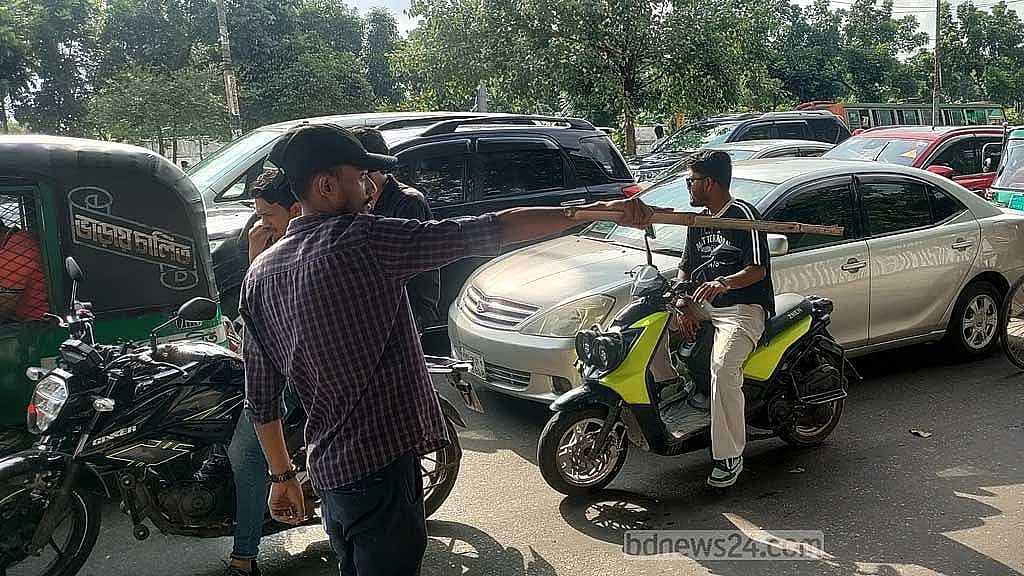
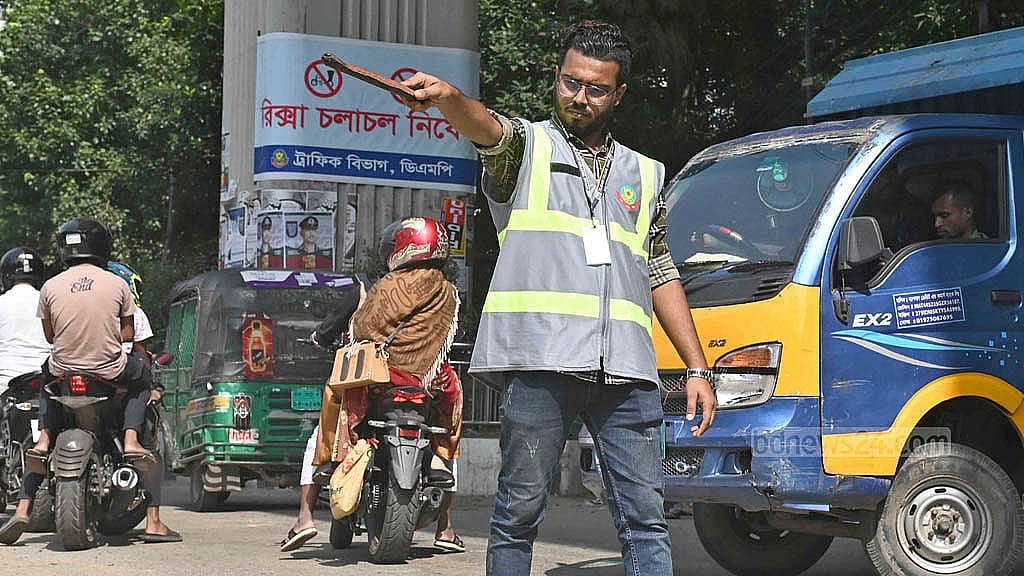
Students stepping into traffic management roles on Dhaka's streets have sparked a lively debate and mixed reactions, highlighting both concerns about potential health risks and doubts about their effectiveness in easing congestion.
On Tuesday, traffic sergeants at Asad Gate struggled to control jam caused by rickshaws and ride-sharing motorcycles near the Manik Mia Avenue crossing.
Order prevailed on the streets when students took charge of traffic, but as soon as their shifts concluded, the usual chaos ensued, with vehicles clogging crucial lanes.
While traffic police recognise the advantages of student involvement, concerns about safety and potential risks linger.
Some commuters commend the effort but point out problems such as faulty signals and overly enthusiastic manoeuvres that might exacerbate traffic issues.
The initiative began on Nov 5 with 55 students, with more students gradually being introduced to assist in traffic control. However, there are still questions regarding the health risks and safety of students, especially considering the challenges faced during such assignments.
A senior official from the home ministry said, "If police face problems, students will face the same."
Meanwhile, traffic officials, including Khondkar Najmul Hasan, additional commissioner of traffic at Dhaka Metropolitan Police, confirmed that 291 students have already been assigned to assist with traffic, with a total of 600 students planned for deployment.
Prof M Shamsul Haque, former director of the Accident Research Institute at Bangladesh University of Engineering and Technology, or BUET, strongly opposes the use of students for this task.
He told bdnews24.com, "It is scientifically unsound and could lead to unnecessary complications between road users and students, potentially worsening the situation."
Shamsul expressed concerns over the long-term implementation of this initiative, urging authorities to ensure that students' involvement remains temporary.
The decision to involve students came after the police were overwhelmed following the fall of the Sheikh Hasina government on Aug 5.
In the aftermath, students took up traffic management duties until the return of traffic police.
However, the police force has struggled to regain its full efficiency, prompting the government to enlist 300 students to assist in controlling traffic, with a daily stipend.
As the traffic situation continues to evolve, questions remain about the sustainability and safety of using students to fill the gaps left by a strained law-enforcing system.
MIXED EXPERIENCES OF TRAFFIC MANAGEMENT
While discussing the topic at Manik Mia Avenue, ride-sharing motorcycle driver Shamim Ahmed said, “The students are doing a good job. When they are present, the vehicles that move in the wrong direction, especially battery-operated rickshaws, are better controlled. The buses do not stop randomly for passengers anymore.”
He continued, “However, in some cases, they suddenly run onto the road, or get overly enthusiastic by giving multiple signals at once. But perhaps after a few more days, things will improve.”
A traffic constable on duty at the same signal remarked, “The students sometimes give incorrect signals, which causes confusion. We go and correct it.”
Sohag Mia, a bus driver for Bikash Paribahan, which operates on the Azimpur to Uttara route, said: “Sometimes, students come from behind and start hitting my bus, asking why I’m stopping. But they don’t understand that there’s no space to move forward because another vehicle is blocking the way.”

However, he acknowledged that having students on the streets had improved traffic discipline compared to before.
Massud Alam, a passenger on the same bus, said: “In many places, new police officers are arriving, but nobody listens to them. When the students are around, they listen. They are putting in a lot of effort.”
WHAT ARE THEIR EXPERIENCES LIKE?
On Tuesday, near the Mohammadpur Bus Stand in Dhaka, Mahbubul Alam, a graduate of Alhaj Mokbul Hossain University College, was busy managing rickshaws and motorcycles driving in the wrong direction.
While he successfully stopped one rickshaw, he grew visibly frustrated as other rickshaws tried to push through from behind.

He said, “The problem is that none of us want to follow the rules. People used to blame the police, but now they’ll probably blame us. Still, we are trying to bring people from the wrong side to the right side.”
He said there is still a shortage of traffic police on the streets, explaining: “At one signal, where seven to eight police officers used to work, now only two to three are present. We are informing the higher authorities about this.
“Our manpower will increase. Once it does, we will no longer work based on the traffic police's recommendations. We will work the way we think is best, and they will only oversee us.”
Kaiser Ahmed, a final-year Computer Science diploma student at the Graphic Arts Institute, shared his experience, saying: “I was working the night shift on Monday at Manik Mia Avenue. At around 8:30pm, as we were about to leave, rickshaws and motorcycles started parking wherever they could.
“Also, some passengers got off the bus and attempted to cross the road right there, even though they could have waited a little to cross at the signal further ahead. Getting everyone to follow the law is our challenge. We are trying to raise awareness, and hopefully, after some time, things will improve.”
WHAT WILL HAPPEN TO HEALTH RISKS?
A 2021 study involving 384 police officers responsible for traffic management in various areas of Dhaka revealed that 84 percent of the police officers suffered from various respiratory issues.
The study, titled Traffic Air Pollution and Respiratory Health: A Cross-Sectional Study Among Traffic Police in Dhaka City, Bangladesh, was published in the Journal of Medical Science and Clinical Research.
Dr Shakila Yeasmin, a research physician at the Institute of Epidemiology, Disease Control and Research, or IEDCR, was one of the key members of the research team.
The study showed that the respiratory problems caused by air pollution were almost the same among both smokers and non-smokers in the police force.
The next year, another study, conducted under the leadership of Assistant Prof Saika Nizam of the Department of Occupational and Environmental Health at Bangladesh University of Health Sciences, found that 41.9 percent of rickshaw drivers and 30.7 percent of traffic police officers suffered from ear-related issues due to noise pollution.
Sub-Inspector Sardar Nurul Amin, director of the Rajarbagh Central Police Hospital, said: “Traffic police members usually suffer more from respiratory issues due to dust. They often face injuries related to accidents.”
He added, “Students are also at the same risk. While working, they must wear masks. If they are a little cautious, the risks can be minimised. There is also some risk of accidents due to the disorganised movement of rickshaws. They should remain cautious about that as well.”
To prepare students for their duties on the roads, the youth development department organised a two-day training programme.
Akher, director (administration) of the youth development department, told bdnews24.com: “We have received a list, and based on that, we provided a two-day training. After that, we do not know what they will do or where they will work. The Ministry of Home Affairs is handling the rest.”
SM Humayun Kabir, joint secretary (police-2 branch) of the home ministry, said: “Traffic police officers are human, aren’t students also human? If the traffic police face problems, students could face them too.”
WILL STUDIES BE DISRUPTED?
Student Mohammad Rubel says, “My studies are not being affected. If we have to work, we have to adjust. However, we do have the option to choose shifts that suit us. If I have a class in the morning, I can work in the afternoon. If I need leave for exams or any emergency, I can inform my seniors and apply for leave.”
Mahbubul Alam, a student working at the Mohammadpur Bus Stand since Nov 10, said: “Students generally have a lot of free time. That’s why we’ve been officially given the opportunity to work part-time.”

THE RISK OF INJURY
One of the initial conditions for joining the traffic police duty was getting family consent.
Kaiser says, “My parents initially didn’t want me to go out in the sun, which is understandable. But later I convinced them. We’ve worked before, so it doesn’t seem too challenging now. The officers (traffic police) also advise us to take breaks and drink water.”
Rubel, a student working at Asad gate, says, “Naturally, my parents didn’t want me to work in the sun, but I explained to them. If I can help someone reach the hospital on time or assist someone in getting to their office, that’s my success.”
The students, while working, said that they felt they were helping and also felt more relaxed.
TSI Atabul Hossain, working at the Asad gate signal, said: “Sometimes, when the students are there, people listen more.”
However, some risks were highlighted in his statement.
He says, “Whenever students see battery-operated rickshaws, they run after them. If an accident happens, who will take responsibility? What will happen if something occurs without our knowledge? We keep telling them not to take such risks.”
He further added, “Reckless rickshaw drivers sometimes let passengers on, and then drive long distances. If they end up assaulting someone, that’s another risk. We try to explain these issues to them as much as we can.”
DMP Additional Commissioner Najmul, says: “Generally, students help remind people not to drive in the wrong lane, not to ride without helmets, or cross the road carelessly. The traffic police are still responsible for the main traffic control tasks.”

'STRONG OPPONENT' M SHAMSUL HAQUE
Transport expert M Shamsul Haque is not in favour of students being deployed on the streets in this manner.
He told bdnews24.com, “Our road environment is toxic. It’s not right to expose students to such conditions; it’s not suitable environmentally either.”
Commenting on the large number of students taking to the streets during the chaos following the government’s fall, he said, “It’s acceptable in the short term. But now, I want to believe that since the police force is not fully operational yet, students have been deployed temporarily. This should not become a long-term solution. That would not be good for the police or the students, and road users will get frustrated. There will often be arguments with them. The students should be removed from the streets quickly.”
For the long term, he suggested traffic control through automated signal lights, saying, “If that area is focused on, it will bring relief to the people.”
SELECTION PROCESS
After the government's fall, the students who were working on the streets were listed, and then selected for two-day training under the youth development department.
Afterwards, they underwent another two-day training at Rajarbagh Police Lines.
Physical fitness and other checks were carried out before the selected students were officially recruited and given appointment letters by the Dhaka Metropolitan Police, or DMP.
Mohammad Rubel, a BBA student from The International University of Scholars working at Asad Gate signal, said: “The main focus of the training at Rajarbagh was fitness—height, weight, physical illnesses. We were also informed about various traffic details. Those who passed the fitness check were given appointment letters.”

The training from the youth development department took place on Oct 21-22, and the Rajarbagh training was on Oct 30-31.
Rubel added, “We work in two shifts every day: from 8am to 12pm, and from 4pm to 8pm. We report to the traffic in-charge at our assigned points, and then they show us where to work. We carry out our duties there.”
Traffic police officer Khondkar Najmul said, “Traffic control on the streets requires physical effort. We can’t just take anyone who shows interest. In the first slot, 450 students showed interest in working, and after evaluating their physical fitness and other aspects, 291 were selected.”
HOW THE HONORARIUM IS PAID
Each student is paid Tk 500 per day for working four hours a day.
Rubel, who works at the Asad Gate signal, said: “They told us we could take the payment either daily or weekly. However, we requested it to be paid every 15 days or monthly. Initially, payments will be given in hand, but later it may be transferred through the bank.”
Khondkar Najmul Hassan, additional commissioner (traffic) of the DMP, said: “The payment will be made by the ministry. Since the budget hasn’t been approved yet, they have not received any payment so far. However, they will be paid either every 15 days or once a month.”
[Writing in English by Arshi Fatiha Quazi]