Published : 29 Oct 2025, 07:48 AM
Updated : 21 Aug 2026, 02:39 PM


Amid disagreements among political parties, the National Consensus Commission has become the focal point for deciding how the July National Charter will be implemented.
Experts’ opinions were solicited, and based on these, the commission submitted recommendations for the implementation process, designed to be enacted through a public referendum.
The release of these recommendations has already sparked debate, with some politicians and analysts warning that it could open a path to new controversy.
The Bangladesh Nationalist Party (BNP) has raised objections to the implementation procedure, arguing that it bypasses dissenting views from parties involved in the constitutional reform process.
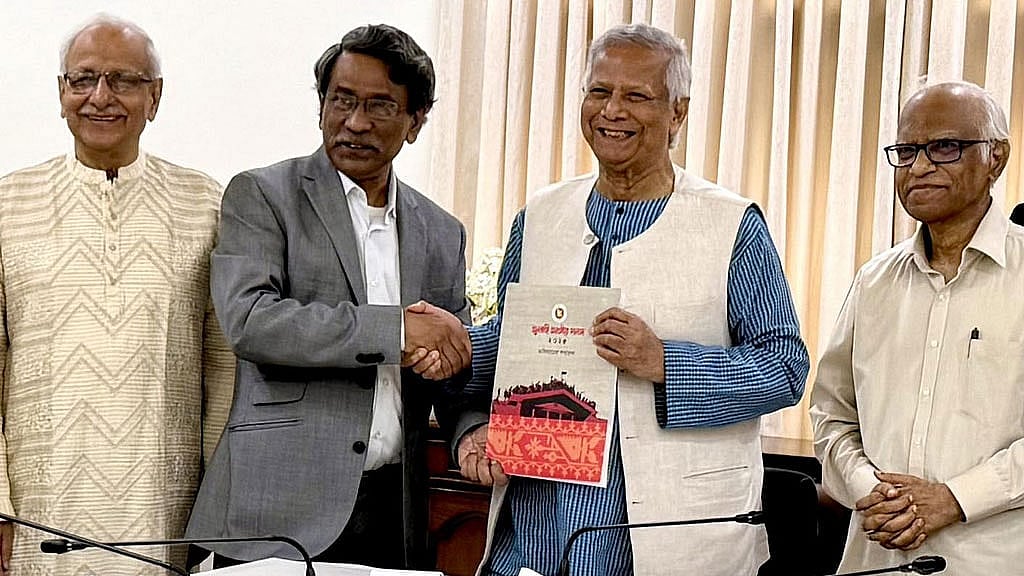
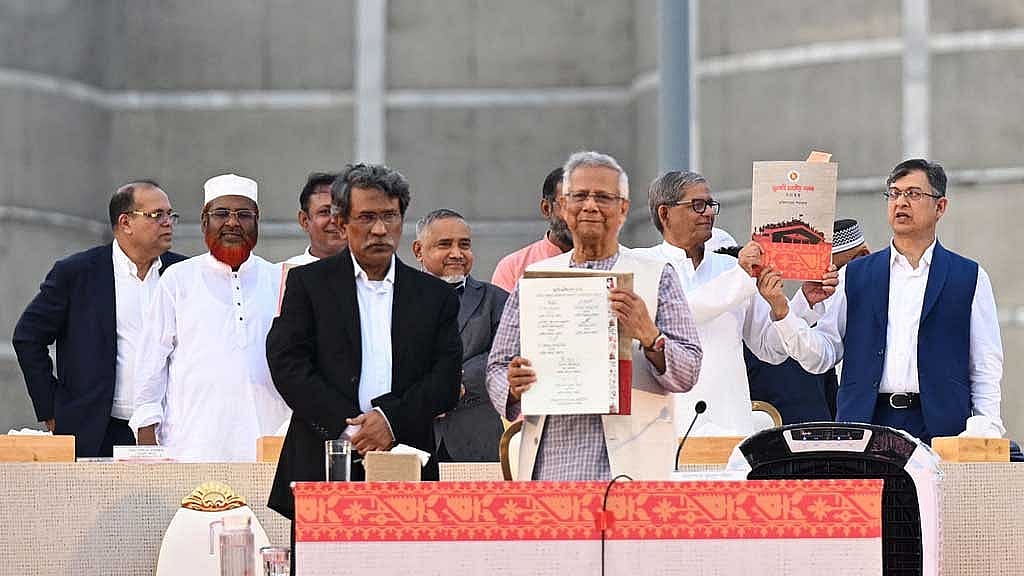
On Tuesday, the Consensus Commission formally submitted the draft implementation order and recommendations to Chief Advisor Muhammad Yunus.
The party leaders reacted strongly to the proposals. Analysts have suggested that the government should first secure political parties’ agreement to determine the next steps.
Dhaka University political science Prof Kazi Mohammad Mahbobor Rahman fears the commission’s recommendations could introduce fresh divisions.
“If the government can bring the parties to an agreement on this order, it will be a success. But if consensus is not achieved, the government will weaken, political instability will rise, and the referendum could face serious challenges,” he said.
Twelve days after the July Charter was signed, the commission handed over the implementation recommendations, outlining two alternative methods for implementing the constitutional reform proposals in the Charter, along with their legal basis.
“The July National Charter 2025 provides two possible paths for government implementation and legal grounding of the constitutional reform proposals,” it said.
WHAT EXPERTS SAY
After the publication of the commission’s recommendations, discussion over the July Charter’s implementation intensified.
Questions were raised, particularly by the BNP, over why the objections of certain political parties were not included. A leader from the Communist Party of Bangladesh (CPB), involved in discussions with the commission, acknowledged these concerns.
Professor Mahbobor said, “The central idea of the commission was to take proposals that had consensus among political parties to a referendum. Proposals without agreement would remain as notes of dissent.
“But the question in the referendum is presented as a simple yes or no on the Charter itself, leaving no room for dissent notes. This undermines a year of careful work among parties.”
He added, “The key challenge now is whether this presentation of the Charter will create new divisions or cracks in national unity. This could also jeopardise the referendum itself. The support of political parties in the referendum is now uncertain.”
Political analyst Abdul Alim echoed concerns about heightened division.
“Political divisions have existed from the start, and they remain. Consensus is not guaranteed, especially on elections, parliamentary structure, and proportional representation.
“Without agreement, new crises could emerge. This implementation process does not resolve the existing disagreements,” he said.
Alim also noted ambiguity due to the lack of a set timeline for the referendum.
“The recommendations do not specify a clear deadline, leaving unresolved disagreement that existed from the beginning,” he said.

HOW THE CHARTER WILL BE IMPLEMENTED
The commission recommended issuing the “July National Charter (Constitutional Reform) Implementation Order 2025” with two alternative approaches for carrying out the reforms through a referendum and the Constitutional Reform Council.
One proposal states: “To implement the constitutional amendments included in the July National Charter 2025, the government will issue an order titled July National Charter (Constitutional Reform) Implementation Order 2025. The order and Schedule-1 will present a full draft bill for public referendum to exercise sovereign power.”
Schedule-1 contains 48 constitutional amendment proposals discussed by the commission. While some proposals in the July Charter included political parties’ notes of dissent, the schedule for the referendum omits these.
Following the issuance of the order, a Constitutional Reform Council will be formed alongside the newly elected parliament. This council will exercise ‘constituent power’ over constitutional reforms.
The commission said, “If the referendum yields positive support, the Constitutional Reform Council will consider the approved constitutional reform bill as facilitating its mandate.
“If the council fails to complete reforms within 270 days of its first session, the approved bill will automatically become part of the Constitution.”
The second proposal allows the formation of the Council through the order and referendum, but removes the requirement to present a full draft bill. The 270-day implementation mandate remains.
WHAT THE ORDER STATES
The commission’s draft order details the conduct of the referendum and the formation and functioning of the Constitutional Reform Council.
The draft states: “The referendum will be held at an appropriate time before the next parliamentary polls or on the day of the election, pursuant to this order.”
It added, “For the exercise of the people’s sovereign power, the constitutional amendments included in the July National Charter in this order and Schedule-1 will be presented in the referendum.”
The ballot question will read: “Do you approve the July National Charter (Constitutional Reform) Implementation Order 2025 and the constitutional amendments included in Schedule-1?”
If a majority votes ‘yes’, a Constitutional Reform Council will be formed from members elected to parliament, holding concurrent responsibility for constitutional reform.
“Elected representatives will take the oath both as Members of Parliament and members of the Constitutional Reform Council. The Council will complete the constitutional reforms within 270 days using the sovereign power of the people, after which its mandate will end.”
The draft order also stipulates that proportional representation in the upper house will be formed within 45 days after reform completion or automatic enactment.
It says, “The term of the Upper House will run from the date of oath-taking until the end of the lower house term under this order.”
WHAT HAPPENS IF RESULT IS NEGATIVE
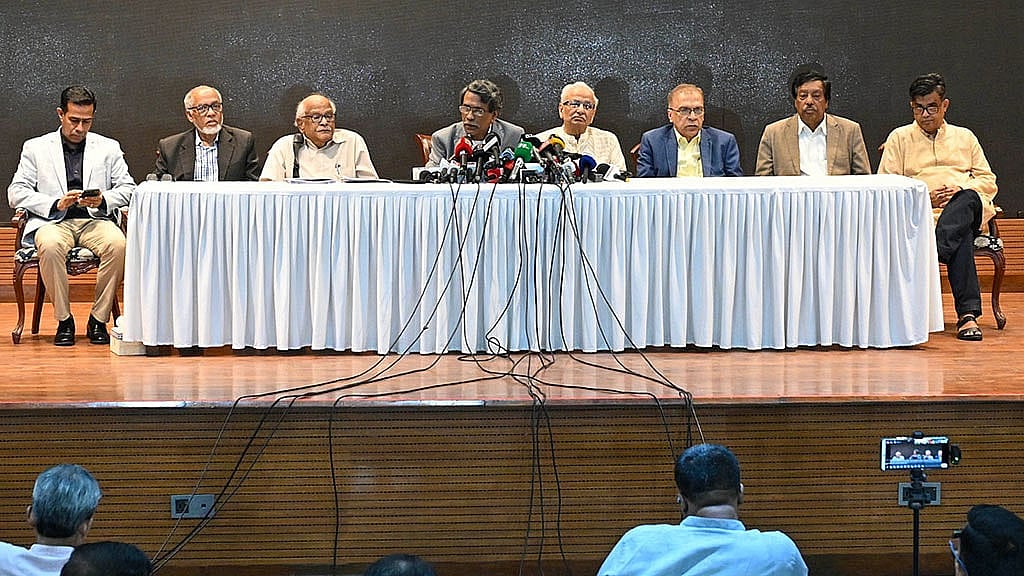
Questions have arisen over what would happen if the proposed referendum for implementing the July Charter fails. Consensus Commission Vice-Chair Ali Riaz emphasised trust in the electorate.
Speaking on Tuesday, he said, “If the referendum does not pass, it does not pass. That means the people have rejected it.”
Citing Latin America, he referred to Chile, where two attempts at a constitutional referendum failed.
“The first draft lost, with critiques that it leaned too far right or left. Then it was revised and put to another vote, which also failed. If it does not pass, it means the people do not accept it. That is why I say -- trust the people.”
The 48 proposed constitutional amendments under the July Charter will be presented as a single package in the referendum.
He said, “Typically, a referendum has one or two questions, sometimes more. In Iceland, there were six. Our recommendation is one package question: Do you support this order and the constitutional reform proposals contained in its Schedule-1?”
On concerns over partial agreement within the package, Riaz cited Turkey’s 2016 referendum: “There were 21 issues under one question, and it passed narrowly at 51 percent. Some voters agreed with some parts and disagreed with others. How they voted, I cannot say. But Bangladesh is not the first country to try capturing multiple issues under a single question.”
He added, “Doubting the public’s understanding makes me uncomfortable. The government has a responsibility to explain clearly, make the question accessible, and reach everyone.
“The people of Bangladesh have resisted authoritarianism before and exercised their political judgment.”
POLITICAL PARTIES’ POSITION
Following the submission of the implementation process to the government on Tuesday, senior BNP leader Salahuddin Ahmed criticised the commission’s recommendation as including extraneous elements. He expressed both thanks and frustration.
Salahuddin noted the absence of “notes of dissent”: “Among the 84 clauses of the July Charter, multiple parties had differing views. Remarkably, these dissenting notes are missing in the submission.”
He also challenged the new “Constitutional Reform Council” concept, saying it was never discussed in the commission and that any reform must remain the prerogative of the elected parliament.
He questioned the legality of holding a referendum before the general election: “The Election Commission’s constitutional mandate covers parliamentary and presidential elections. Only if the July Charter gains a mandate through a referendum can a reform council be formed. Otherwise, it should proceed as signed.”
Salahuddin also rejected proportional representation (PR) in the upper house, saying it was never part of the consensus. He criticised the 270-day automatic inclusion of amendments, calling it “absurd”.
Ruhin Hossain Prince, former CPB general secretary, described the removal of dissent from the implementation order as a “new crisis”. He opposed holding a referendum before the parliamentary election, warning it could disrupt February’s election preparations.
Prince said, “The main task now is the parliamentary election. Nothing should hinder it. Simple solutions must not be made complex. Parties’ commitments should be evaluated by the people during elections.”
Meanwhile, the National Citizen Party (NCP) reiterated its call for a pre-election referendum, outlining a six-step plan. The party, composed of July Uprising leaders, argued that structural reforms should precede the next parliamentary vote.
The Jamaat-e-Islami has similarly demanded a referendum by November. Ahead of the commission briefing on Tuesday, the party submitted 18 demands to the Election Commission.
Secretary-General Mia Golam Porwar told reporters, “The meeting was open and cordial. We discussed each point at length, and the commission listened attentively, providing explanations.”
Porwar added, “Among our 18 demands is a nationwide referendum before the parliamentary elections, to be completed by November. The public must understand the proposed structural changes before voting.
“Holding both the referendum and elections on the same day may cause technical and security issues, so we propose a separate schedule for the referendum.”