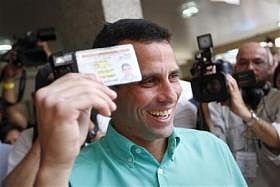
Venezuela's Capriles to run against socialist Chavez
Youthful state governor Henrique Capriles won Venezuela's opposition primary on Sunday, setting up a potentially close battle with socialist President Hugo Chavez in an October election.
bdnews24.com News Service
bdnews24.com
Published :
13 Feb 2012, 03:58 AM
Updated :
09 Aug 2022, 03:25 PM
CARACAS, Feb 13 (bdnews24.com/Reuters) - Youthful state governor Henrique Capriles won Venezuela's opposition primary on Sunday, setting up a potentially close battle with socialist President Hugo Chavez in an October election.
The primary ballot marked a step forward in the historically fractured opposition's decade-long attempts to oust Chavez, whose 13-year rule has galvanized the poor but divided the South American OPEC nation and spooked foreign investors.
Official results showed Capriles won 62 percent of the vote in Venezuela's first-ever opposition primary vote, easily beating out his nearest rival Pablo Perez who took 30 percent.
Perhaps as important as Capriles' victory was the opposition turnout of 2.9 million voters in the poll, considerably above what the coalition had targeted in a sign that Chavez's adversaries have improved their ability to mobilize supporters.
"Who says Hugo Chavez is invincible? We have a saying here: 'every dog has its day'," said Leopoldo Lopez, a high-profile opposition leader who recently joined Capriles' camp after bowing out of the primary race.
"He (Chavez) can't be very happy, I think he's seeing himself in the pages of history."
Capriles, 39, hopes his energetic style and decent record governing Miranda state can help him counter Chavez's vast government spending and popularity among the poor.
In a sign of opposition unity, which will be crucial for their effort to unseat Chavez, Perez immediately vowed to back Capriles.
Chavez supporters, however, were quick to dismiss the results, noting that the total turnout in Sunday's ballot was only a fraction of the country's 18 million registered voters.
They say the opposition represents an old, discredited political elite who paid scant attention to the poor majority in the past and will never beat the president. Polls show that Chavez, a former soldier, has an edge as the campaign begins to heat up.
Information Minister Andres Izarra said on his Twitter account that the 2.9 million voters on Sunday were less than the number they had mobilized to request a 2004 recall referendum that Chavez ultimately beat out.
"Now let's hope they recognize Chavez's victory on October 7," he wrote.
CHAVEZ STILL STRONG
Chavez, 57, has won almost all of a dozen or so national votes in Venezuela since taking power in 1999, and has survived national strikes, massive street protests and even a brief military coup that toppled him for 36 hours.
Capriles hails Brazil's market-friendly but socially conscious policy model as his inspiration and has said he would take a "no shocks" approach to dismantling Chavez's statist economic policies, such as currency controls.
He might, though, move faster to end controversial friendships with anti-U.S. figures like the leaders of Iran, Cuba and Belarus.
"I aim to be a president who talks much less, who doesn't invade Venezuelans' personal lives so much," Capriles said this week in a pointed reference to Chavez's longwinded speeches, which local media are often obliged to run live.
Sunday's voting was smooth with long, orderly queues around pro-opposition neighborhoods of the capital Caracas where walls were plastered with the candidates' posters. Young activists rode motorbikes exhorting voters to head to the polls.
Chavez strongholds were largely devoid of opposition propaganda, however, and state TV gleefully broadcast images of some semi-deserted polling centers with just one or two voters.
Reading a newspaper in a sunny square deep in the pro-government January 23 area on hills above Chavez's presidential palace, 66-year-old retired pharmacy assistant Ramon Paraera said no one would beat the president. "Chavez is helping the people. He's with the people, not the bourgeoisie," he said, sitting below a mural of revolutionary heroes including Ernesto "Che" Guevara.
Peru's conservative Nobel literature laureate Mario Vargas Llosa praised the coalition for transcending the mediocre, divided opposition of Venezuela's past and avoiding "cannibalism" during the primary - in contrast to the US Republican race going on to the north.
"Who says there can't be a Venezuelan spring?" he wrote.
At stake is control of the biggest crude reserves in the world and state oil company PDVSA, which despite declining output still sends more than three quarters of a million barrels a day to the United States and about half a million to China.
Chavez has nationalized almost all Venezuela's oil industry over the years, kicking out US majors and putting PDVSA in charge of multibillion dollar projects. The opposition deny government allegations they plan to privatize the company.
Never out of the spotlight for long, Chavez attended a rally on Sunday to celebrate the 198th anniversary of the "Batalla de La Victoria" ("Battle of Victory") against Spanish forces.
Following cancer surgery last year, Chavez seems to be continuing to recover and is making ever longer TV appearances, including a record speech last month of nearly 10 hours.
"We cannot let Venezuela lose its independence," said Chavez, who often mocks his political foes as U.S. stooges and sell-outs. "Especially not after these 13 years of battle."
The former soldier pledges "more socialism" for Venezuela if he wins re-election, while the opposition is stressing its commitment to addressing Venezuelans' non-ideological concerns -- crime, unemployment and social services.
bdnews24.com/cr/0958 h.