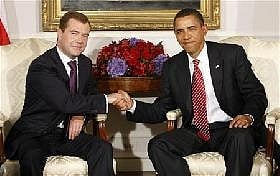
US, Russia agree Iran may face new sanctions
US President Barack Obama said he and Russian President Dmitry Medvedev agreed on Wednesday that further UN sanctions will be considered if Iran does not respond to proposals to end a nuclear standoff.
bdnews24.com News Service
bdnews24.com
Published :
24 Sep 2009, 05:21 AM
Updated :
12 Aug 2022, 01:49 PM
UNITED NATIONS, Sep 24 (bdnews24.com/Reuters) - US President Barack Obama said he and Russian President Dmitry Medvedev agreed on Wednesday that further UN sanctions will be considered if Iran does not respond to proposals to end a nuclear standoff.
Foreign ministers from the five permanent UN Security Council members -- the United States, Russia, Britain, France and China -- and a German official met at the United Nations to continue discussions about Iran's nuclear program, which the West suspects is aimed at developing atomic weapons.
Tehran insists its nuclear ambitions are limited to the peaceful generation of electricity and has rejected Security Council demands that it suspend all sensitive nuclear activities, including its uranium enrichment program.
"Iran has been violating too many of its international commitments," Obama said after meeting Medvedev.
Medvedev made clear that Moscow was ready to back further sanctions against the Islamic Republic unless it changes course on its nuclear program, despite Russia's general reluctance to support such punitive measures.
"Russia's position is simple," he said. "Sanctions are seldom productive but they are sometimes inevitable."
Earlier, French President Nicolas Sarkozy told the UN General Assembly that Iran would be making a "tragic mistake" if it thought the world would not respond to its nuclear program.
The six powers that met at the United Nations have offered Iran economic and political incentives if it stops enriching uranium, but Tehran has yet to officially reply. In a television interview, Sarkozy said Iran has until December to respond.
Iranian President Mahmoud Ahmadinejad, whose disputed re-election in June has sparked widespread protests in Iran, addressed the assembly, too, but made no direct reference to Iran's nuclear program.
Hundreds of Iranians picketed Iran's UN mission in New York, vowing not to accept Ahmadinejad as their leader.
IRAN MUST GIVE 'SERIOUS RESPONSE'
Russian Foreign Minister Sergei Lavrov joined his counterparts from the other five countries to discuss their October 1 meeting with an Iranian delegation in Geneva. It will be the six powers' first meeting with Iran since July 2008.
After the meeting, British Foreign Secretary David Miliband read a statement agreed unanimously by the six.
"We expect a serious response from Iran and will decide, in the context of our dual track approach, as a result of the (October 1) meeting, on our next steps," Miliband said.
US Secretary of State Hillary Clinton made clear after the meeting that the United States and its allies were serious about the "dual-track approach" to Iran -- pursuing talks with it while considering further UN sanctions if Tehran ignores UN demands that it freeze its enrichment program.
"No one should underestimate our intention to follow through on either or both of these tracks," she told reporters. "It depends on Iran's response."
Russia had previously ruled out new sanctions against Iran but appears to have recently reversed its position.
Obama announced last week that he would scrap plans for a US missile shield in the Czech Republic and Poland that had angered Russia. Washington and Moscow have denied any quid pro quo deal on Iran sanctions in exchange for scrapping the shield, but analysts and UN diplomats suspect otherwise.
Russia and China reluctantly backed three council resolutions imposing sanctions against Iran over its nuclear program but worked hard to dilute the measures.
The United States and Germany have called for targeting Iran's energy sector if it refuses to suspend its enrichment program. The UN sanctions in place against Tehran focus on its nuclear and missile industries.
Israeli Prime Minister Benjamin Netanyahu, speaking on NBC's "Today" show, repeated Clinton's call for "crippling sanctions" against Iran.
Asked about a possible Israeli military strike against Iran's nuclear facilities, he gave what has been his stock answer during his US visit: "I don't deal in hypotheticals."
bdnews24.com/md/1122 hrs.