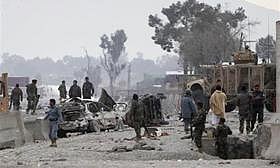
US rejects strategy shift after Afghan protests, shooting
The Obama administration will not swerve from plans to move into an advisory role in Afghanistan, US officials said on Monday, despite the killing of US advisers over the weekend that underscored the risks foreign soldiers will face as they rush to train Afghan forces.
bdnews24.com News Service
bdnews24.com
Published :
28 Feb 2012, 04:09 AM
Updated :
09 Aug 2022, 03:29 PM
WASHINGTON, Feb 28 (bdnews24.com/Reuters) - The Obama administration will not swerve from plans to move into an advisory role in Afghanistan, US officials said on Monday, despite the killing of US advisers over the weekend that underscored the risks foreign soldiers will face as they rush to train Afghan forces.
"We're not going to let the events of the past week, which are regrettable and unfortunate and tragic, influence the long horizon view that we're taking," Defense Department spokesman George Little told reporters at the Pentagon.
"There is absolutely no reason to change course when we're making the kind of progress we're making," Little said later.
The Pentagon's rhetorical offensive, which echoed remarks a day earlier by US ambassador to Afghanistan Ryan Crocker, appeared designed to tamp down speculation that the violence might prompt US military commanders to abandon a course that is supposed to gradually move US forces out of a combat role and put Afghan troops in the lead.
Concerns about the future of the US fight in Afghanistan have mounted in recent days, as protests over the burning of copies of the Koran on a US military base have raged and after two US officers were shot inside the Afghan Interior Ministry, prompting NATO to pull all advisers from ministries in Kabul.
The Taliban claimed responsibility for a Monday suicide attack that killed nine people in eastern Afghanistan, highlighting the challenges that remain for Washington and its allies as they push ahead with troop reductions that will remove most combat forces by the end of 2014.
Standing up an Afghan army capable of confronting militants - who are not giving up the fight - will be essential if the Western project in Afghanistan is to succeed. But 'green-on-blue' incidents such as the killing of the two US officers are emerging as a major obstacle to that goal.
According to the Pentagon, around 70 members of the NATO force were killed in 42 insider attacks from May 2007 through January 2012.
Such attacks have grown more common as the United States has sent tens of thousands more soldiers to Afghanistan in recent years and as Afghans tire of the foreign military presence more than a decade after the Taliban government was toppled. It is a troubling trend for the US force as they prepare to move away from combat and shift into an advisory role.
One US official, speaking on condition of anonymity, said the events of the past week would likely accelerate discussions among US, NATO and Afghan officials about possible changes to security procedures for training and advisory activities. New protocols could be announced "in the relatively near future," he said.
"This has been a subject of discussion for months," the official said.
Captain John Kirby, a US military spokesman in Kabul, said US advisers would return to ministries in Kabul when General John Allen, who commands US and NATO forces in Afghanistan, deemed it acceptable. He gave no further details.
HUMAN, FINANCIAL COST
Overall, US officials pushed back at suggestions that what they called 'isolated' incidents would reshape US plans for Afghanistan. As the human and financial cost of the war mounts, the Obama administration is seeking to broker a peace agreement between the Taliban and the Afghan government that it hopes would provide for a stable future once the West withdraws.
US officials will be thrashing out the course ahead in meetings leading up to a NATO summit in Chicago in May, where President Barack Obama is expected to unveil his plans for drawing down the remaining US forces, as he once did for Iraq.
Those discussions will also likely address a bilateral agreement, which officials hope to conclude before the NATO summit, that would authorize a smaller US military presence in Afghanistan to counter extremist threats beyond 2014.
The Obama administration, with few alternatives at hand, may opt to hunker down and hope that a spate of top-level US apologies over the burning of the Muslim holy book will help ease the Afghan furor. The Pentagon said the number of protests across Afghanistan had dwindled to three on Monday from 24 on Saturday.
"There have been bumps in the road ... and we've gotten over them," the US official said.
The path ahead will not be an easy one for Obama, who is running for re-election in November. He is likely to face mounting pressure from some within his own party to accelerate the US exit from Afghanistan, while Republicans are likely to seize on any indication of an accelerated departure as proof the president is neglecting a key security priority.
"I personally think this argues for getting out sooner rather than later ... Ultimately, only the Afghan people and Afghan forces can secure their country," said Representative Adam Smith, the top Democrat on the House Armed Services Committee.
"There's no question that what has happened makes the situation more difficult. But no matter how we go ahead, under any scenario, we're going to have to continue to work with the Afghan government," Smith said.
Some of Washington's partners have shown even greater sensitivity to insider attacks. Last month, French President Nicolas Sarkozy suspended training and support operations and announced that France would withdraw entirely by the end of 2013 after four French troops were killed by a rogue Afghan soldier.
No matter what immediate course they adopt, US officials are likely to take whatever steps they can to reduce the risk to advisers.
Retired Lieutenant-General David Barno, who commanded US forces in Afghanistan from 2003 to 2005, said US soldiers might be sent to protect their peers inside ministries, as they were in Iraq. Or special forces could take over the training mission from conventional soldiers, he said.
"This is a complicated mission that requires a lot of skill and training," he said.
Even US officials acknowledge the risks cannot be eliminated.
"It is impossible in any large organization, be it the US military or Afghan national security forces, to guarantee zero risk," Little said.
While some risk will remain in the Afghan training mission, "it's worth taking," Little said.
bdnews24.com/cr/1009 h.