UN to dispatch humanitarian team to Sri Lanka
UN Secretary-General Ban Ki-moon said on Thursday he was sending a humanitarian team to Sri Lanka's war zone, where thousands are trapped while troops push to end to a 25-year war with Tamil Tiger rebels.
bdnews24.com News Service
bdnews24.com
Published :
24 Apr 2009, 04:41 AM
Updated :
12 Aug 2022, 12:58 PM
COLOMBO, Apr 24,(bdnews24.com/Reuters) - UN Secretary-General Ban Ki-moon said on Thursday he was sending a humanitarian team to Sri Lanka's war zone, where thousands are trapped while troops push to end to a 25-year war with Tamil Tiger rebels.
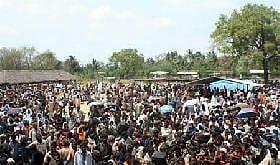
Ban's decision came after the military said an exodus of 103,000 people from the tiny coastal strip had slowed, four days after troops blew up an earthen barrier the Liberation Tigers of Tamil Eelam (LTTE) built to stop them escaping.
The safety of the remaining tens of thousands in the 13 square km (5 square mile) rebel area prompted the UN Security Council on Wednesday to demand the LTTE surrender and Sri Lanka institute another pause to the fighting.
"So many lives have been sacrificed. There is no time to lose," Ban told a news conference in Brussels.
The LTTE, whose fighters wear cyanide capsules to be taken in case of capture, has ruled out giving up its fight to build a separate state for the Tamil minority. The LTTE began fighting in the early 1970s, and has waged a full-blown civil war since 1983.
With conventional victory so close, Sri Lanka has rejected calls for another truce after its two-day holiday fighting pause last week was spurned by the rebels, who are designated a terrorist group by more than 30 countries.
Ban said that the "rapidly deteriorating situation" had prompted him to immediately dispatch a humanitarian team to the war zone, which the army had earlier set up as a no-fire zone but has now turned into its final hunting ground for the LTTE.
"The purpose of this humanitarian team would be to first of all monitor the situation and support humanitarian assistance and try to do whatever we can to protect the civilian population," he said, urging the government to cooperate.
Sri Lanka's minister for disaster management and human rights said the world body had not yet made an official request.
"Once we have been informed we will see certainly see how we can faciliate such a visit," Mahinda Samarasinghe told Reuters.
Colombo has resisted every attempt so far to give the Tigers breathing space, pointing to what it says is the LTTE's record of manufacturing civilian crises to build external pressure for truces it has then used to rearm.
"DIRE STRAITS"
Earlier this week, the International Committee of the Red Cross said fighting had killed several hundred people. A land and sea battle on Wednesday blocked the evacuation of wounded by sea and the delivery of aid supplies by a ship, it said.
"We are negotiating with the parties in terms of having a safe area around the boats to allow the fishermen to bring the wounded to us," ICRC spokesman Simon Schorno said in Geneva.
The Tigers and the military traded blame over the incident.
The ICRC lowered its estimate of civilians still trapped in a narrow coastal strip on the island's north to less than 50,000.
Earlier, military spokesman Brigadier Udaya Nanayakkara said operations to finish Asia's longest-running war would not let up. Troops were moving toward where LTTE founder-leader Vellupillai Prabhakaran is believed to be hiding.
Nanayakkara denied LTTE accusations that troops were using artillery: "We are not using heavy weapons at all. We are only using small arms," Nanayakkara said.
Independent confirmation of battlefield accounts is difficult because outsiders are generally barred from it.
For a fourth straight day, the military progress drove the Colombo Stock Exchange higher, traders said. It closed up 1.82 percent on Thursday, and is up almost 5 percent this week.
United Nations spokesman Gordon Weiss said the world body had confirmed that between 90,000 and 100,000 people had left the combat zone since Monday. They will join 80,000 people already in refugee camps away from the front.
"There is serious overcrowding in the camps and it is only to get worse in coming days," Weiss said in Colombo. "It is a huge exodus and it threatens to overwhelm the available.
bdnews24.com/lq/1048.