Published : 26 Feb 2022, 08:37 PM
Updated : 18 Jul 2022, 02:28 PM


The Ukrainian president, Volodymyr Zelenskyy, posted a video on Twitter on Saturday, telling the public not to believe false reports.
He was alive. Kyiv had not fallen. Any reports of Ukraine laying down its arms was a lie, Zelenskyy said.
“I’m here. We are not putting down any arms. We will protect our country, because our weapons are our truth. The truth is that this is our land, our country, our children, and we will protect them all,” he said.
“That is it. That’s what I wanted to tell you. Glory to Ukraine.”
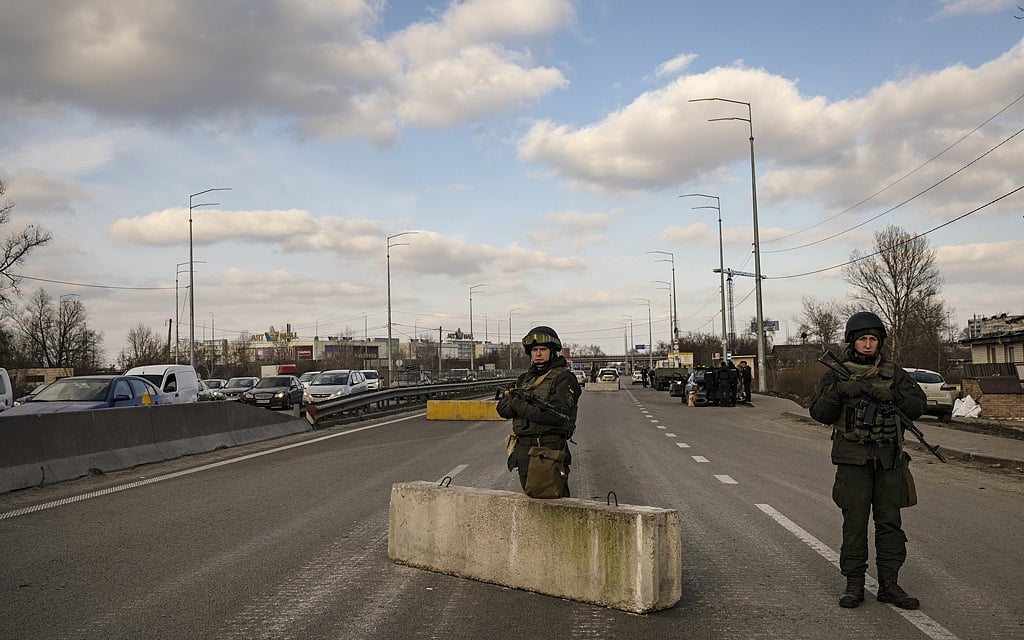
His comments, released before 9 am, came as fighting intensified in Kyiv. What until three days ago had been a thriving European metropolis has been transformed into a battle zone. Russian troops pressed in from all directions.
There was intense street fighting, and bursts of gunfire and explosions could be heard across the city, including its heart, Maidan square, where in 2014 Ukrainian protests led to the toppling of a pro-Moscow government.
The Russian military has a decisive edge in cyberwarfare, tanks, heavy weaponry, missiles, fighter planes and warships. In sheer numbers, its military dwarfs that of Ukraine’s.
Russia has established attack lines into three cities — Kyiv in the north, Kharkiv in the northeast and Kherson in the south — and Ukrainian troops are fighting to hold all three. The Pentagon reported late Friday that the Russians did not appear to be in control of a single major population center. Significantly, the senior US defense official said, Ukrainian command and control remains intact.
The Ukrainian government reported hundreds of Russian soldiers have been killed in the war, along with scores of their own soldiers, while the Russian ministry of defense issued a statement on Saturday morning that made no mention of any casualties or anything about the fight for Kyiv.
The Russian invasion started with targeted airstrikes before dawn Thursday, but on the third day of the war, bloody battles were often being waged in close quarters. Ukrainska Pravda, a Ukrainian news site, citing eyewitnesses, reported combat 400 yards from Kyiv’s city center, Maidan Square.
All Ukrainian men of fighting age are being drafted into service, and tens of thousands are eagerly signing up. Ukrainians were asked to make Molotov cocktails. And there were tearful scenes at airports in western Ukraine as wives kissed their husbands goodbye before they headed to the front.
The nation has rallied around its president, Zelenskyy, a former comedian.
To Zelenskyy and other officials, the objective of the Russian invasion of a neighboring country that posed no military threat is to topple the government.
Zelenskyy has said that he is “target No. 1.”
As battles were waged around the city on Saturday morning, there were reports of clashes near the city’s train station and along a central thoroughfare, Bohdan Khmelnitsky Street, leading from Victory Square toward the city center, according to the witness accounts. Along that street, closer to the city center, bursts of gunfire could be heard through the night.
“We are stopping the horde, so far as we can,” the secretary of the Ukrainian Security and Defense Council, Oleksy Danilov, said around 7 am Saturday. “The situation is under control of the Armed Forces of Ukraine and citizens of Kyiv.”
In dozens of interviews in the tense hours before the invasion and in the days after, Ukrainians struggled to understand how a country at peace so suddenly found itself at war. For many Ukrainians, the answer was found in Russia’s president, Vladimir Putin.
This is Putin’s war. But what frightened people perhaps as much as the threat of missiles and bombs, was that they did not know what he wanted.
The fear was evident in the drive from Kyiv to a small village outside the city. Military convoys had replaced families going on vacation or visiting friends. Where once Kyiv was known as a city where the music played a touch too loud in its cafes, the incessant wail of air raid sirens drowned out all joy.
The fear was evident in the faces of the people seeking safety in western Ukraine, after they emerged from 20-hour train rides in packed carriages that were kept pitch-black to avoid being targeting by Russian rockets.
From Lviv in the west, to Odessa in the south, and Kharkiv and nearly all points in between, people huddled in air raid shelters and lined up and bank machines and stocked up on essentials.
While the Russians, for the moment, were not in control of any city, it was only the first phase of a conflict that could stretch into weeks or longer. — ANDREW E KRAMER, MARC SANTORA, VALERIE HOPKINS and MICHAEL SCHWIRTZ
On both sides of the Korean Peninsula, eyes are on Washington's response to Russia.
SEOUL — Both North and South Korea are likely to be closely watching the American response to Russia’s invasion of Ukraine, though for different reasons, analysts say.
North Korea carried out a flurry of missile tests in January, but none this month — possibly out of deference to its neighbor and ally China, which was hosting the Winter Olympics. With the Games now over and the Biden administration’s attention fixed on Ukraine, North Korea might decide it’s time to resume weapons tests, to gain more diplomatic leverage with Washington.
“The crisis in Ukraine gives North Korea more room for options, whether it’s a long-range missile test or even a nuclear test,” said Cheon Seong-whun, a former head of the Korea Institute for National Unification, a government-funded research institute in Seoul.
In South Korea, many people will see Washington’s response to Russia’s invasion as a test of its dependability as a military ally, said Lee Byong-chul, a professor of political science at the Institute for Far Eastern Studies at Kyungnam University in Seoul.
He said a failure of American leadership could even increase public support for the idea of South Korea having its own nuclear weapons — an idea that the South’s government opposes, but which has gained popularity as the North has kept building its arsenal and China has become more assertive in the region.
“South Koreans saw the United States already looking something like a toothless tiger when it withdrew chaotically from Afghanistan,” Lee said. “If it proves spineless in Ukraine, they will talk more about arming their country with nuclear weapons, because they wonder whether Ukraine would have suffered the humiliation it is suffering now had it not have given up its nuclear weapons.”
After the breakup of the Soviet Union, Ukraine gave up the Soviet nuclear weapons on its soil in exchange for security guarantees.
South Korean online chat rooms were abuzz with people discussing the Ukraine invasion’s implications for the divided Korean Peninsula. A weak American response would harden North Korea’s determination not to give up its nuclear arsenal, some people said.
The South Korean government has condemned the invasion and pledged to join international sanctions against Russia. As of Saturday, the North Korean government had not issued a statement about the invasion. — CHOE SANG-HUN
Landmarks in New York and elsewhere use lights to show support for Ukraine.
Several New York landmarks are being illuminated in blue and yellow, the colors of the Ukrainian flag, through the weekend as a show of solidarity for the people of Ukraine, Gov. Kathy Hochul said Friday.
“New York is the proud home of the largest Ukrainian population in the United States, and we condemn the unjust and unconscionable violence being perpetrated against the people of Ukraine,” Hochul said in a statement. “We stand in solidarity with those in New York who are scared for their family and loved ones, and our prayers are with the innocent victims as they fight to maintain their freedom as a sovereign people and nation.”
The landmarks include the World Trade Center, the Empire State Building, the Kosciuszko Bridge, the Mid-Hudson Bridge and other structures and buildings throughout the state.
Landmarks have been similarly lit up in recent days across the world, including the Eiffel Tower, the London Eye, the Colosseum in Rome and the Brandenburg Gate in Berlin.
Several cities across the United States, including Boston, Chicago, Cincinnati, Dallas, Minneapolis and Kansas City, Missouri, and Little Rock, Arkansas, have also joined the effort.
Some were skeptical of the displays, with one commenter tweeting about the Empire State Building, “This won’t help the good people of Ukraine. What will?” — NADAV GAVRIELOV
© 2022 The New York Times Company