Published : 05 Sep 2014, 02:46 AM
Updated : 19 Oct 2022, 07:37 PM


The breakthrough came after a week in which the pro-Moscow separatists scored major victories with what NATO says is the open support of thousands of Russian troops.
Speaking on the sidelines of a NATO summit in Wales, Poroshenko said the ceasefire would be conditional on a planned meeting going ahead in Minsk on Friday of envoys from Ukraine, Russia and Europe's OSCE security watchdog.
"At 1400 local time (0700 ET on Friday), provided the (Minsk) meeting takes place, I will call on the General Staff to set up a bilateral ceasefire and we hope that the implementation of the peace plan will begin tomorrow," he told reporters.
Alexander Zakharchenko, head of the main rebel Donetsk People's Republic, said in a statement his men would also order a ceasefire, from one hour later, provided that Kiev's representatives signed up to a peace plan at the Minsk meeting.
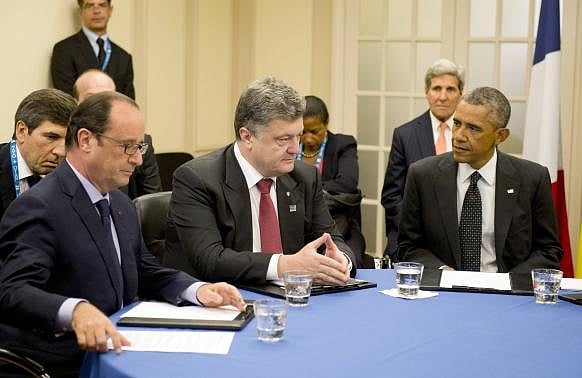
French President Francois Hollande, Ukrainian President Petro Poroshenko, U.S. President Barack Obama, British Prime Minister David Cameron, German Chancellor Angela Merkel and Italian Prime Minister Matteo Renzi meet to discus Ukraine at the NATO summit at the Celtic Manor resort, near Newport, in Wales September 4, 2014.Reuters
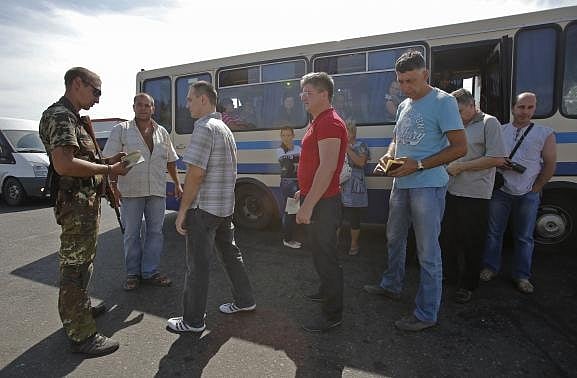
A pro-Russian separatist checks documents of bus passengers at a checkpoint outside the village of Kreminets near the city of Donetsk, eastern Ukraine, September 4, 2014. Reuters
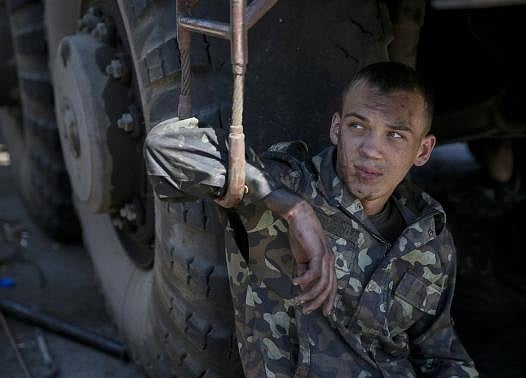
A Ukrainian army serviceman rests as he repairs military vehicles at his camp near Kramatorsk September 4, 2014. Reuters
A Ukrainian military source said troops were bracing for a potential attack on the city.
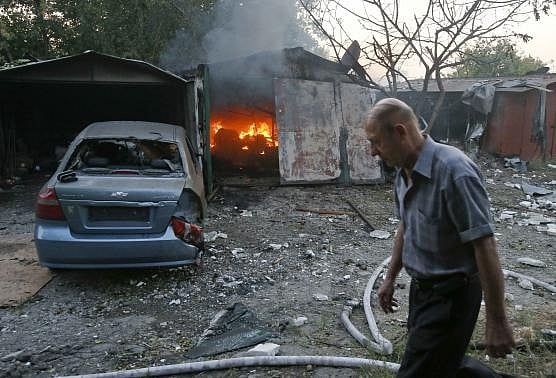
Government shells rained down overnight on a residential district of Donetsk, capital of one of the rebels' two self-proclaimed independent states.
The West has backed Kiev by imposing economic sanctions on Moscow, but has also made clear it will not fight to protect the country, where pro-Russian rebels rose up in two provinces after Moscow annexed the Crimea peninsula in March.
Poroshenko was invited to meet US President Barack Obama, Germany's Angela Merkel, France's Francois Hollande and other Western leaders at the NATO summit in Wales, hosted by Britain's David Cameron.
The summit stage was set with harsh words for Russia: "To the east, Russia has ripped up the rule book with its illegal, self-declared annexation of Crimea and its troops on Ukrainian soil threatening and undermining a sovereign nation state," Obama and Cameron wrote in a joint newspaper editorial.
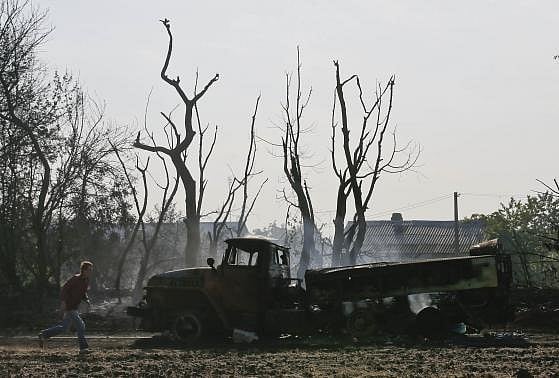
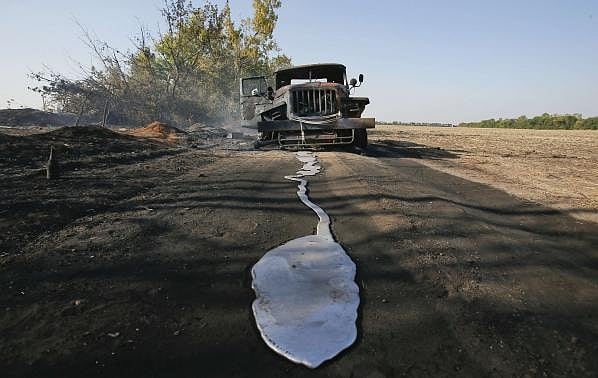
A puddle of melted material is pictured in front of a burnt truck belonging to Ukrainian forces on a road near the village of Berezove, southwest from Donetsk, September 4, 2014. Reuters
But after the announcement of the potential ceasefire, Western officials appeared to take a softer line.
German Foreign Minister Frank-Walter Steinmeier said he was moderately optimistic that de-escalation could be achieved.
The prospect of a ceasefire could also give France an opportunity to reverse a decision to postpone the delivery of a French helicopter carrier warship to Russia, due next month.
"What are the conditions (of delivering the ship)? A ceasefire and a political settlement. Today those conditions are not in place," Hollande said.
If there were further complications the delivery would be delayed, but the contract would not be suspended, he added.
Moscow had accused him of caving in to US political pressure: "France's reputation as a reliable partner that carries out its contractual obligations has been thrown into the furnace of American political ambitions," Russian Foreign Ministry deputy spokeswoman Maria Zakharova wrote on Facebook.
Conflicting signals
The past few days have seen conflicting signals from both Moscow and Kiev.
Putin made a number of belligerent statements over the past week before unveiling his peace proposal on Wednesday and discussing it by telephone with Poroshenko.
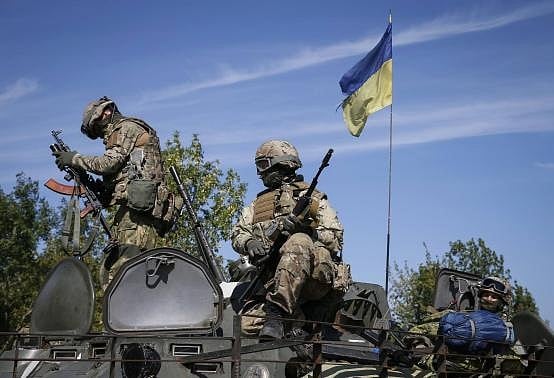
Members of the military special forces sit on an armoured vehicle near Kramatorsk September 4, 2014. Reuters
The Ukrainian leader hinted at a possible ceasefire on his website on Wednesday, but that wording was later dropped.
His prime minister, Arseny Yatseniuk, derided Putin's peace proposal as a "deception" and said Putin's real aim was to "destroy Ukraine and restore the Soviet Union".
Ukraine has previously refused to discuss any political deal with the rebels, calling them terrorists and proxies of Moscow.
But with the hope evaporating of a swift victory, Poroshenko may have felt it is now time to hear the Kremlin's offer.
This week the rebels dropped a demand for full independence and said they would accept some kind of special status in Ukraine. That lifts one of the main obstacles to peace talks.
Russian Foreign Minister Sergei Lavrov discussed the ceasefire with his French and German counterparts, and accused Washington of trying to undermine the nascent peace process.
Putin's peace offer would leave rebels in control of territory that accounts for a tenth of Ukraine's population and an even larger chunk of its industry.
It would also require Ukraine to remain unaligned.
Kiev had said last week it would try to join NATO, although full membership is unlikely since several members oppose it.
The rebels said they would agree as part of the ceasefire to allow a humanitarian corridor for aid and refugees.
The truce would be monitored by observers from the Organisation for Security and Cooperation in Europe.
On the ground, there has so far been no sign yet of any ceasefire. Government forces shelled the southern outskirts of the rebel bastion of Donetsk overnight.
Bomb shelter
Houses in Donetsk's leafy Petrovka district were pockmarked with shrapnel. Residents had sought refuge in a bomb shelter.
A man runs past a burnt truck belonging to Ukrainian forces near the village of Berezove, southwest from Donetsk, September 4, 2014. Reuters
"I don't think they can reach any agreements now. Each side comes up with conditions unacceptable for the other. And so we get shelled," said Lena, who declined to give her surname.
Reuters journalists saw a rebel column including a tank driving south from Donetsk towards the village of Berezovo.
Residents said three burnt out military trucks in the village had carried Ukrainian troops that came under attack.
Government troops had been on the offensive since Poroshenko took office in June, squeezing the rebels into two provincial capitals, Donetsk and Luhansk.
But last week the rebels turned the tide with an advance along the coast of the Sea of Azov.
A NATO officer, speaking on condition of anonymity, said NATO believed several thousand Russian troops were in Ukraine with hundreds of tanks and armoured vehicles.