


Published : 23 Nov 2019, 03:29 PM
Updated : 08 Apr 2022, 02:30 PM


The British foreign minister, Dominic Raab, was quoted as saying in October that “unaccompanied minors or orphans” who were caught up in the fighting in Syria could be returned to Britain “assuming they would not represent a security threat.”
On Thursday, Raab said that repatriating such children “was the right thing to do.”
“These innocent, orphaned, children should never have been subjected to the horrors of war,” Raab said in a statement. “Now they must be allowed the privacy and given the support to return to a normal life.”
Britain has been among the most resistant countries to repatriate its citizens, even stripping a teenager, Shamima Begum, who traveled to Syria to marry an Islamic State fighter, of her citizenship.
But pressure on European countries to repatriate them has increased since Turkey invaded Kurdish-controlled territory in northern Syria last month. President Recep Tayyip Erdogan of Turkey said in recent weeks he would deport dozens of captured Islamic State militants and their families.
British authorities did not make the number of children or their age public or offer any other details, but a senior Kurdish official posted on Twitter that three British orphans of parents who had joined the Islamic State had been handed over to a British delegation.
The Rojava Information Center, an information service led by activists in Kurdish-held areas, said the children were ages 7 to 10.
The Kurdish official, Abdulkarim Omar, posted a video on Facebook in which he is seen greeting Britain’s special envoy for Syria, Martin Longden, and signing documents that appear to make the handover official.
The legacy of the Islamic State “still creates victims, including the children of their own foreign fighters,” Longden says in the video. “Those children, they have no responsibility for the situation they now find themselves in.”
An email sent to the foreign secretary’s office seeking comments was not immediately answered Friday.
Human rights organizations and lawyers have urged governments to take back families who traveled to territories once controlled by the Islamic State, arguing that the longer the children stay, the harder it will be to reintegrate them into their home country.
In April, Kosovo repatriated more than 70 children, and Central Asian countries have taken back hundreds of others, including more than 350 in Kazakhstan.
But the prospect of the potential return of children of Islamic State members has been met with much greater resistance overall. Since the US-led coalition defeated the Islamic State in its last territory in March, European nations have repatriated just a limited number of children and families on a case-by-case basis.
France repatriated five children in March and 12 more in June. That same month, Belgium took back six children and Norway five. Omar, the Kurdish official, said Tuesday on Twitter that Kurdish forces had handed over an orphaned child to a Danish delegation.
Courts in some countries, including the Netherlands and Belgium, have ruled that some families should be repatriated, but in general, analysts say, European governments have taken a passive approach on repatriation.
“European governments have taken the few fighters and families sent in their direction by Turkish authorities or the Kurds, but they are not proactively demanding repatriation or seeking to accelerate it,” said Thomas Renard, a senior research fellow at the Egmont Institute, a research group in Brussels.
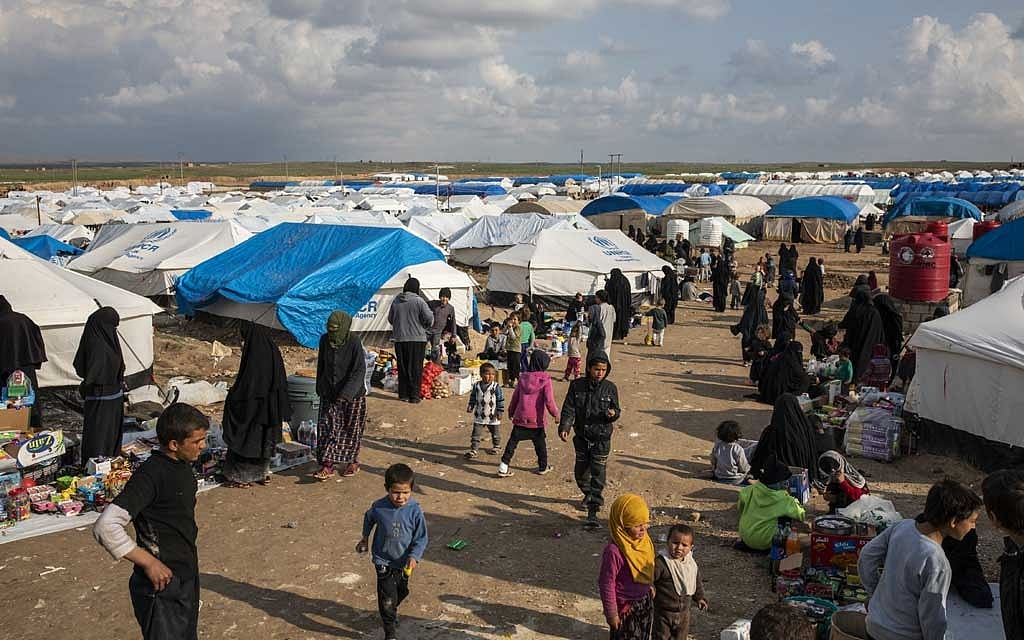
Nonprofit organizations and experts have warned that thousands of women and children remain stranded in squalid camps, suffering from, and dying of, malnutrition, disease, and in the winter, exposure to the cold.
Yet, while the Turkish incursion in northern Syria may have prodded European governments to address repatriations, it may have made the returns more complicated, analysts said.
“The Kurdish forces used to be the only interlocutor for repatriation, and now we’ve added Turkey, and potentially another interlocutor if the regime of Bashar al-Assad puts its hands on citizens of European countries at some point,” Renard said, referring to the Syrian leader.
As Turkish forces moved into Kurdish-controlled territories in northern Syria last month, Kurdish militias struck a deal with the Russian-backed Syrian government allowing Assad’s army to retake control of northern territories. That fed fears among Western governments that citizens could be detained by Syrian forces and then used as bargaining chips.
The announcement that Britain would take back at least some children from Syria was welcomed by advocates, although they urged the government to repatriate more. “It shows that the route remains open and the repatriations are possible, despite the tense situation on the ground,” said Orlaith Minogue of the charity Save the Children.
Estimates vary, but up to 60 British children are still in Syria, according to the organization.
“Three children are the tip of the iceberg,” said Joanna Cook, a senior researcher fellow at the International Center for the Study of Radicalization at King’s College in London.
Cook said that by repatriating only orphaned children, British authorities were creating a “hierarchy of victims,” with the most vulnerable orphans seen as the most acceptable to be repatriated.
“That is not addressing the problem in the way the current situation requires it,” Cook added.
©2019 The New York Times Company







