


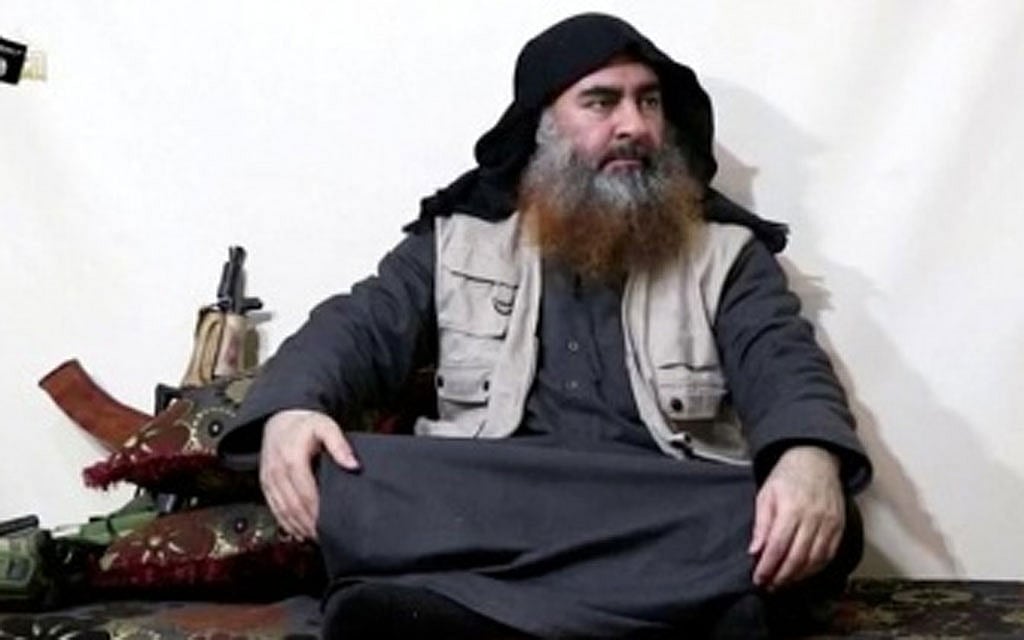
Published : 27 Oct 2019, 07:38 PM
Updated : 05 Aug 2022, 06:00 PM


“Last night, the United States brought the world’s No. 1 terrorist leader to justice,” Trump said in an unusual nationally televised address from the White House. “Abu Bakr al-Baghdadi is dead.”
Trump said al-Baghdadi was chased to the end of a tunnel, “whimpering and crying and screaming all the way” as he was pursued by American military dogs. Accompanied by three children, al-Baghdadi then detonated a suicide vest, blowing up himself and the children, Trump said.
Al-Baghdadi’s body was mutilated by the blast, but Trump said tests had confirmed his identity. The president made a point of repeatedly portraying al-Baghdadi as “sick and depraved” and him and his followers as “losers” and “frightened puppies,” using inflammatory, boastful language unlike the more solemn approaches by other presidents in such moments. “He died like a dog,” Trump said. “He died like a coward.”
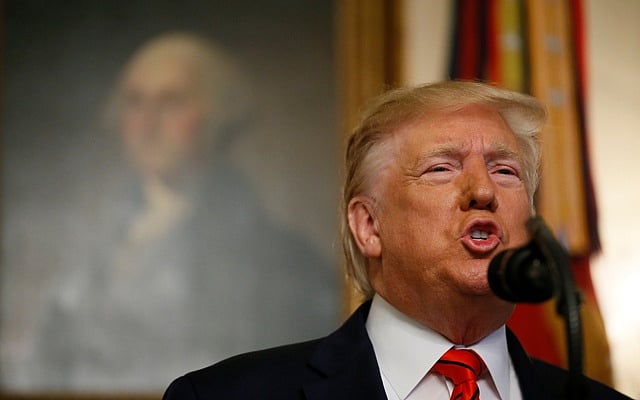
US President Donald Trump makes a statement at the White House following reports that US forces attacked Islamic State leader Abu Bakr al-Baghdadi in northern Syria, in Washington, US, October 27, 2019. Reuters
Trump, who is under threat of impeachment for abuse of power by pressuring Ukraine to investigate his domestic political rivals, appeared eager to claim credit for the raid, engaging in a lengthy question-and-answer session with reporters after his statement as he personally walked them through the details, promoted his own role and compared himself favourably to past presidents.
The White House released a photograph of Trump surrounded by top advisers on Saturday in the Situation Room where he monitored the raid on al-Baghdadi’s hideout in Syria, much like the famed image of President Barack Obama watching the raid that killed Osama bin Laden in 2011. He even seemed to suggest that killing al-Baghdadi was a bigger deal than killing bin Laden.
Al-Baghdadi never occupied the same space in the American psyche as bin Laden but proved to be a tenacious and dangerous enemy of the United States and its allies in the Middle East.
The son of a sheepherder from Iraq, al-Baghdadi, 48, was arrested by occupying American forces in 2004 and emerged radicalised from 11 months of captivity and came to assemble a potent terrorist force that overtook al-Qaida. He promoted a virulent form of Islam and at one point controlled a swath of territory the size of Britain.
For Trump, a successful operation against al-Baghdadi could prove both a strategic victory in the battle against the Islamic State and a politically useful counterpoint to critics in both parties who have assailed him in recent weeks for withdrawing American troops from northern Syria, which allowed Turkey to attack and push out America’s Kurdish allies. A senior American official confirmed that Kurdish intelligence officials in both Syria and Iraq helped locate the target of the raid despite the tensions over the Turkish operation.
But experts have long warned that even eliminating the leader of shadowy organisations like the Islamic State does not eliminate the threat. Al-Baghdadi has been incorrectly reported killed before, and American military officials were concerned that Trump, who posted a cryptic message on Twitter on Saturday night teasing his Sunday announcement, was so eager to announce the development that he was getting ahead of the forensics.
A Defense Department official said before the president’s announcement that there was a strong belief — “near certainty” — that al-Baghdadi was dead, but that a full DNA analysis was not complete. The official said that with any other president, the Pentagon would wait for absolute certainty before announcing victory. But Trump was impatient to get the news out, the official said, and Defense Secretary Mark T Esper agreed to go on the Sunday morning shows as a last-minute addition to the programs to promote the apparent success.
Critics of the president’s decision to withdraw American forces quickly argued that the operation took place in spite of, not because of, Trump and that if the military had not slow-rolled his plan to withdraw, the raid would not have been possible. Rather than justifying a pullout, they said, the raid underscored the importance of maintaining an American military presence in Syria and Iraq to keep pressure on the Islamic State.
“We must keep in mind that we were able to strike Baghdadi because we had forces in the region,” said Rep. Michael Waltz, R-Fla., a former Army Green Beret. “We must keep ISIS from returning by staying on offense.”
Al-Baghdadi has been the focus of an intense international manhunt since 2014 when the terrorist network he led stormed onto the scene in the Middle East, seizing huge parts of Iraq and Syria with the intention of creating a caliphate for Islamic extremists. He was believed to hew to extreme security measures, even when meeting with his most-trusted associates.
If al-Baghdadi’s death is confirmed, it would set off a succession struggle among top Islamic State leaders. Many other top leaders have been killed in American drone strikes and raids in the past few years. Anticipating his own death, al-Baghdadi delegated authorities to regional and functional lieutenants to ensure that the Islamic State operations would continue.
“There are few publicly well-recognized candidates to potentially replace al-Baghdadi,” said Evan F Kohlmann, who tracks militant websites at the New York security consulting firm Flashpoint Global Partners.
© 2019 The New York Times Company










