


Published : 07 May 2019, 06:10 PM
Updated : 17 Oct 2022, 11:39 AM


Trump’s threat to increase tariffs on $200 billion worth of Chinese goods Friday morning followed a visit last week by his top advisers to Beijing, in which the Chinese “retreated” on parts of the deal, the advisers said.
“We’re moving backwards instead of forwards, and in the president’s view that’s not acceptable,” Robert Lighthizer, the president’s top trade negotiator, told reporters Monday.
Trump on Sunday threatened to hit nearly all of China’s exports to the United States with tariffs. The president was angered by China’s attempt to reverse commitments to essentially codify an agreement to provide American companies with more equal treatment, according to people familiar with the negotiations. The president was also irked by China’s insistence that the United States quickly lift all the tariffs Trump had placed on $250 billion worth of imports.
A final trade agreement could still be reached, and China, which depends on the US economy for trade, said Monday that it still planned to send a delegation to the United States this week for talks. However, a spokesman for the Chinese Foreign Ministry declined to specify on Monday whether Vice Premier Liu He, who has led the talks for the Chinese, would travel to the United States for scheduled meetings, instead saying that “the Chinese team is preparing to go to the US for consultations.”
Treasury Secretary Steven Mnuchin said the United States would reconsider imposing higher tariffs on China if the negotiations got “back on track.” He added that negotiators had been optimistic in the past about the prospects for a deal, but that recent interactions with the Chinese had moved negotiations “substantially backwards.”
Trump’s last-minute warning highlights the difficult political position facing his administration as it tries to convince businesses, lawmakers and consumers that the deal it strikes with China will truly level the playing field and put the United States in a better economic position. He is also facing pressure to show that the pain of his trade war will be worth it for the companies, farmers and consumers caught in the middle.
On Monday, Trump repeated his insistence that China rebalance its economic relationship with the United States and end its role as a net exporter of goods.
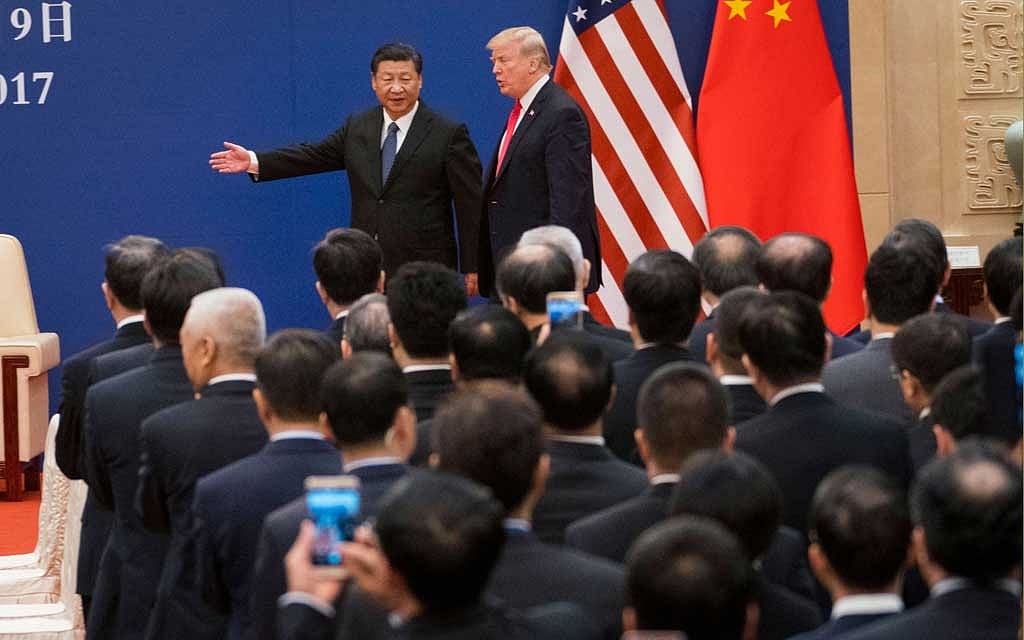
President Donald Trump and President Xi Jinping of China in Beijing, Nov 9, 2017. Trump upended what appeared to be steady progress toward reaching a trade pact after he threatened on May 5, 2019, to impose still more tariffs on Chinese-made goods unless Beijing moves closer to a deal. The New York Times
The decision to up the ante came after Trump’s trade advisers returned dismayed by China’s refusal to mention commitments it had made to update various Chinese laws in the final text of the trade agreement.
Instead, Chinese negotiators had insisted that any concessions would need to be achieved through regulatory and administrative actions, not through changes made to Chinese law through its legislature. The provisions included, but were not limited to, the forced transfer of technology from American companies to Chinese firms, the people familiar with the negotiations said.
Chinese negotiators have also continued to insist that Trump lift the tariffs he has placed on $250 billion worth of goods more quickly than the administration wants. With the two sides still disagreeing over issues including how China subsidizes its companies, its restrictions on data transfers, rules for foreign cloud computing companies and its approvals of genetically modified seeds, the president concluded that China’s offers were not good enough.
Late last week, Trump and a small circle of advisers decided the United States was in a strong enough economic position to ramp up tariffs on $200 billion worth of Chinese exports. People familiar with the president’s thinking said he believed a strong American economy would enable the United States to withstand any blowback from those higher tariffs — including Chinese retaliation — until China was ready to come back to the negotiating table.
His unconventional approach drew accolades from both sides of the political aisle.
“Hang tough on China, President @realDonaldTrump,” Sen. Chuck Schumer, the Democratic leader, said on Twitter.
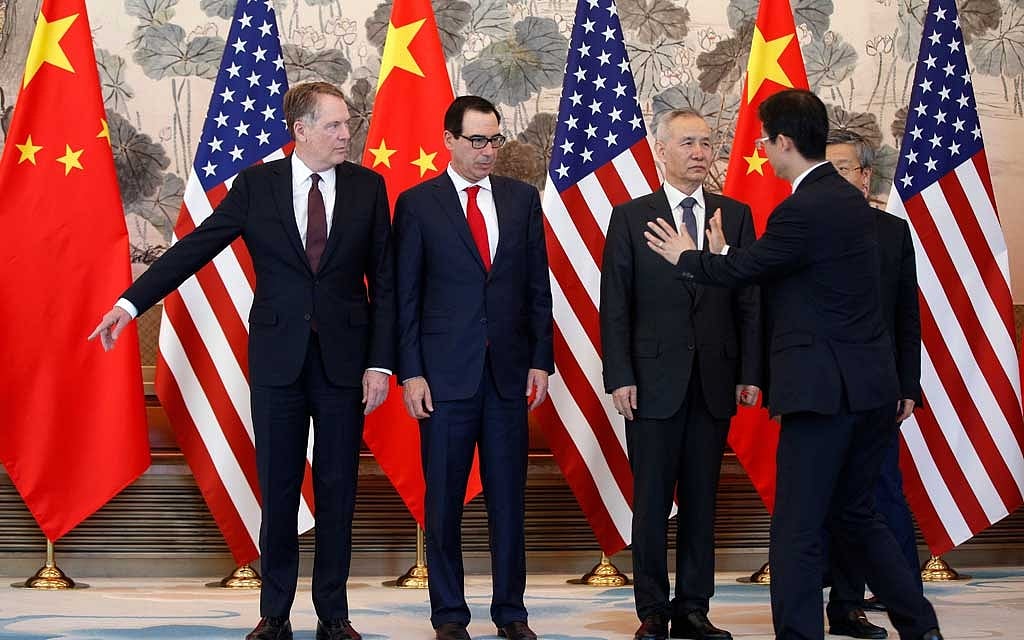
Vice Premier Liu He of China, second from right, with Treasury Secretary Steven Mnuchin, second from left, and Robert Lighthizer, the US trade representative, far left, after a meeting in Beijing, May 1, 2019. The New York Times
Advisers to Trump say he has felt vindicated by a string of positive economic data, in particular the first-quarter gross domestic product, which increased partly as a result of rising exports. While economists have attributed economic growth in the first quarter to a variety of factors, the president and his advisers interpreted the figures as evidence that his tariffs are reducing the trade deficit and boosting growth.
Trump’s belief that his trade war is not having an economic downside is fuelling his insistence that some of the tariffs on China remain in place. But China has insisted that all the tariffs must come off as part of the deal.
The president has turned to tariffs as a source of leverage to bring other negotiations to the close. In talks last year over the North American Free Trade Agreement, Trump threatened to leave Canada out of the deal and strike a deal with Mexico, a gambit that brought negotiations to a rapid conclusion.
Yet analysts have questioned whether volatility in the stock markets could change the president’s mind. He has repeatedly referred to stock markets as a kind of scoreboard for his presidency.
In a note Monday, Joshua Shapiro, chief US economist for MFR, an economic research firm, said his forecast and most others assumed that the US-China trade talks resulted in no further damage, at a minimum. “Given expectations of an agreement, failure to achieve one would be a serious blow to markets and the economy,” he wrote.
©2019 New York Times News Service







