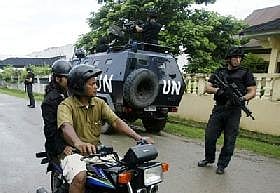
State of emergency in East Timor amid chaos
Australian troops began arriving in East Timor on Tuesday to help enforce a state of emergency declared after a double assassination attempt that left the tiny nation's president in hospital with triple gunshot wounds. Here is a timeline showing the political instability that has dogged East Timor since independence in 2002:
bdnews24.com News Service
bdnews24.com
Published :
12 Feb 2008, 07:13 AM
Updated :
24 Apr 2022, 08:11 PM
Jan 12, (bdnews24.com/Reuters) - Australian troops began arriving in East Timor on Tuesday to help enforce a state of emergency declared after a double assassination attempt that left the tiny nation's president in hospital with triple gunshot wounds.
Here is a timeline showing the political instability that has dogged East Timor since independence in 2002:
- May 20, 2002: East Timor becomes an independent nation, after a period of UN administration following an historic 1999 vote that ends Indonesia's post-1975 occupation. Former guerrilla leader and independence hero Xanana Gusmao becomes president.
- Dec 4: Capital Dili under curfew after rioting blamed on regrouping Indonesian-backed militiamen. Several people are shot dead in clashes and the prime minister's house is burned down.
- May 19, 2003: United Nations extends mandate of 3,800-strong UN Mission in East Timor (UNMISET) for a year.
- March 9, 2005: Indonesia and East Timor launch joint truth commission to address 1999's bloody rampage which saw about 1,000 killed, mostly by pro-Jakarta militia.
- April 28: UN Security Council votes to keep scaled-back U.N. presence in East Timor for another year.
- Feb 8, 2006: Hundreds of soldiers, many of them former independence fighters, go on strike over pay and alleged discrimination.
- March 16: Premier and military chief Mari Alkatiri sacks 600 of the country's 1,400-strong army on charges of desertion. The move inflames the country's east-west divide and unleashes months of chaos which see an estimated 100,000 people displaced and 37 killed.
- May 25: The first of 2,500 peacekeepers from Australia, New Zealand, Malaysia and Portugal arrive to quell violence.
- July 10: Nobel Peace Prize laureate Jose Ramos-Horta sworn in as interim prime minister. Two weeks after Alkatiri steps down amid accusations he was responsible for the crisis.
- Aug. 30, 2006: Major Alfredo Reinado, one of the figureheads of the May revolt, walks out of a Dili jail with 50 other inmates, embarrassing security forces.
- March 4, 2007: Reinado escapes a raid by foreign troops on his hideout, but four people are killed in the ensuing gunbattle.
- March 5: Thousands of people take to the streets, burning tyres and blocking roads, to protest against the attempt to capture Reinado.
- May 20: Ramos-Horta sworn in as country's second president after elections.
- June 30: Parliamentary election sees former ruling party Fretilin win 21/65 parliament seats, far short of majority needed to rule. Gusmao's party, the CNRT, takes 18 seats.
- Aug. 6: New coalition government led by Gusmao sworn in by Ramos-Horta to end political stalemate. Violence breaks out following day as Fretilin supporters decry Gusmao's appointment as prime minister.
- Feb. 7, 2008: Rebels loyal to Reinado fire on Australian troops patrolling Dili, but no one is hurt.
- Feb. 11: Reinado is killed and Ramos-Horta shot and wounded in an early morning rebel attack on the president's house. Ramos-Horta is airlifted to Australia for surgery and about 200 fast-reaction Australian troops sent to Dili.
Prime Minister Gusmao escapes a similar attack that leaves his car riddled with bullets.
- Feb. 12: Interim President Vicente Guterres declares a 48-hour state of emergency.
bdnews24.com/lq/1310hrs