


Published : 10 May 2022, 01:49 AM
Updated : 18 Jul 2022, 02:52 PM


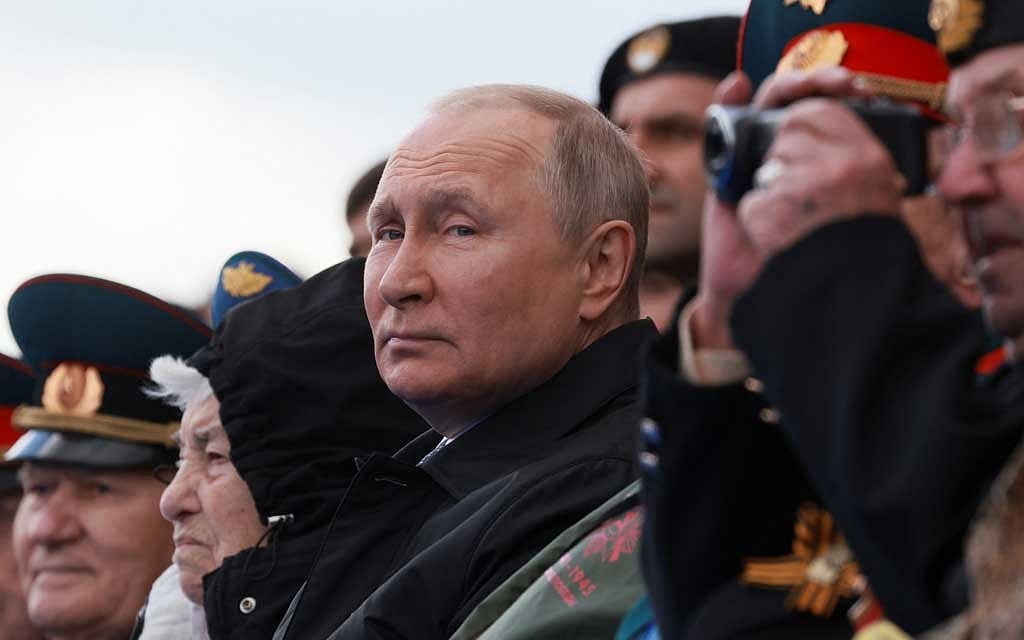
Instead, Russian President Vladimir Putin stood in Red Square in Moscow on Monday, on Russia’s most important secular holiday, and delivered a message for the broader Russian public: that they could keep on living their lives. The military would continue fighting to rid Ukraine, in his false telling, of “torturers, death squads and Nazis,” but Putin did not make any new attempt to prepare his people for a wider conflict.
The calibrated tone shows that although some Western officials predicted Putin would use the May 9 holiday to double down on the war, he remains cautious about demanding too much from regular Russians. The only policy announcement Putin made in his speech, in fact, was one aimed at assuaging the pain directly caused by the war — signing a decree to provide additional aid to the children of killed and wounded soldiers.
“He has developed a certain sense of what is and is not possible,” said Gleb Pavlovsky, a close adviser to Putin until falling out with him in 2011, explaining why the Russian leader does not appear ready to order a mass mobilisation. “He understands that no propaganda can by itself force someone to die.”
Western and Ukrainian officials had speculated that Putin could use the martial pomp of the May 9 holiday to declare Russia is in a state of war and expand military conscription, allowing him to increase his depleted forces that have experienced so many struggles on the battlefield.
But rather than prepare society for more sacrificing, Putin gave what was, in many ways, a subdued speech compared with the fiery rhetoric he has deployed on other occasions over the past two months; it was also the speech, of all his recent appearances, that the Russian people were most likely to see, since it came during the televised Victory Day parade, the Russian state’s marquee annual event celebrating the Soviet victory over Nazi Germany in World War II.
Some analysts say that although polls show there is broad support for the war in Russia, there appears to be concern in the Kremlin that this support is not deep. Pavlovsky said Putin seems keen to avoid doing further damage to the unspoken deal with the Russian people that he fashioned after coming to power: Regular Russians stay out of politics, and the Kremlin largely lets them live their lives.
Indeed, while more than 15,000 Russians were arrested at anti-war protests in the first weeks of the war, the vast majority stayed silent, even if they opposed it. And although Western sanctions have hit Russia’s economy, it has not collapsed, allowing many people to continue living largely as they had before the Feb. 24 invasion.
Independent pollster Levada found last month that 39% of Russians were paying little to no attention to what the Kremlin calls the “special military operation” in Ukraine.
A mass mobilisation of the Russian public, or a switch to a wartime economy, would undermine that balance, bringing the reality of war into many more households.
“It could turn out that people are prepared to support the war while sitting at home in front of the TV, as they say, but that they are not at all prepared to go and fight,” Pavlovsky said. “That’s the central position that Putin understands and is trying not to touch.”
But some analysts warned that even if Putin defied some Western expectations Monday, the threat of escalation remained high in the coming weeks. Tatiana Stanovaya, who has long studied Putin and founded France-based political analysis firm R. Politik, said that it’s likely that Putin simply saw the Victory Day parade as the wrong time and place to signal an escalation — especially because many Russians were still enjoying the country’s traditional holiday period of early May.
She said that the greatest danger lay in Putin’s frustration at the West’s arms deliveries to Ukraine and that he might use Russia’s vast nuclear arsenal to deter it by detonating a single weapon to demonstrative effect. In Putin’s narrative, the West is goading Ukraine into resistance in order to weaken Russia; late last month, Putin warned that countries that “create a strategic threat to Russia” could expect “retaliatory strikes” that would be “lightning fast.”
“In his understanding, the problems that Russia is facing in Ukraine right now stem not from a lack of forces but from the West arming Ukraine,” Stanovaya said. “He’s at war with the West, so he has to show the West that it must retreat. And he has to show it in a way that really scares everyone.”
©2022 The New York Times Company













