


Published : 01 Jan 2017, 10:28 PM
Updated : 11 Apr 2022, 08:50 PM


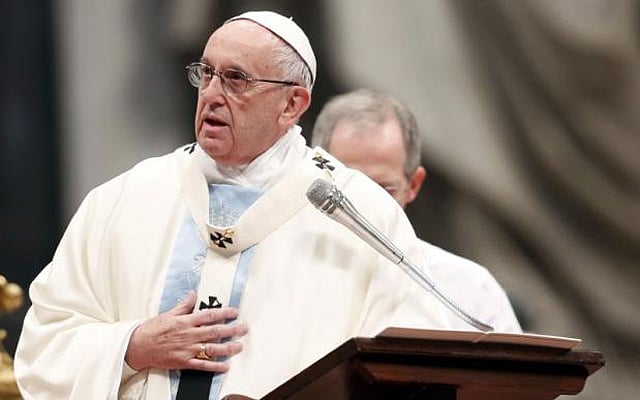
Speaking to some 50,000 people in St. Peter's Square for his traditional noon address, Francis departed from his prepared text to condemn the Istanbul nightclub attack that killed at least 39 people.
"Unfortunately, violence has stricken even in this night of good wishes and hope. Pained, I express my closeness to the Turkish people. I pray for the many victims and for the wounded and for the entire nation in mourning," he said.
"I ask the Lord to sustain all men of good will to courageously roll up their sleeves to confront the plague of terrorism and this stain of blood that is covering the world with a shadow of fear and a sense of loss," he said.
He said 2017 will be what people make of it.
"The year will be good in the measure that each one of us, with the help of God, seeks to do good day after day," he told the crowd on a cold morning.
Speaking on the day the 1.2 billion-member Roman Catholic Church marks its World Day of Peace, he said peace was constructed by saying 'no' to hate and violence and 'yes' to brotherhood and reconciliation.
Francis earlier said Mass in St. Peter's Basilica, where in a homily he said the lack of physical contact among people brought on by modern means of virtual communication "is cauterizing our hearts and making us lose the capacity for tenderness and wonder, for pity and compassion.
A neighbor interviewed by the Globo television network said that he and family members heard blasts about a quarter to midnight but did not immediately recognize it as gunfire, not New Year fireworks.
Only when one of those shot ran into their property, bleeding and asking for help, did they realize that someone had been shooting. State police said they were called to the scene at 12:40 a.m. local time.
Although Brazil struggles with high rates of crime and violence, mass shootings are uncommon. Gun deaths are frequent in heists, holdups and in confrontations among police, drug gangs and other criminals, but shooting sprees like those often seen in the United States are not prevalent.
Campinas, an industrial and university city of over 1 million residents, is located about 100 kilometers northwest of the city of São Paulo, Brazil's biggest metropolis.










