


Published : 09 Apr 2019, 02:21 PM
Updated : 08 Apr 2022, 02:07 PM


The list included the close aide, Saud al-Qahtani, who officially served as the royal court’s media czar, but appeared to have overseen the operation to seize Khashoggi. It was one of a dozen or so operations by what US intelligence officials called the Saudi Rapid Intervention Group, set up by al-Qahtani to silence or eliminate dissent about Crown Prince Mohammed’s rapid rise to become the de facto Saudi leader.
But conspicuously missing from the list is the crown prince himself, despite the conclusion by US intelligence agencies that he was ultimately responsible for sending the team to Istanbul to kill Khashoggi, and for other actions by the Rapid Intervention Group. More than a year before Khashoggi’s death, US intelligence officials intercepted a communication from the crown prince saying that if Khashoggi, a Washington Post journalist who lived in Virginia, did not voluntarily return to the kingdom and cease publishing his criticism, the state should go after him “with a bullet.”
Based on the findings of the CIA, which he led until last year, Pompeo would have been free to add the crown prince to the list, though that would have been an unusual move to take against a leader of a close ally. But Pompeo has at times also sounded passive about the investigation, saying he was giving the Saudis time to complete their own inquiry.
By moving to name the Saudis and barring them and their immediate families from traveling to the United States, the Trump administration appears to be trying to tamp down an unusual uprising in Congress that has involved members of both parties.
But it is far from clear that the relatively minor penalty, against Saudis who would be unlikely to enter the United States under current conditions, will be viewed as sufficient. Pompeo and President Donald Trump are likely to still face the accusation that they are deliberately ignoring the CIA’s intelligence findings in an effort to put the killing behind them. Trump once called the report about the crown prince’s involvement a “feeling” by the CIA, and has insisted that the evidence is not conclusive.
It is unclear whether their effort to move on from the killing will work: Congress has already moved to stop all US support for Saudi military action in Yemen, and there are questions about continued military transfers. And Trump’s administration has negotiated for two years now on a deal to sell civilian nuclear power designs and equipment to Saudi Arabia, an action that would require congressional approval and raises concerns about whether the Saudi government might use the technology to seek a nuclear weapon. The crown prince has been explicit that if Iran got a weapon, Saudi Arabia would as well.
The administration regards Saudi Arabia as its key partner in confronting Iran.
The announcement appeared timed to generate little news and less embarrassment for the Saudi crown prince. Pompeo’s list was published Monday evening, on a day in which upheavals at the Department of Homeland Security and Pompeo’s decision to name the Islamic Revolutionary Guards Corps a foreign terrorist organisation dominated headlines. Pompeo had appeared at the State Department press room and took questions on the Iranian designation earlier Monday, making no mention of the approaching announcement on Saudi Arabia.
One US diplomat involved in Saudi affairs who was not authorised to speak on the subject said the decision to act had taken considerable time.
The Saudis have never publicly talked about the whereabouts of al-Qahtani, who was the crown prince’s chief enforcer and one of the architects of the effort to consolidate his power. In private, Saudis say he is under house arrest. But there is no indication whether he is being criminally prosecuted, and some reports indicated that he continued to hold power until the investigation became too hot, and someone near the crown prince had to take the fall.
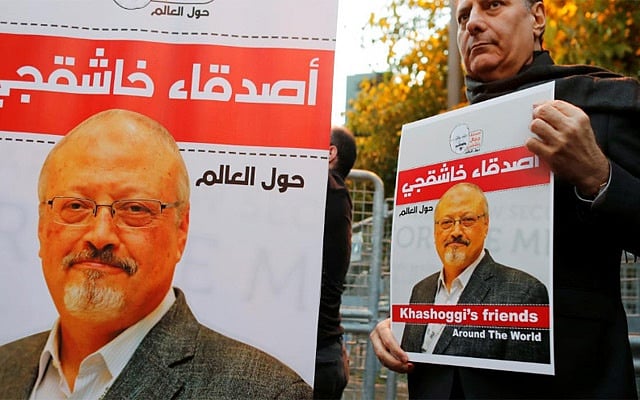
The list of barred Saudis also included several members of the team sent to Istanbul, where Khashoggi was killed at the Saudi Consulate in an encounter that the Saudis insist was intended to forcibly bring him back to Riyadh, the Saudi capital. It includes the leader of that team, Maher Abdulaziz Mutreb, an intelligence officer who knew Khashoggi from their days working together at the Saudi Embassy in London. He often travelled with the crown prince abroad.
Mutreb and another Saudi listed by the State Department, Thaar Ghaleb al-Harbi, a member of the royal guard and a favourite of the crown prince’s for his role in fighting off an attack on one of Crown Prince Mohammed’s palaces, are standing trial, Saudi officials have told The New York Times.
Also listed was Salah Tubaigy, whom The Washington Post recently identified as a “medical specialist” for the Saudi Interior Ministry who is said to have administered a powerful sedative to Khashoggi during a struggle inside the consulate. He died shortly thereafter, perhaps because of the sedative, or his asthma, or because of strangulation.
His body was cut up and has never been recovered.
Much of the evidence against the men named in the State Department’s list came from Turkey, which had surveillance videos outside the consulate and had apparently bugged the consulate itself, resulting in an audio recording of the killing.
@2019 New York Times News Service













