Pakistan seeks US help to ease India tensions
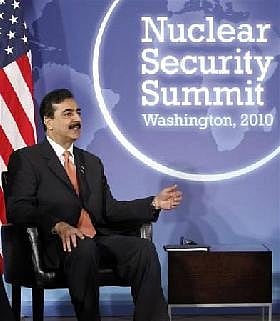
Pakistan's Prime Minister Yusuf Raza Gilani urged Washington on Monday to help ease tensions with India but said there were no plans for the rivals to meet on the sidelines of a nuclear summit.
bdnews24.com News Service
bdnews24.com
Published :
13 Apr 2010, 04:57 AM
Updated :
10 Aug 2022, 10:38 PM
WASHINGTON, Apr 13 (bdnews24.com/Reuters) - Pakistan's Prime Minister Yusuf Raza Gilani urged Washington on Monday to help ease tensions with India but said there were no plans for the rivals to meet on the sidelines of a nuclear summit.
Gilani said US President Barack Obama raised Pakistani-India tensions during their White House meeting on Sunday. Obama met separately with India's prime minister on the same day.
"President Obama discussed with me that he really wants ... good relations (between India and Pakistan) and certainly it is in everybody's interests to play a role, whatever they can play, to bring Pakistan and India closer," Gilani said.
Pressed on whether Obama offered specific help on issues such as resolving the dispute over Kashmir, Gilani told reporters this was not discussed.
Asked whether he would meet India's Prime Minister Manmohan Singh while both men are in Washington for a summit on nuclear security, Gilani replied: "It is not scheduled at the moment."
Indian officials said Singh gave Obama a list of concerns about Pakistan during their Sunday meeting, particularly over the activities of Lashkar-e-Taiba, the Pakistan-based militant group responsible for the Mumbai attacks.
New Delhi complains Pakistan has not reined in the group or punished those responsible for the November 2008 attacks on India's financial capital.
MUMBAI ATTACKERS
Asked about India's complaints, Gilani said Pakistan did not want its soil to be used by militant groups and Islamabad had banned Lashkar-e-Taiba and frozen their bank accounts.
But he said Pakistan needed more evidence from India over the group. "If there is more information they will be brought to justice," he added.
India and Pakistan have fought three wars since their independence from British rule in 1947 and launched a tentative peace process in early 2004.
India suspended those talks after the Mumbai attacks and senior diplomats held their first official dialogue last month, although no breakthrough emerged.
Pakistan's Foreign Minister Shah Mehmood Qureshi said India needed to "look beyond Mumbai."
"Mumbai was sad, Mumbai was tragic and should not have happened. But we are as much victims of terrorism as Indians are," Qureshi told reporters after Gilani's media lunch.
Asked what role Washington could play in the peace process, he said: "To nudge us together and to facilitate the process."
Qureshi said the United States -- which has more than 80,000 troops in Afghanistan -- would benefit from improved ties between India and Pakistan as Islamabad could shift its focus from its eastern border.
"The more ease we have on the eastern front, the better equipped we are to deal with the western front (Afghanistan)," said Qureshi.
Gilani repeated a plea for Pakistani access to civilian nuclear technology, an irritant in US-Pakistani ties as New Delhi has its own nuclear deal with Washington.
"We believe that the objectives of nuclear nonproliferation would be better served if the policy of nondiscrimination is adopted across the globe for peaceful uses of nuclear energy," Gilani said.
Pakistan is suffering from an energy crisis, with daily power cuts weighing both on the economy and public patience.
Washington has been dubious about even having talks about a nuclear deal, largely due to concerns over the case of a Pakistani scientist Abdul Qadeer Khan, who transferred nuclear secrets to North Korea, Iraq and Iran.
bdnews24.com/kms/1057h.