


Published : 18 Aug 2014, 08:40 PM
Updated : 23 Apr 2022, 03:07 PM


The truce is due to run out at 2100 GMT (5.00 p.m. EDT). A Palestinian source quoted by Egypt's state news agency MENA said Egyptian mediators were making "a big effort to reach an agreement in the coming hours".
Both sides said gaps remain in reaching a long-term deal that would keep the peace between Israel and militant groups in the Gaza Strip, dominated by Hamas Islamists, and allow reconstruction aid to flow in after five weeks of fighting.
Israeli Justice Minister Tzipi Livni addressed the prospect of renewed hostilities, while signaling that Israel would continue to hold its fire as long as Palestinians did the same.
"If they shoot at us, we will respond," Livni, a member of Prime Minister Benjamin Netanyahu's security cabinet, told Israel Radio.
The Palestinian Health Ministry put the Gaza death toll at 2,016 and said most were civilians in the small, densely populated coastal territory. Sixty-four Israeli soldiers and three civilians in Israel have been killed.
Late on Sunday, a Palestinian official said Israel's position in the talks, as presented to them by Egyptian mediators, was a "retreat from what had already been achieved and discussions had returned to square one".
The official, who was not named, told MENA that Israel had toughened its stance and had presented "impossible" demands, particularly on security issues. He said the Palestinians would review the situation and offer their response on Monday.
"We are determined to achieve the demands of our people and foremost is ending the aggression and launching the rebuilding process and lifting the Israeli-imposed blockade of the Gaza Strip," MENA quoted the official as saying.
SECURITY
Netanyahu said on Sunday that any deal on the territory's future had to meet Israel's security needs. He warned Hamas it faced "harsh strikes" if it resumed its attacks.
Hamas also seeks the construction of a Gaza sea port and the reopening of an airport destroyed in previous conflicts, as part of any enduring halt to violence. Livni said such issues should be dealt with at a later stage.
Israel, which launched its offensive on July 8 after a surge in Hamas rocket fire across the border, has shown scant interest in making sweeping concessions, and has called for the disarming of militant groups in the enclave of 1.8 million people.
Hamas has said that laying down its weapons is not an option.
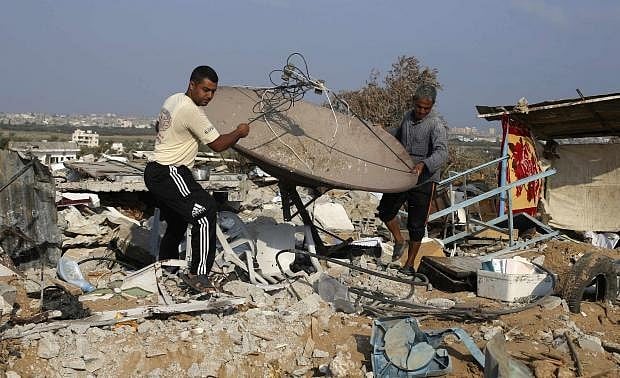
The Gaza offensive has had broad public support in Israel, where militants' rockets, many of them intercepted by the Iron Dome anti-missile system, have disrupted everyday life but caused little damage and few casualties. By contrast, Israeli bombardment of Gaza has wrought widespread destruction.
The United Nations said 425,000 people in the Gaza Strip have been displaced by the conflict.
Israel and Hamas have not met face-to-face in Cairo, where the talks are being held in a branch of the intelligence agency, with Egyptian mediators shuttling between the parties in separate rooms. Israel regards Hamas, which advocates its destruction, as a terrorist group.
In Gaza, Pierre Krähenbühl, head of the United Nations Relief and Works Agency, said he hoped ceasefire talks would lead to substantial change on the ground.
"There has to be a message of hope for the people of Gaza, there has to be a message for something different, there has to be a message of freedom for the people, freedom to move, freedom to trade," Krähenbühl told reporters.
Assange would be arrested if he exited the London embassy because he has breached his British bail terms.
The 43-year-old Australian fled to the embassy in June 2012 to avoid extradition for questioning in Sweden over sex assault and rape allegations, which he denies.
He says he fears that if extradited to Sweden he would then be handed over to the United States, where he could be tried for one of the largest information leaks in US history.
Assange would be arrested if he exited the London embassy because he has breached his British bail terms.
"I am leaving the embassy soon ... but perhaps not for the reasons that Murdoch press and Sky news are saying at the moment," Assange told reporters at the embassy in central London.
Britain's Sky News, part owned by Rupert Murdoch's 21st Century Fox, had earlier reported that Assange was considering leaving the embassy due to deteriorating health.
'CALL OFF THE SIEGE'
WikiLeaks began releasing thousands of confidential U.S. documents on the Internet in 2010. That embarrassed the United States, and some critics say it put national security and people's lives at risk.
Ecuador later granted Assange political asylum. But he was unable to leave Britain and has ended up living in the embassy's cramped quarters in central London.
His comments briefly raised the possibility of his leaving imminently. But Kristinn Hrafnsson, his spokesman, told reporters that he could only do so if the British government "calls off the siege outside". Assange had no intention of handing himself over to the police, he added.
Ecuador's Patino said he would try to hold talks with his British counterpart to resolve the case. Recent changes to British extradition laws may mean Assange would not be facing extradition if his case had just started.
Britain's Foreign Office said it remained as committed as ever to reaching a diplomatic solution to the problem, but reiterated that Assange still needed to be extradited.
"As ever we look to Ecuador to help bring this difficult, and costly, situation to an end," a spokeswoman said.
The Assange issue has put Britain and Ecuador at odds, with London angered by the decision of Ecuador's socialist President Rafael Correa to grant him asylum and Quito unhappy at the British refusal to allow him safe passage.
Asked about his health, Assange said anyone would be affected by spending two years in a building with no outside areas or direct sunlight, a complaint he has made several times before.







