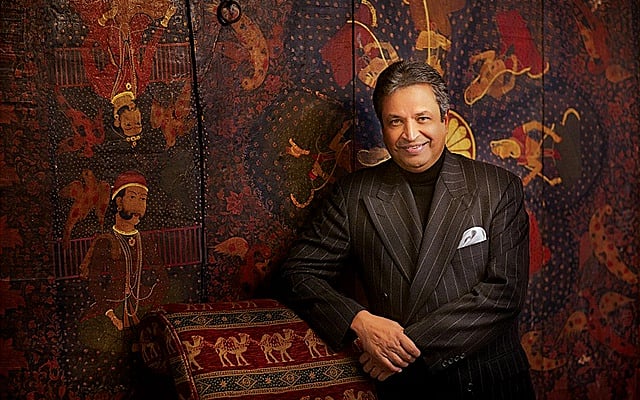
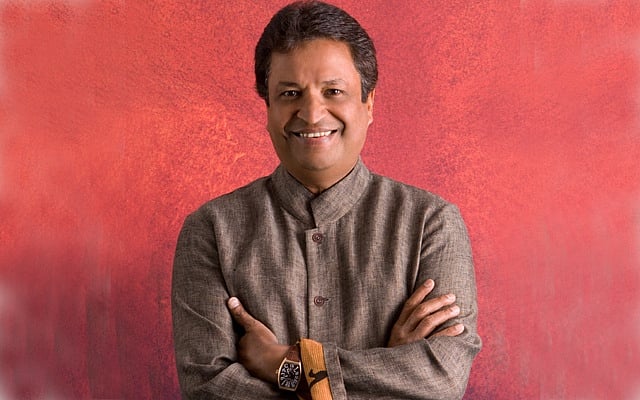
Nepal’s first Forbes billionaire Binod Chaudhary is visiting Dhaka to attend the Social Business Summit organised by micro-credit guru Mohammed Yunus. The chairman of the Cinnovation/ Chaudhury Group owns nearly 80 companies with interests in banking, foods, cement, real estate, hotels, power, retail, electronics. But Chaudhury, 57, faced with restrictions at home, has built much of his estimated $1 billion fortune overseas through his Singapore-based arm Cinnovation. Chaudhury spoke exclusively to bdnews24.com on the eve of his Dhaka visit on a wide range of regional issues:
Q: You are the first billionaire on the Forbes list from your country? How does it feel?
Chaudhury: I am humbled! I have said repeatedly on earlier occasions as well, this is like a Nobel Prize to me after all these years of hard work.
Q: We understand you are visiting Bangladesh. Do you have any specific investment plans for that country?
Chaudhury: I am primarily visiting Bangladesh for two reasons. One is to attend the Social Business Summit organized by Nobel Laureate Prof. Mohammad Yunus’s Yunus Center. We have entered into a partnership agreement to start the Social Business Fund in Nepal, which we are very proud of and something which we want to implement at the earliest. I want to learn from the experiences of Yunus Center’s other partners and decide the strategy on how we go forward. At the Same time, I have been also invited by ICC Bangladesh. My very dear friend Mr. Mahbubur Rahman, President of ICC Bangladesh have decided to felicitate me on a non- South Asian having being recognized with this distinction in Forbes. Likewise, the Embassy of Nepal is also hosting an Interaction with Business Community on the topic “Business and Investment Opportunities in Nepal” where I have been invited.
Q: Do you think his micro-credit model has real durable value for economic development of a poverty stricken region like South Asia?

Chaudhury
: I am convinced that that is the most effective tool for uplifting the deprived sector. Obviously, every movement needs to be implemented properly. Otherwise, there can be distortions. For weaker economies where unemployment and job creation continues to be a big challenge, micro credit is a highly respectable form of self employment generation and contributing to the National economic activity. The cost of credit, however, is an issue which is often used against the micro credit philosophy. This is a serious issue. Over the years, the cost has also come down. One needs to understand that it is a classic debate of what is better; not having the means of supporting the process of job creation and self employment, or paying little bit more towards the admin cost of the same. It’s a question that each one needs to answer based on their own judgment.
Q:
Do you think Nepal should no longer depend on Calcutta port which is dying and develop transit linkages to Bangladesh for use of better ports available in that country?
Chaudhury
: We have explored in the past the use of alternate ports in Chittagong and Khulna. I myself led a delegation as the President of FNCCI, more than 20 years ago to Khulna to explore. One must understand that being philosophical is one thing but being practical is another. Rules of Bangladesh port can only become efficient provided the Indian transit corridor and the infrastructure on all the three sides: in Bangladesh, India and Nepal become strong and are available for use 24/7. It’s a tri- lateral issue which has to be settled in a more logical manner. Leave alone the Bangladesh port, even the idea of using another Indian port like Visakhapatnam for so many regulatory/ logistic reasons has not been practical.
Q:
Do you think Nepal should also look at Bangladesh for power exports?
Chaudhury
: Again it’s a tri- lateral issue. Unless there is a real economic engagement between the SAARC economies and there is a change of the overall environment, it can remain a vision with no strong legs to stand on.
Q:
As someone who has grown in business in South Asia, would you imagine violent politics and agitations such as is common in Bangladesh or Nepal or elsewhere in South Asia holds back the region from achieving its true potential?
Chaudhury
: You’re right. Chaotic political environment and the backlash in Nepal due to transitional politics is a huge challenge for running businesses in a predictable manner. Cost of doing business has become more expensive, our competency to remain competitive in the region is eroding every day. I hope that the wisdom will prevail among the politicians and the political parties and I also hope that the business community will come together including the civil society, to build adequate pressure from the ground. At the end of the day, who are the politicians? They are one of us. And we are the people who elect them.
Q:
Do you think there is any real importance India's neighbours should give to what Prime Minister Manmohan Singh's now famous line ‘India's neighbours should be partners in her economic growth and benefit from it’?
Chaudhury
: Absolutely no issue. As a matter of fact, that’s what the neighbors have been doing historically. Look at the trends of exports, balance of payment and the direction of all socio-economic activities which are all centered towards India. I can speak for my country that Nepal’s total trade relations with India is the largest by far, India is the largest investor, India has the monopsony for our huge energy prospects and many others. India continues to remain the hub for education and medicine, and religious visits for Nepalese across the border. However, unless this trend is balanced and made sustainable, the trouble would be that India will be surrounded by paupers, after India attains the position of becoming the World’s third largest economy. So, India’s peace and stability rests in the neighbours becoming prosperous.
Q:
Would you argue for total open trade in South Asia?
Chaudhury
: From my perspective, on a bi-lateral basis, it is more moving in that direction. Nepal has a virtual open trade with India yet, huge trade imbalance. I guess that is the situation of most South Asian countries. However, as a regional block, everyone knows that SAARC is the poorest example in the World of an economic union. Leave alone a common market, even a preferential trading arrangement as a region is not thinkable. To export goods to Pakistan, although we are connected by landmass, we have to go to either Dubai or Singapore. We’ve already talked about the situation linking the Bangladesh port. Another issue of opening up the markets is- will these smaller economies be able to survive without protecting their National production and services? So far, the trend is that because of the huge inflow of the cheap products from China and India, most of the SAARC countries in local industries are being depleted and production capabilities are eroding. I am worried a day may come when we will have a common market but we’ll have nothing to export.
Q:
What about China? Would you imagine countries like Nepal and Bangladesh would hugely benefit if China and India did not see each other as competitors in South Asia but as collaborates and partners in growth?
Chaudhury
: I am seeing that there is growing collaborative efforts between China and India. But at the same time, Chinese presence is growing and becoming much more effective in many South Asian neighbors of India. Chinese are pumping in big time money and resources to work towards developing many infrastructure projects. India and China need to decide along with such countries what should be a coordinated approach in terms of how the country’s Geo- economic direction move, where the respective country’s resources should be pumped in, and in turn, how there can be a co-existence of both the countries in pulling out the South Asian neighbors form the serious political and economic turmoil.
Q:
One last question -- where do you think Nepal is headed politically and economically?
Chaudhury
: Well, we do have the reminisces of a transitional politics and a confusion arising out of that. Each one is in the process of consolidating their own positions in the country, including the foreign powers. So, at this stage, I don’t think it is realistic to expect that there would be a stable visionary leadership to support Nepal’s aspiration for growth. However, the good News is that due to huge inflow of remittance, the country’s poverty level is going down- which now stands at less than 20 percent. And due to the liberal form of the economy, the overall economic activities are flourishing. In the absence of which, Nepal would not have attained a steady growth of four and a half percent during the last 20 years of conflict and transition