


Published : 02 Apr 2021, 12:25 AM
Updated : 14 Oct 2022, 06:30 PM


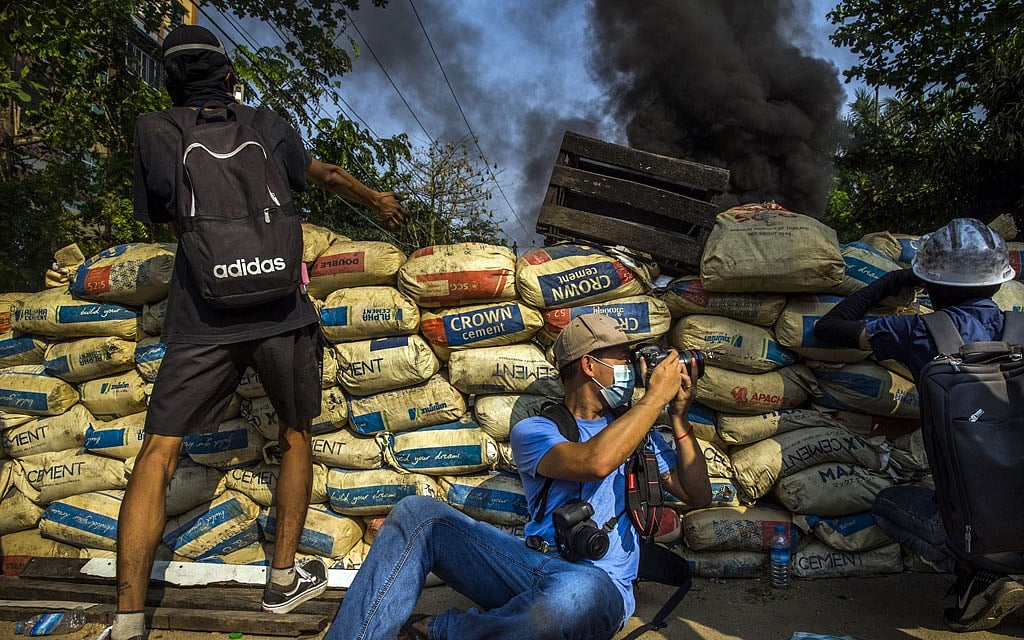
Since then, the regime has arrested at least 56 journalists, outlawed online news outlets known for hard-edge reporting and crippled communications by cutting off mobile data service. Three photojournalists have been shot and wounded while taking photographs of the anti-coup demonstrations.
With professional journalists under pressure, many young people who came of age during a decade of social media and information sharing in Myanmar have jumped into the fray, calling themselves citizen journalists and risking their lives to help document the military’s brutality. They take photographs and videos with their phones and share them online when they get access. It is a role so common now they are known simply as “CJs.”
“They are targeting professional journalists, so our country needs more CJs,” said Ma Thuzar Myat, one of the citizen journalists. “I know I might get killed at some point for taking a video record of what is happening. But I won’t step back.”
Thuzar Myat, 21, noted that few people were able to document the protests in 1988, when the Tatmadaw, as the military is known, stamped out a pro-democracy movement by massacring an estimated 3,000 people. She said she saw it as her duty to help capture evidence of today’s violence even though one soldier had already threatened to kill her if she did not stop.
The regime’s apparent goal is to turn back the clock to a time when the military ruled the country, the media was firmly in its grip and only the wealthiest people had access to cellphones and the internet. But the new generation of young people who grew up with the internet say they are not giving up their freedoms without a fight.
“What we are witnessing is an all-out assault on the centres of democracy and liberty,” said Swe Win, co-founder and editor-in-chief of Myanmar Now, one of the banned outlets. “We are very concerned that Myanmar will become North Korea. They will crush any form of information gathering and sharing.”
The Tatmadaw has a history of suppressing opposition. When it seized control in 1962, it reigned for nearly a half-century before deciding to share power with elected civilian leaders and opening the country to the outside world.
In 2012, under a new quasi-civilian government, inexpensive mobile phones began flooding in, and Facebook became the dominant online forum. A vibrant media sprouted online, and newsstands overflowed with competing papers.
Since the Feb. 1 coup, protests have erupted almost daily — often with young people at the forefront — and a broad-based civil disobedience movement has brought the economy to a virtual halt. In response, soldiers and police have killed at least 536 people.
At the United Nations on Wednesday, the special envoy on Myanmar, Christine Schraner Burgener, warned that “a bloodbath is imminent.” The regime has arrested thousands, including the country’s civilian leader, Aung San Suu Kyi. On Thursday, one of her lawyers said she had been charged with violating the official secrets act, adding to a list of alleged offenses.
While the military uses state-owned media to spread its propaganda and fire off warnings, attacks on journalists have increased drastically in recent weeks, as have arrests.
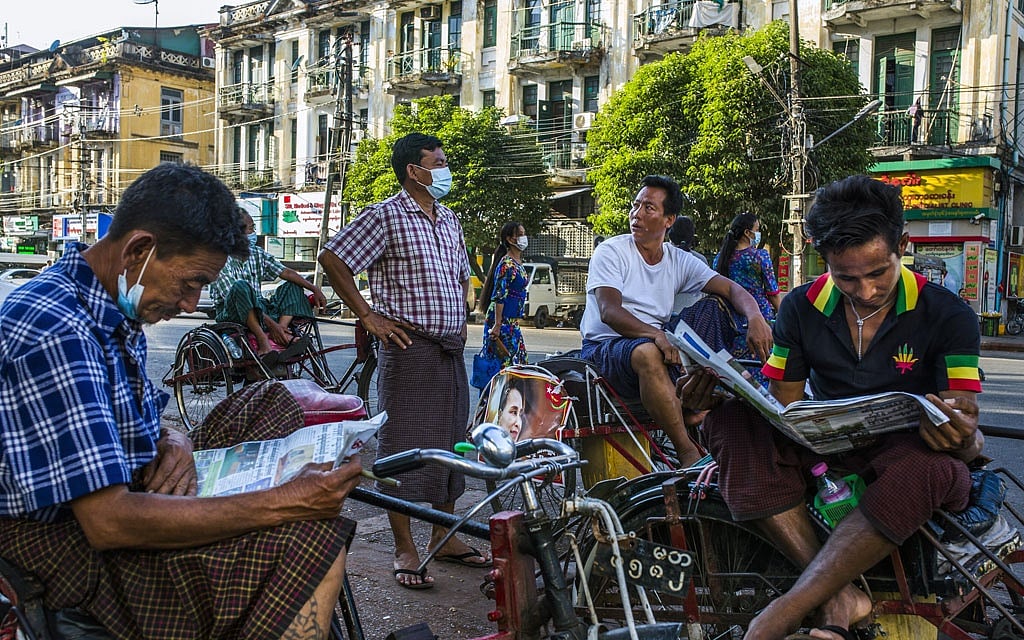
Pedicab drivers read the newspaper in Yangon, Myanmar, on Feb. 17, 2021. The security forces have arrested at least 56 reporters, outlawed online news outlets and crippled communications, so young people have stepped in with their phones to help document the brutality. (The New York Times)
At the same time, soldiers and police routinely search civilians’ phones for protest photographs or videos.
“If you are arrested with video clips, you can go to prison,” said Myint Kyaw, who was secretary of the Myanmar Press Council, an independent advocacy organisation for the news media, before quitting in protest in February along with most of the board.
At a recent news conference, a spokesperson for the junta said it was up to journalists to avoid behaviour that could be construed as breaking the law.
“Only the journalist’s action itself can guarantee that they will not be arrested,” said the spokesperson, Brig. Gen. Zaw Min Tun. “If their actions violate the law, then they will be arrested.”
All three journalists who have been shot and wounded say they were targeted by security forces.
Freelance journalist Ko Htet Myat Thu, 24, was taking pictures of protests Saturday in Kyaikto, a town in southern Myanmar, when a soldier shot him in the leg, he said. A video of his arrest taken by a citizen journalist from a nearby building shows soldiers beating him and forcing him to hop on his good leg as they led him away.
Another photojournalist shot that day, Si Thu, 36, was hit in his left hand as he was holding his camera to his face and photographing soldiers in Mandalay, the country’s second-largest city. He said he believes the soldier who shot him was aiming for his head.
“I had two cameras,” he said, “so it was obvious that I am a photojournalist, even though I had no press helmet or vest. I’m sure that the military junta is targeting journalists because they know we are showing the world the reality on the ground, and they want to stop us by arresting or killing us.”
Of the 56 journalists arrested, half have been released, according to a group that is tracking arrests. Among those freed were reporters for The Associated Press and the BBC.
But 28 remain in custody, including at least 15 who face prison sentences of up to three years under an unusual law that prohibits the dissemination of information that might induce military officers to disregard or fail in their duties.
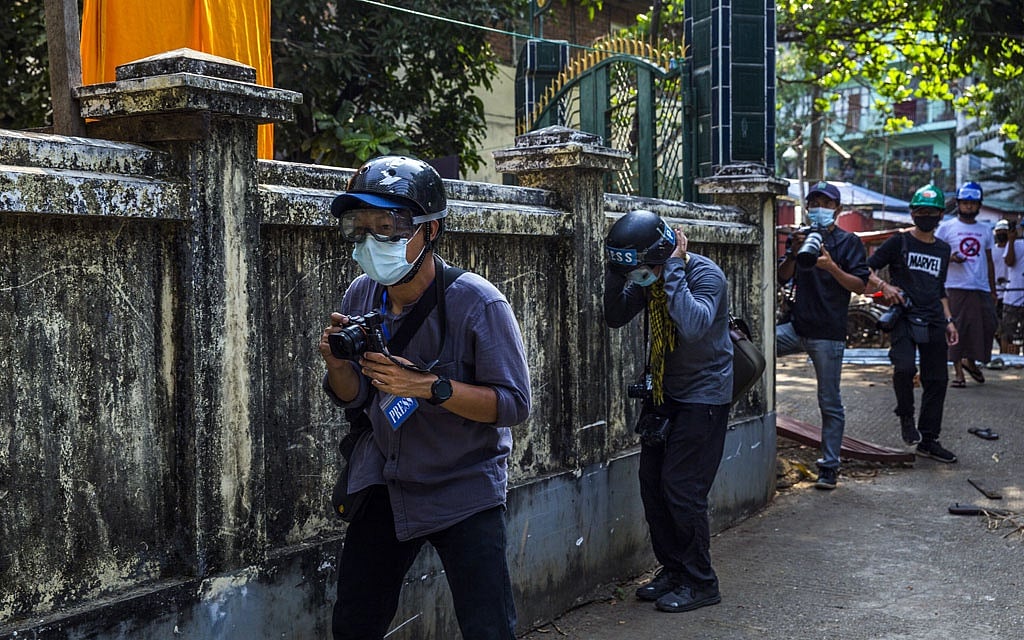
Journalists take cover during clashes between protesters and security forces in Yangon, Myanmar, on Feb. 18, 2021. To keep from being targeted, many have stopped wearing helmets or vests emblazoned with the word "PRESS" to try to blend in with the protesters. (The New York Times)
She is among those who have been charged under the vague and sweeping statute. She has been allowed to meet just once in person with her lawyer.
Swe Win, the Myanmar Now editor, himself served seven years in prison for protesting in 1998.
“All these court proceedings are being done just for the sake of formality,” he said. “We cannot expect any fair treatment.”
With mobile communications blocked, Facebook banned and nightly internet shutdowns, Myanmar’s mainstream media has come to rely on citizen journalists for videos and news tips, said Myint Kyaw, the former press council secretary.
One of them, Ko Aung Aung Kyaw, 26, was taking videos of police arresting people in his Yangon neighbourhood when an officer spotted him. The officer swore at him, aimed his rifle and fired, Aung Aung Kyaw’s video shows.
The bullet hit a wall in front of him.
“I know that recording these kinds of things is very risky, and I might get shot to death or arrested,” he said. “But I believe I need to keep doing it for the sake of having a record of evidence to punish them.”
©2021 The New York Times Company







