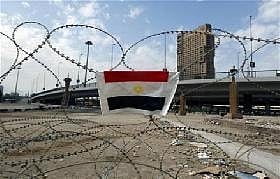
Mubarak still in power as government and opposition talk
President Hosni Mubarak held onto power Monday, defying a popular uprising against his autocratic rule, after the government opened talks with opposition groups to resolve Egypt's deepest crisis in 30 years.
bdnews24.com News Service
bdnews24.com
Published :
07 Feb 2011, 06:15 AM
Updated :
10 Aug 2022, 04:19 PM
CAIRO, Feb 07 (bdnews24.com/Reuters) - President Hosni Mubarak held onto power Monday, defying a popular uprising against his autocratic rule, after the government opened talks with opposition groups to resolve Egypt's deepest crisis in 30 years.
The banned Muslim Brotherhood was among the groups who met with officials over the weekend, a sign of how much has already changed in 13 days that have rocked the Arab world and alarmed Western powers.
But opposition figures said their core demand that Mubarak must go immediately was not met. Some expressed concern that the government was playing for time in the hope that Mubarak would hang on until September, when his current term expires.
People in central Tahrir Square, focal point of an uprising that has seen hundreds of thousands of protesters take to the streets and clashes in which an estimated 300 people have been killed, said they would intensify their battle to oust him.
After nightfall Sunday, soldiers fired shots in the air to try to disperse the crowd. But the demonstrators, who on Saturday lay down in front of army tanks, remained and the troops abandoned the attempt.
The nation got back to work Sunday and banks reopened after a week-long crisis with lines of customers seeking access to their accounts.
Government ministers will hold their first full cabinet meeting Monday since Mubarak reshuffled his cabinet on January 28 in an attempt to mollify protesters enraged by years of corruption, economic hardship and political oppression.
But it was far from certain that the situation had been defused, despite appeals from longtime Mubarak backer the United States for an "orderly transition" to more democratic rule.
The presence at the talks of the banned Muslim Brotherhood, whose members have for years been repressed by Mubarak's feared security forces, was a significant development.
The demonstrators around Tahrir Square, largely young and secular, lack their clear organization and leadership.
The government said after the meeting, chaired by Vice President Omar Suleiman, they agreed to draft a road map for talks, indicating Mubarak would stay in power to oversee change.
It would also move to release jailed activists, guarantee press freedom and lift Egypt's emergency laws. A committee was set up to study constitutional issues.
But the opposition said the government failed to meet their demand for a complete overhaul of the political system.
Abdel Monem Aboul Fotouh, a senior Brotherhood figure, said the government statement represented "good intentions but does not include any solid changes."
Opposition activists reject any compromise which would see Mubarak hand over power to Suleiman but also serve out his term -- essentially relying on the old authoritarian system to pave the way to full civilian democracy and saving his face.
bdnews24.com/ah/1216 h.